
Culture
side view of a red stop sign on a metal pole on a city street with no people around it.
(Getty Images)
grammatically speaking

AI loves an em dash — writers in the US, on the other hand, aren’t so keen

Which punctuation marks are getting left behind in modern America?

Claire Yubin Oh

Of the many tips and tricks people are coming up with to determine whether a piece of writing has been written with a little help from AI, the world seems to have homed in on the use of one particular punctuation mark: the em dash.

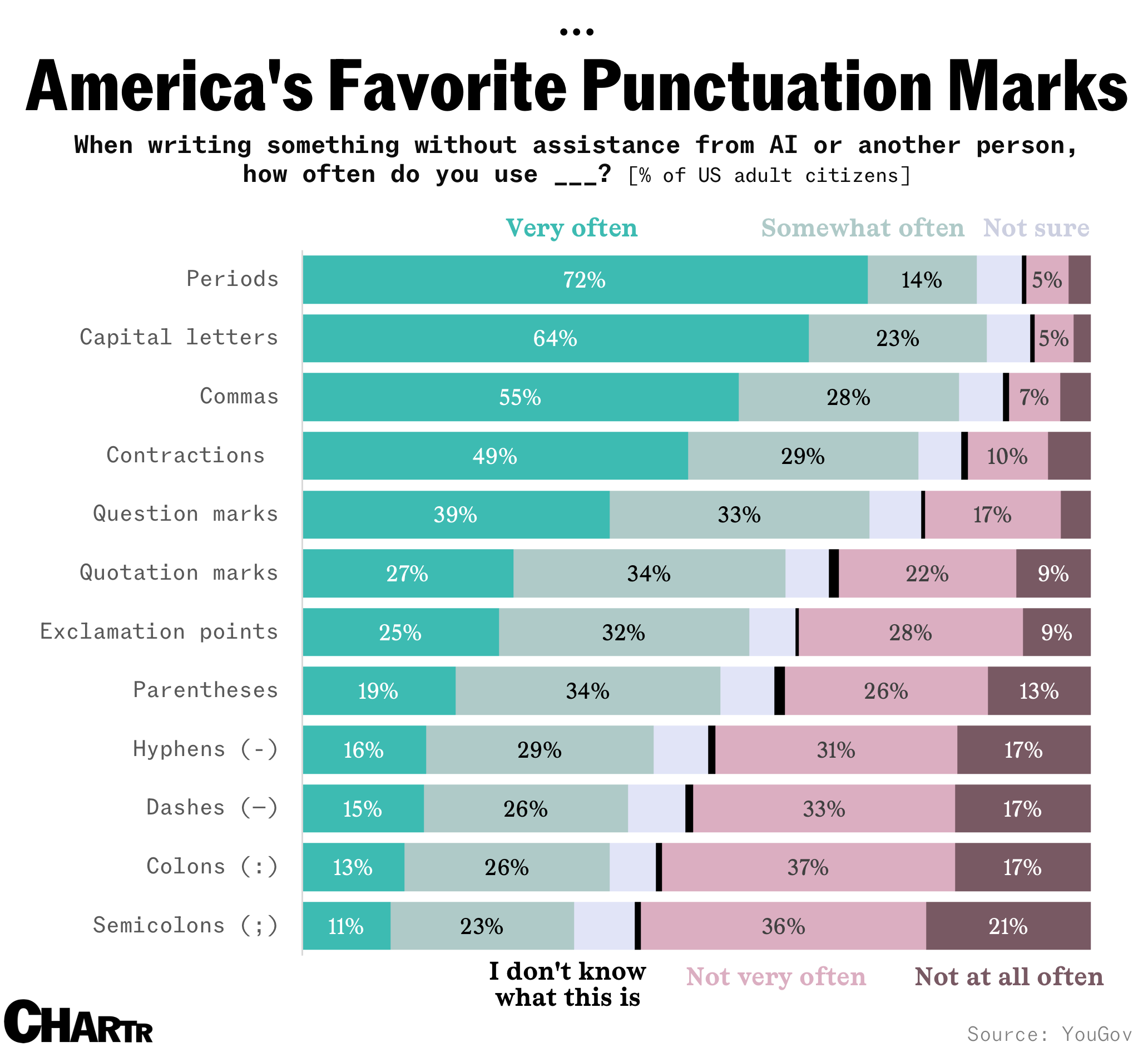
Though some writers have rushed in to defend the dash — the overuse of which sits alongside pizza glue and bluebberrygate in the pantheon of things people laugh at AI about — perhaps a key reason the prevalence of the punctuation mark seems so bot-like to readers is that, as writers, Americans hardly use it.

Indeed, per a recent YouGov survey, dashes are some of the least used pieces of punctuation in Americans’ arsenals, ranking just ahead of colons and semicolons, per the poll.
Punctuation marks chart
Sherwood News

As you might imagine, the survey revealed that American adults who describe themselves as “good” or “very good” writers are more likely to use the rarer forms of punctuation on the list. However, for the majority of Americans, marks like the semicolon and the em dash remain mostly reserved for esteemed authors and English teachers... or those who aren’t above enlisting a chatbot for a little help to jazz up their communications.

Interestingly, the vast majority of Americans said they do little writing outside of sending texts and emails, with journaling, nonfiction and fiction writing, and other forms of creative or academic writing all falling by the wayside in 2025, according to YouGov’s research.

More Culture

See all Culture
Family in front of TV

Hollywood may have its best year at the box office since 2019, but streaming audiences are still obsessed with old content

Viewers are opting for catalog content over new shows and movies across (pretty much) every major streamer.

Tom Jones6/29/26
culture
Tom Jones

The BBC has become the world’s top news website... by collapsing a little less than its competition

Press Gazette just published its annual look at the biggest news sites in the world across all languages; for the most part, it doesn’t make for particularly pretty reading.

The journalism industry publication’s latest update, which is based on estimates provided by Similarweb for May, found that 37 of the world’s 50 most visited news sites saw their reach shrink. Press Gazette highlighted that American outlets have been hit particularly hard by declining Google traffic compared to European counterparts, owing to the platform’s AI features rolling out earlier in the US.

Even the BBC, having climbed the rankings from last year to top the 2026 chart — reportedly in part thanks to Similarweb’s decision to combine the “.co.uk” and “.com” versions of the URL, given that the sites redirect to each other depending on the user’s location — showed a 1.9% decline from last year.

Latest Stories

Sherwood Media, LLC and Chartr Limited produce fresh and unique perspectives on topical financial news and are fully owned subsidiaries of Robinhood Markets, Inc., and any views expressed here do not necessarily reflect the views of any other Robinhood affiliate, including Robinhood Markets, Inc., Robinhood Financial LLC, Robinhood Securities, LLC, Robinhood Crypto, LLC, Robinhood Money, LLC, Robinhood U.K. Ltd, Robinhood Derivatives, LLC, Robinhood Gold, LLC, Robinhood Asset Management, LLC, Robinhood Credit, Inc., Robinhood Ventures DE, LLC and, where applicable, its managed investment vehicles.