

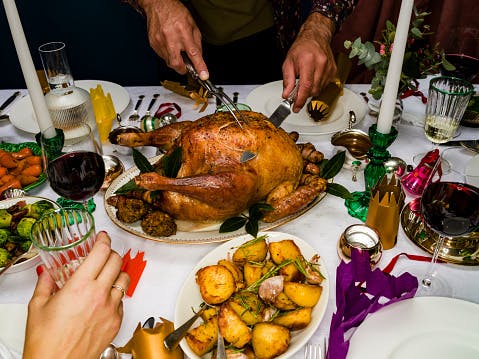
Americans are eating less turkey, even as the birds keep getting bigger
Turkeys aren’t what they used to be. They’re huge now.
Turkey season is back, and so is the price war for another inflation-squeezed Thanksgiving. Last month, Walmart rolled out its cheapest turkey deals since 2019, offering a complete 10-person holiday meal for under $40. Aldi announced a similar $40 package, while Kroger joined in with a meal bundle priced at under $4.75 per person.
So how are holiday meals staying cheap when everything else is going up?
Retailers seem happy to absorb much of the turkey costs — a classic “loss leader” to draw cost-conscious shoppers in — even as wholesale turkey prices are expected to rise 40% year over year in 2025, per the USDA. Part of that jump reflects a supply crunch, with production falling to a 40-year low amid an avian flu wave that’s wiped out more than 2.2 million birds this year.
Zooming out, however, America’s turkey problems started long before the latest outbreak — as consumers have been falling out of love with Thanksgiving’s favorite bird for decades.
From the 1970s to the 1990s, turkey’s per-capita consumption in the US nearly doubled as it gained popularity as a lean, healthy alternative to red meat. But since its 1996 peak, consumption has dropped 25%, while chicken, pork, and beef have come to dominate Americans’ protein choices. With demand down — whether because turkey is just too hard to cook, too big for everyday meals, too tied to holiday nostalgia, or there are simply tastier cold cuts available — production followed suit, largely flatlining for decades and slipping to a 30-year low last year.
Ironically, despite shrinking appetites, the birds themselves kept growing. The average turkey now weighs about 32 pounds, nearly double its size in 1960, per USDA data. Decades of selective breeding and artificial insemination created today’s “meatier” (and more profitable) bird, but they also produced an unintended side effect: the modern supersized turkey, which accounts for 99% of grocery store birds, is disease-prone, biologically fragile, and increasingly hard to breed.
A more exclusive turkey club
Between ever bigger birds and waning appetites, America’s turkey industry may be nearing a turning point. As Bloomberg’s Justin Fox pointed out, real (inflation-adjusted) turkey prices stopped falling in the 1990s — right when consumption peaked — suggesting that decades of efficiency gains may finally have run their course.