

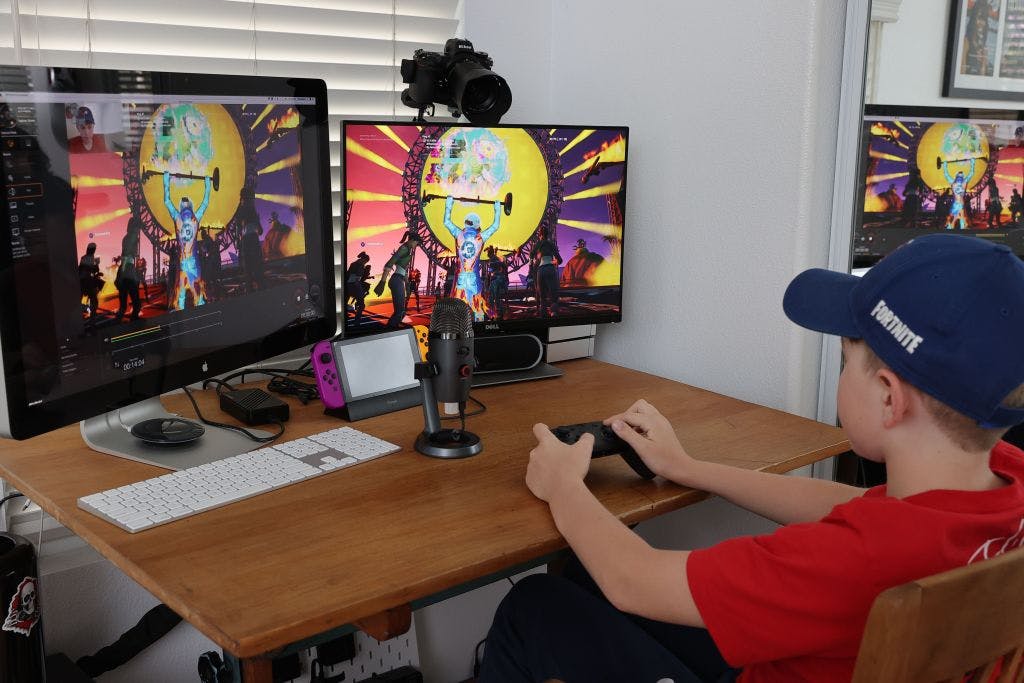
“Fortnite” is more than a game. It’s the single most important influence on popular culture
The game has become a cross-platform sensation that can propel artists to the top of the charts. Brands from Disney to Balenciaga are eager to get in on the action.
If you’ve spent the last year utterly confused by, well, everything in pop culture, chances are you just weren’t paying attention to where a significant chunk of it comes from now: “Fortnite,” the multiplayer video game. While “Fortnite” may be a cartoony game about shooting, it’s also quickly becoming one of the few things creating a modern cultural mainstream experience. How mainstream? Earlier this year, Disney invested $1.5 billion into it — the company’s largest push into video games to date.
“Fortnite” was released in July 2017 by Epic Games, known for its series “Unreal” and “Gears of War.” A few months later, the game blew up when a free-to-play “Battle Royale” mode was released, letting players fight each other on huge virtual maps. Before that, “Fortnite” was largely a sandbox game à la “Minecraft” and “Roblox,” where players built structures and designed their own worlds. Thanks to this new lower barrier to entry, the game gained 10 million players in its first two weeks.
Epic was quick to start monetizing the game’s newfound popularity, though it went about it in a unique way: through licensing. The first official tie-in came in May 2018 when a promotion for “Avengers: Infinity War” allowed players to become Thanos wielding the Infinity Gauntlet. Since then, the game’s many “collaborations” — to use Epic’s official term — have featured everything from John Wick to Ash Williams of “Evil Dead” to the Tesla Cybertruck. Even Balenciaga wants to get in on the action. The game’s wiki shows that over 3,000 tie-in items have been released (though most are limited-time offers).
Epic also started licensing “Fortnite” for in-game “live events.” One of the biggest came in the form of a teaser for an upcoming “Star Wars” movie. In 2020, as part of an effort to increase socializing during lockdown, the “Party Royale” mode was introduced, removing any combat or gameplay and turning the game into “Second Life” — or, honestly, a better approximation of the metaverse than Facebook has managed to build. Both modes allow “Fortnite” to hold concerts, which is where the game’s sway has become most noticeable.
The first in-game “Fortnite” concert was performed by DJ Marshmello in February 2019. The next year, as the pandemic forced artists to cancel tours, the Party Royale stage became a bona fide concert venue, featuring shows by Diplo, BTS, Ariana Grande, and more. Unlike other peak-pandemic entertainment fads, the “Fortnite” concert has become a crucial stop for touring pop stars, with players zooming around the map while a giant avatar of their favorite pop star plays in the center. These concerts are popular partly because they’re not exactly performance-intensive, but also because they help artists sell stuff. Forbes reported that Travis Scott earned $20 million in merchandise sales from his 2020 virtual concert, more than 10 times the take of any stop on his IRL tour.
These concerts are having an effect on streaming numbers too. According to data we’ve been tracking from Spotify, a musician’s streaming numbers get a noticeable bump after it’s announced they’ll be doing a “Fortnite” concert. Most recently, this spike propelled “Si Antes Te Hubiera Conocido,” by Latin singer Karol G, to become the fifth-most-streamed song on Spotify in August. That uptick corresponds directly with a series of concerts in the game that were announced August 15. When Metallica performed in-game in June, all six of the songs it played rose on the Spotify streaming charts. Metallica’s entire catalog had its highest number of listeners in two years.
The game’s popularity also extends to its many commentators and players. The most-watched stream on Twitch last month was the exclusive debut of Spanish streamer Rubius’ new in-game “Fortnite” skin: players can purchase an avatar modeled after him and wear his cat as a backpack. The stream garnered 383,000 concurrent views. Rubius — real name Rubén Doblas — is the biggest Spanish-language “Fortnite” streamer. He’s broken YouTube records and even starred in an anime, but getting his own skin in “Fortnite” has become his most popular Twitch stream ever.
“Fortnite” is, of course, not the only mega-platform in town; “Minecraft” and “Roblox” are both hugely popular with young gamers too. But Garbage Day data shows that “Fortnite” is the first to reliably start influencing other platforms. It has essentially become big enough to move the rest of the web — when something happens in the game, platforms all over the internet light up with content about it.
For decades, video games, though a gargantuan industry, have sat just outside the cultural mainstream. Everyone’s mom might know who Mario is, but how many of them have actually sat down and played the game for six consecutive hours? That’s the thing that separates video games from movies and TV: you have to learn how to play them, which has always limited their wider popularity. But as “Fortnite” becomes a genuine cross-platform sensation, the question is whether it can jump the hurdle into common culture. The business model is there. The celebrities are on board. But is the timing finally right? Let’s see what Mickey Mouse has to say.
Garbage Day is an award-winning newsletter that focuses on web culture and technology, covering a mix of memes, trends, and internet drama. We also run a program called Garbage Intelligence, a monthly report tracking the rise and fall of creators and accounts across every major platform on the web. We’ll be sharing some of our findings here on Sherwood. You can subscribe to Garbage Day here.