


Tariff fallout has hit Hollywood, with China restricting US movie screenings
American films have already been falling out of favor at one of the world’s biggest box offices.
Last week, the China Film Administration announced — in response to President Trump’s 125% tariffs on Chinese imports to the US — that it would “moderately reduce” the number of American movies allowed to screen in the nation, effective immediately.
The government agency cited that tariffs would “inevitably further reduce the domestic audience’s favourability towards American films.” But, per Reuters, analysts are predicting that the retaliatory restriction is unlikely to make much difference to Hollywood’s bottom line, since US-produced movies have been underperforming at China’s box office for some time now.
Hollywood ending?
Even as the global box office saw strong summers in 2023 and 2024 (though, before “A Minecraft Movie,” US ticket sales had stalled so far this year), American franchises have slumped at the Chinese box office in recent years. As outlined by CNBC, nine US-produced movies surpassed a $100 million gross in China in 2019 alone; only eight American films reached the same threshold in the five years that followed.
Data from Box Office Mojo tells a similar tale for the performance of popular Hollywood franchises in Chinese theaters — even those that were wildly successful in the States. For example, “Moana 2” was one of the biggest hits in the US last year, bringing in $460 million domestically and over $1 billion worldwide. But, in China, the Disney darling accrued a paltry $15 million, down from the still-slight $33 million generated by the first movie in 2016.
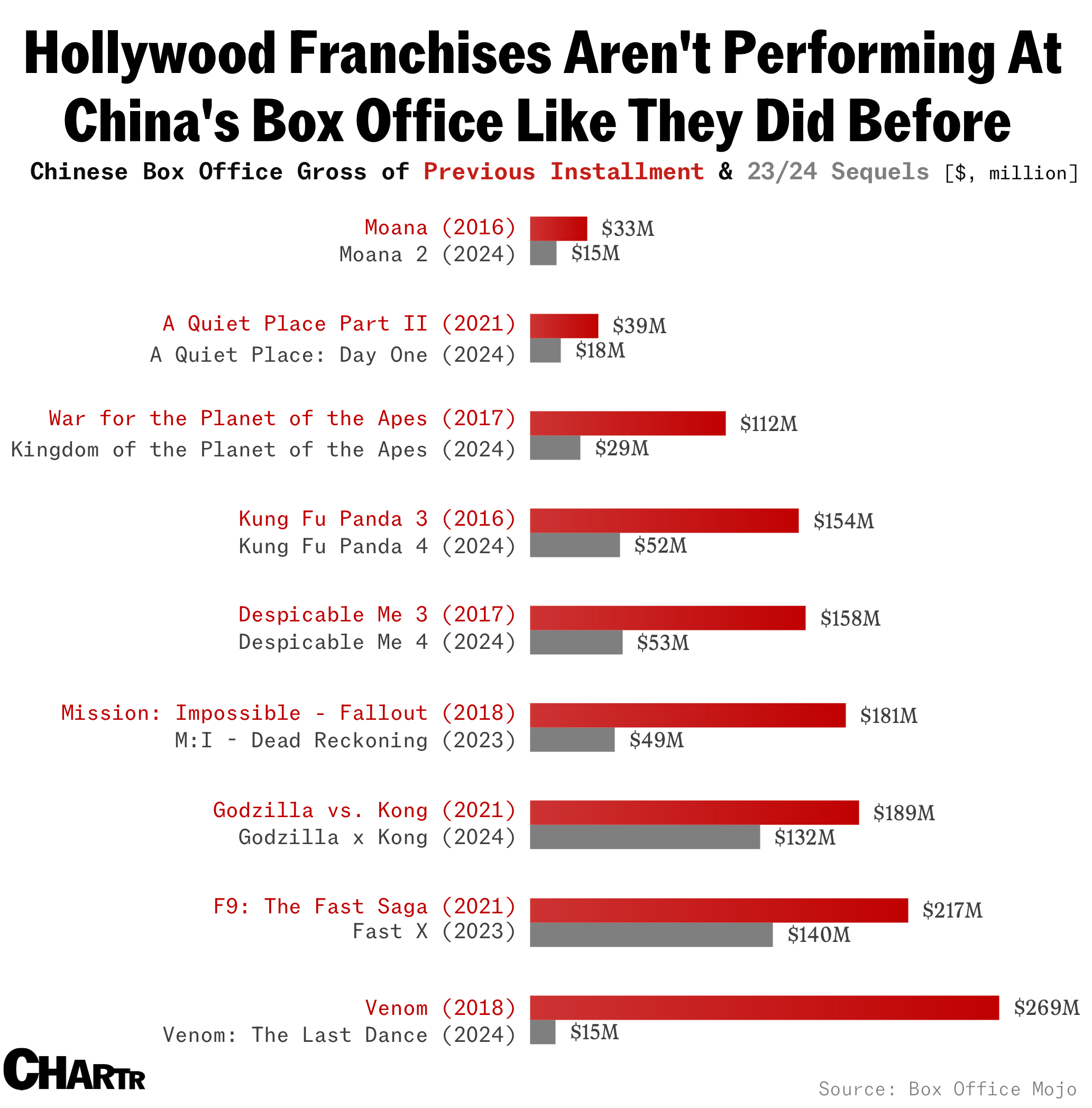
Follow-up installments from franchises that were originally big successes in China are also seeing box office takings dwindle. For example, the first “Venom” movie brought in an impressive $269 million in the country back in 2018, but its 2024 follow-up brought in just 6% of that total, and surprise international hits like last year’s “Kung Fu Panda 4” reported much smaller takings in China than previous releases managed.
Home movies
At the same time, China’s domestic film industry is flourishing. Per CNBC, Chinese animation “Ne Zha 2,” which was released domestically in January, is now the only movie in history to make $1 billion from a single market and the only non-Hollywood movie to hit $2 billion at the global box office. In fact, according to a Bloomberg newsletter published last summer, 80% of China’s box office is now generated by Chinese movies.