


While wealthy collectors buy fewer masterpieces, affordable art is having a renaissance
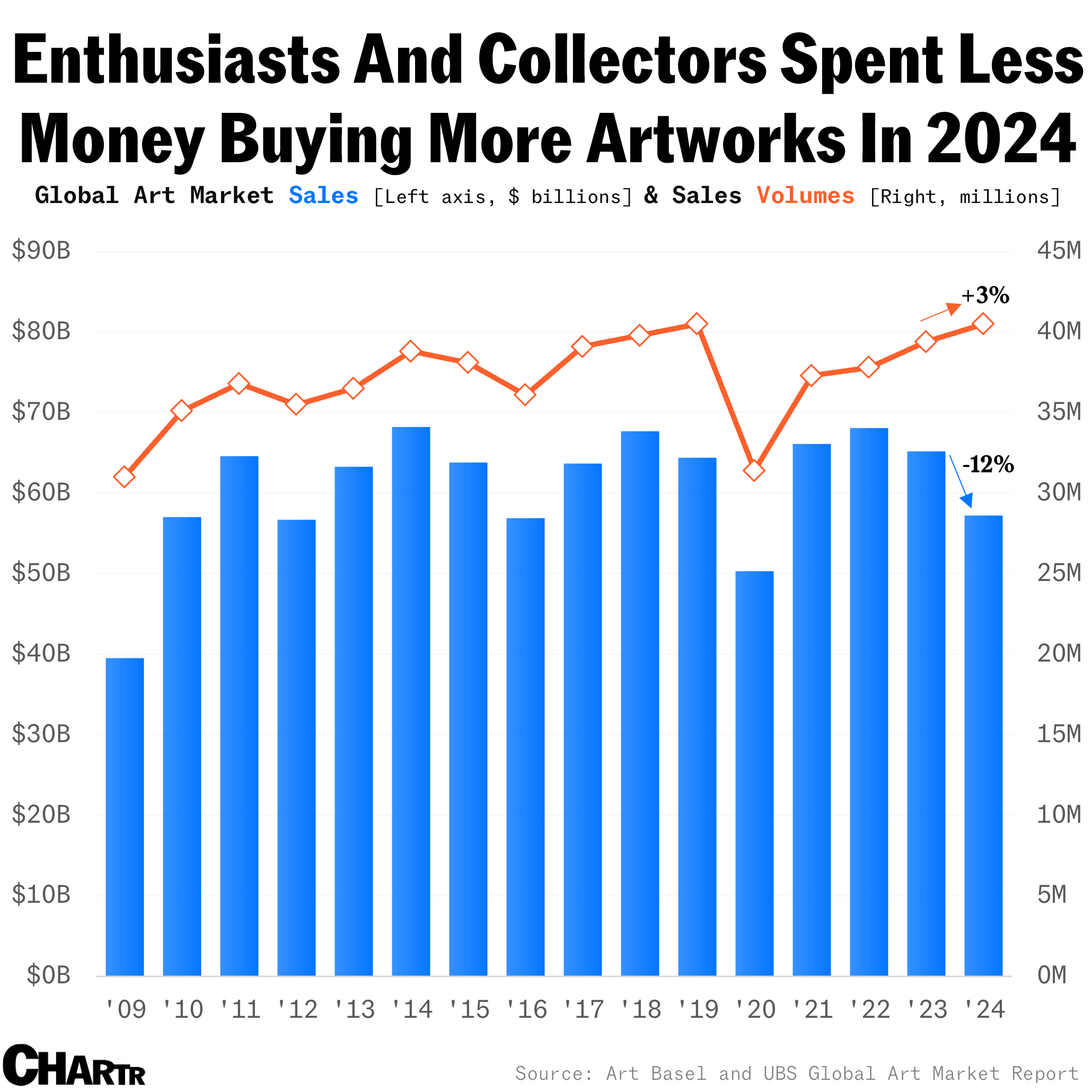
Overall art sales slumped 12% to $57.5 billion last year.
Last week’s international trade tariffs naturally added complications to the broader picture of the global art market, an industry reliant on moving expensive frames across increasingly expensive borders. But the art economy has looked pretty sketchy for a while now, on the back of years of market uncertainty and geopolitical tensions.
For example, per the newly released Art Basel and UBS Global Art Market Report for 2025, the total value of sales in the global art market fell by 12% to $57.5 billion last year, marking the second consecutive year of decline.
Different strokes
Since peaking at ~$68 billion in 2014, overall sales have stalled — with particularly large drops across high-end art sales.
The report detailed that auction sales of single works worth more than $10 million were down almost 40% in 2024, as high-end galleries also saw a 9% sales decline. Meanwhile, the number of billionaires has nearly doubled over the last decade, with the ultrawealthy group’s collective net worth reaching $16.1 trillion at the last count. So, how come rich people aren’t splurging their mounting wealth on Picassos and Pollocks so much anymore?
Quoted in The New York Times, Clare McAndrew, the economist behind the Art Basel report, pointed to both buyers and sellers becoming “more risk-averse,” having been put off by an “uncertain, volatile picture”… even before last Wednesday’s tariff announcement.
The big picture
One of the only silver linings in an otherwise gloomy outlook for the art market is that, despite a slump in sales value, sales volume grew to 40.5 million artworks (up 3%) in 2024, largely owing to a bump in lower-priced art sales. Indeed, auction sales of artworks that fetched less than $5,000 were up 7%, with smaller-scale art dealers (turnovers below $250,000) attracting the largest share of new buyers.
As affordable art becomes more popular — or, what UBS Chief Economist Paul Donovan is calling “democratization in the art market,” per Bloomberg — sourcing lower-cost works closer to home could signal a promising path ahead for the art industry, as it navigates the contemporary tariff-nouveau landscape.