
Culture
Fireworks July 4th

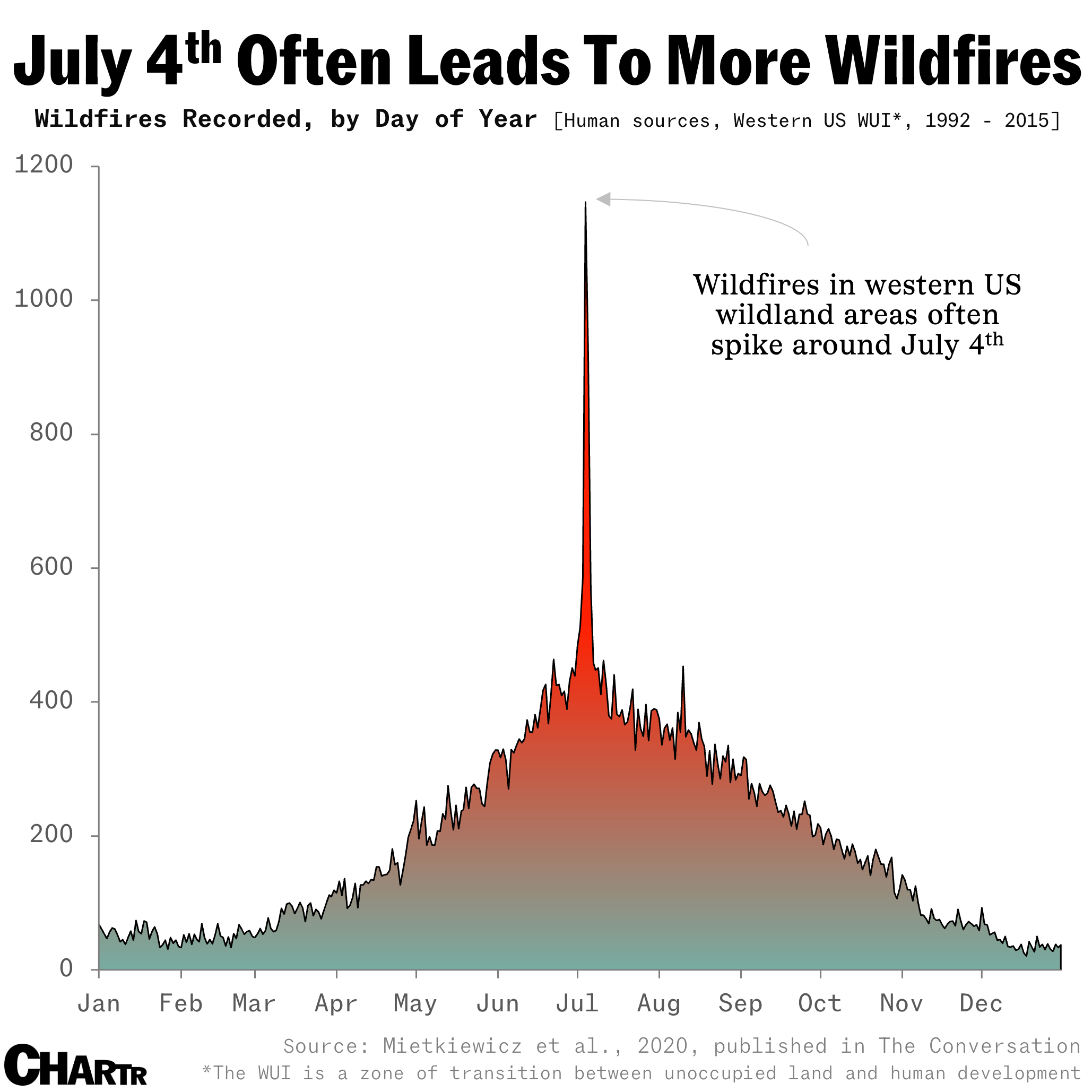
Studies show wildfires often peak around July 4

America’s love of dazzling pyrotechnics comes with risks

Tomorrow, millions of Americans will celebrate July 4th, a holiday which — perhaps surprisingly — ranked joint 6th in a YouGov survey of America’s favorite days of the year (Christmas was first, Thanksgiving second, Halloween third, in case you were wondering).

Most people agree that some of the key ingredients for a good Independence Day bash include lots of hot dogs, as many mayonnaise-based salads as your table can fit, friends and family, and, of course, fireworks. But, America’s love of a dazzling display of pyrotechnics comes with risks.
Fireworks July 4th

In fact, a 2020 study by Mietkiewicz et al., originally published in The Conversation, found that the number of human-caused wildfires often spikes in the days around July 4th — an increase that’s largely attributed to the widespread use of fireworks during the holiday. This regular uptick exacerbates the pre-existing issue of human-caused wildfires in the US. Nearly 85% of wildfires between 2000 and 2017 were caused by humans according to data cited by the National Park Service.

As Reuters reports, wildfires aren’t the only issue caused by fireworks. The noise and light can disturb and endanger certain species of wildlife, and pollutants such as perchlorate can enter the food chain if not properly disposed of. Furthermore, most people don’t handle things-that-go-bang very frequently, leading to an uptick in visits to the emergency room: the chart of firework-related injuries is an even more extreme version of the one above. Stay safe!

More Culture

See all Culture
Family in front of TV

Hollywood may have its best year at the box office since 2019, but streaming audiences are still obsessed with old content

Viewers are opting for catalog content over new shows and movies across (pretty much) every major streamer.

Tom Jones6/29/26
culture
Tom Jones

The BBC has become the world’s top news website... by collapsing a little less than its competition

Press Gazette just published its annual look at the biggest news sites in the world across all languages; for the most part, it doesn’t make for particularly pretty reading.

The journalism industry publication’s latest update, which is based on estimates provided by Similarweb for May, found that 37 of the world’s 50 most visited news sites saw their reach shrink. Press Gazette highlighted that American outlets have been hit particularly hard by declining Google traffic compared to European counterparts, owing to the platform’s AI features rolling out earlier in the US.

Even the BBC, having climbed the rankings from last year to top the 2026 chart — reportedly in part thanks to Similarweb’s decision to combine the “.co.uk” and “.com” versions of the URL, given that the sites redirect to each other depending on the user’s location — showed a 1.9% decline from last year.

Latest Stories

Sherwood Media, LLC and Chartr Limited produce fresh and unique perspectives on topical financial news and are fully owned subsidiaries of Robinhood Markets, Inc., and any views expressed here do not necessarily reflect the views of any other Robinhood affiliate, including Robinhood Markets, Inc., Robinhood Financial LLC, Robinhood Securities, LLC, Robinhood Crypto, LLC, Robinhood Money, LLC, Robinhood U.K. Ltd, Robinhood Derivatives, LLC, Robinhood Gold, LLC, Robinhood Asset Management, LLC, Robinhood Credit, Inc., Robinhood Ventures DE, LLC and, where applicable, its managed investment vehicles.