
Markets
Airlines Face Rapidly Rising Fuel Costs
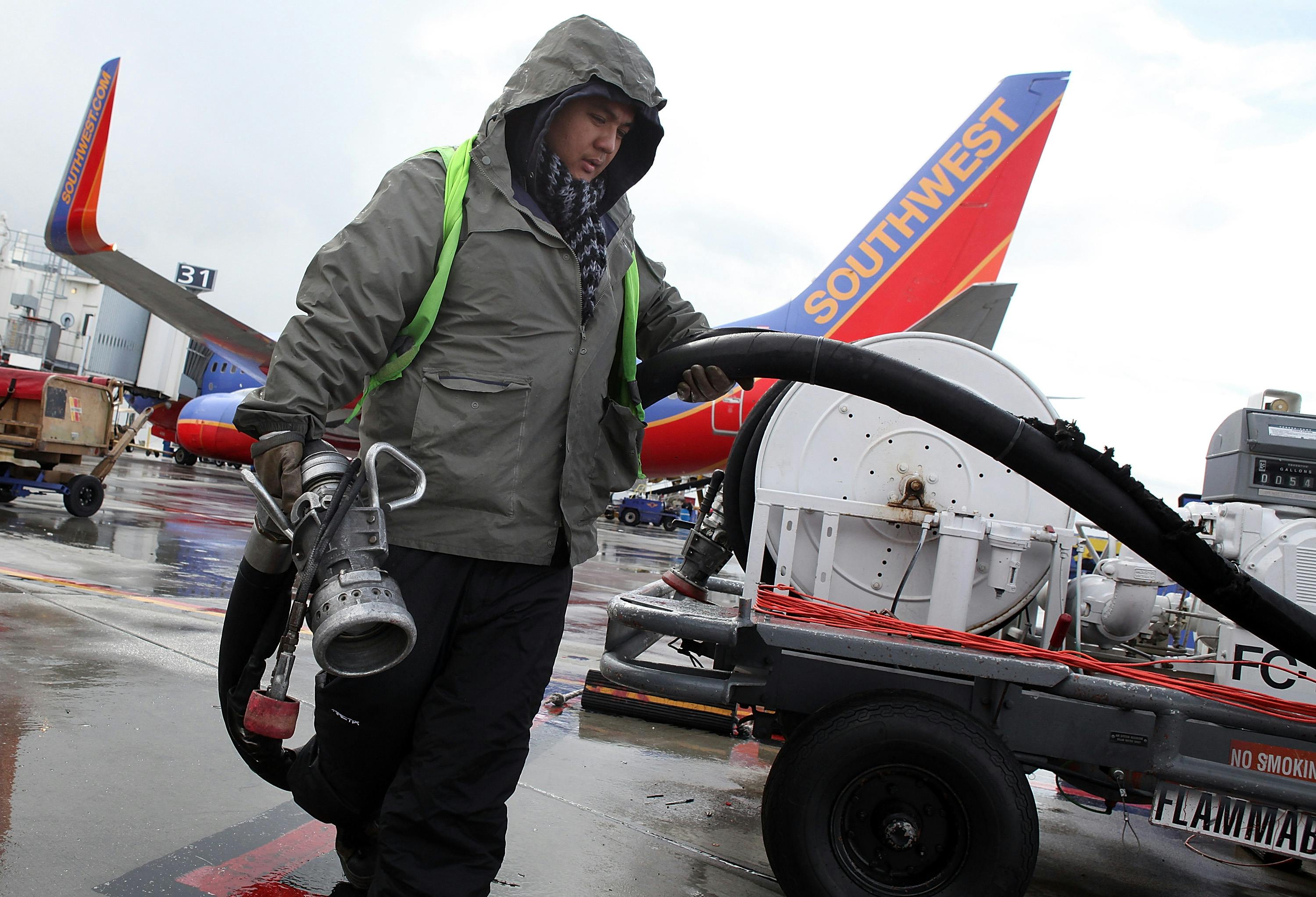
(Justin Sullivan/Getty Images)

Jet fuel refining margins are surging to 20-year highs amid Iran war, threatening airlines

According to a Deutsche Bank note on Friday, airlines haven’t seen this phenomenon since the aftermath of hurricanes Katrina and Rita in 2005.

Max Knoblauch

Amid the war in Iran and the resultant rising oil prices, airlines are facing a jet fuel margin squeeze not seen since the aftermath of hurricanes Katrina and Rita in 2005.

According to a Deutsche Bank note released on Friday, US jet fuel crack spreads — the difference in price between crude oil and the jet fuel refined from it — now range from $85 to $95 per barrel. That difference is equal to or higher than the cost of oil itself.

It’s a rare phenomenon airlines haven’t faced since 2005, when devastating storms caused extensive damage to several refineries. Per DB analyst Michael Linenberg, it represents an existential threat to airlines.

“Absent near-term relief, airlines around the world could be forced to ground 1,000s of aircraft while some of the industry’s financially weakest carriers could halt operations...

The last time we witnessed this phenomenon was in 2005 when crack spreads of as high as $65 per barrel exceeded ~$60 per barrel oil prices in the aftermath of Hurricanes Katrina and Rita. The damage to the airline industry was significant and widespread including major airlines Delta Air Lines and Northwest filing for Chapter 11 bankruptcy in September 2005.”

DB note- jet fuel crack spreads
(Deutsche Bank Research)

Per Deutsche Bank, airlines could face a fuel price headwind “in the $10s of billions on an annualized basis.”

Airline stocks have been pounded since the US military first struck Iran at the end of February. The big four US airlines — Delta Air Lines, United Airlines, American Airlines, and Southwest Airlines — are all down between 10% and 15% since the war began.

Budget airlines, which tend to have tighter margins and are therefore more vulnerable to pricing swings, have fallen even more. JetBlue, Allegiant, and Frontier have each fallen roughly 20%. Alaska Air is down 16% since February 28.

United CEO Scott Kirby addressed fuel costs this week, saying that the spike will have a “meaningful” impact on this quarter’s earnings results, and that higher airfares will “probably start quick.” Kirby added that demand hasn’t been affected.

More Markets

See all Markets
markets

BYND rises on elevated volumes, has now doubled in the last 10 days after product revamps

Beyond Meat soared as much as 18% in overnight trading, extending a winning streak that has seen the stock nearly double since April 10, after gaining over 41% in yesterday's session alone.

That's a significant turnaround for the meat alternative company, which just three weeks ago was tanking after issuing weak sales guidance... with the company’s management laying blame on American society for its business struggles.

Beyond repair?

BYND has had two distinct moments in the sun: one as a bonafide startup stud promising to transform the food industry forever in 2020 and 2021, and the other as a meme-stock, when the company suddenly found itself at the center of a retail trading frenzy last October after a tumultuous few years.

Sparking this latest tick higher appears to be a new product release from last Thursday, when the company revealed that Beyond Immerse, the company's first functional beverage line, had signed a distribution agreement with Big Geyser — one of the country's largest non-alcoholic distributors. That followed an update to its breakfast sausage range just three days earlier.

It's a big ask for a new sausage or protein-packed drinks with fruity flavors — both highly competitive categories — to fully save a company that’s seen sales sink, losses balloon, and its share price crater through the years. But the product news, combined with Beyond appeasing Nasdaq regulators by finally filing its delayed 2025 annual report, seems to have been enough to reinvigorate investor interest, shaking off some concerns about a delisting.

Perhaps most importantly however, is that retail traders are once again fishing in the higher-risk, higher-reward, end of the stock market pond. Risk-on assets have ripped higher in the last few weeks as geopolitical risks calmed, bringing indexes to an all-time high and seeing meme-like stocks soar on speculative excitement rather than business fundamentals. Just from last week, we’ve seen Allbirds and Myseum skyrocket on a surprise AI pivot news. Retail favorites like quantum name IonQ have also caught a bid.

But, where Beyond’s concerned, this ain't 2021 yet. And it's still nowhere near last October, either:

Per Bloomberg data, there’s still plenty of interest in betting against the company — short interest as a percent of the equity float is at 35% — but it still pales compared to the 83% level from its October high.

In simple volume terms, BYND traded only some $224 million as of yesterday — a tiny fraction of October’s busiest day, when $11 billion changed hands.

markets

UnitedHealth beats Q1 estimates, raises annual outlook

UnitedHealth rose in premarket trading after it reported earnings results that beat Wall Street expectations and raised its full-year guidance.

For the full year 2026, the company now expects:

  • Annual adjusted earnings per share to be at least $18.25, up from the previous floor it set at $17.75, and higher than the $17.86 analysts polled by FactSet were expecting.

For the first quarter of 2026, the company reported:

  • Adjusted earnings per share of $7.23 , higher than the $6.58 the Street was penciling in.

  • A medical cost ratio of 83.9%, lower than the 85.5% that was expected. The company said the decrease in spending on medical care was "driven by strong medical cost management and favorable reserve development, partially offset by consistently elevated utilization and unit cost trends."

The company, which is the first of its peers to report earnings this quarter, was up more than 6% in early action on Tuesday. The stock is down 3.8% from the start of the year through yesterday's close.

UnitedHealth's rosy report also lifted some of its peers. Humana, CVS, Elevance Health,Centene and Molina Healthcarewere all up in premarket trading.

The sector has been under pressure in the past year as the cost of providing care, particularly for those on Medicare, has gone up. In the first quarter, UnitedHealth was able to grow its Medicare revenues by 1%, despite having about 1,000 less members, by raising the price of its premiums.

“Investors are likely showing signs of relief with this mornings pre-market on UNH. The stock has had a volatile run over its last few earnings reports, largely dictated by surging medical costs in its Medicare Advantage business and regulatory shifts.

"While the stock has struggled for much of the past year, it is currently showing signs of a turnaround, or at least stability that investors are appreciating," said David Wagner, head of equity and portfolio manager at Aptus Capital Advisors. "The highlight of the report for me was the margins.”

markets

Alaska Air expects higher fuel costs to add $600 million in expenses in Q2

Alaska Airlines on Monday kicked off a big week for airline earnings, reporting its first-quarter results after the bell. The stock ticked down after hours.

Alaska Air reported:

  • An adjusted loss of $1.68 per share, compared to Wall Street estimates of a loss of $1.65 per share.

  • $3.3 billion in revenue, compared to estimates of $3.29 billion.

  • A 17% year-over-year increase in fuel costs to $796 million.

Looking ahead, Alaska said it expects a second-quarter loss per share of $1, deeper than the Wall Street consensus (-$0.15). The company expects April fuel costs of $4.75/gallon and for fuel across the second quarter to add $600 million in expenses.

“Absent the fuel price spike, we would have guided to a solidly profitable quarter,” the airline said in its release.

Alaska Air, like the rest of the commercial airline industry, has been pummeled by fuel costs since the beginning of the war in Iran. Along with Delta Air Lines, United Airlines, American Airlines, Southwest Airlines, and JetBlue, the carrier recently hiked its bag fees to offset higher fuel costs.

Latest Stories

Sherwood Media, LLC produces fresh and unique perspectives on topical financial news and is a fully owned subsidiary of Robinhood Markets, Inc., and any views expressed here do not necessarily reflect the views of any other Robinhood affiliate, including Robinhood Markets, Inc., Robinhood Financial LLC, Robinhood Securities, LLC, Robinhood Crypto, LLC, Robinhood Derivatives, LLC, or Robinhood Money, LLC. Futures and event contracts are offered through Robinhood Derivatives, LLC.

