
Markets
United Health Care Corporate Headquarters Campus
Getty Images

Move over Tesla, UnitedHealth is the battleground stock for retail traders this week as options trading explodes

UNH was the most-discussed ticker on r/wallstreetbets in the last week — and data from Robinhood suggests traders are mostly buyers.

Retail darlings like Palantir Technologies, Nvidia, and Tesla have had to make way for a new battleground stock on popular investing forums in the last week: embattled stock UnitedHealth.

After the shooting of its CEO last year, America’s largest healthcare insurance provider, UnitedHealth, has been under increased scrutiny — becoming a lightning rod for anger and debate over America’s healthcare system.

Now, the company’s sickly stock itself has become a flashpoint.

After plummeting by 50% between April 16 and May 16, UNH has attracted a legion of traders looking to profit from the wild swings in what used to be one of America’s most boring, stable companies, with data from SwaggyStocks — which tracks sentiment on sites like Reddit’s r/wallstreetbets — revealing that its the most-discussed ticker on the forum over the last seven days.
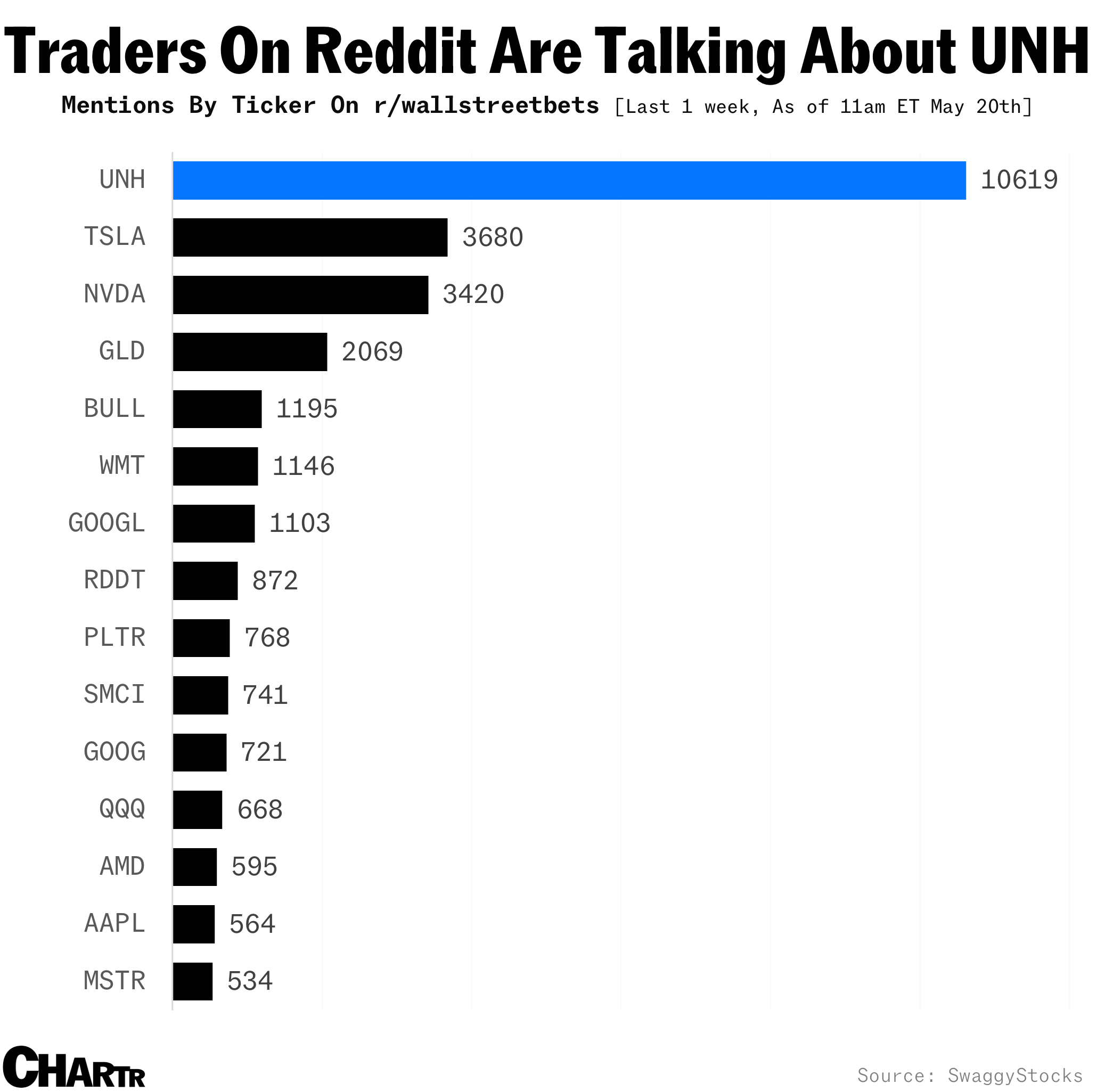
UNH Mentions
Sherwood News

Risk factors

Since reporting weak earnings in mid-April, UNH’s stock has been under pressure. On May 13, the company suspended its guidance, the same day CEO Andrew Witty abruptly stepped down for personal reasons, contributing to shares dropping another 18% in one day.

Some retail traders have taken swings at catching the falling knife by “buying the dip.” Those that did so post-Witty exit were burned just days later on May 15, when The Wall Street Journal reported that UnitedHealth was under investigation for possible Medicare fraud, triggering another 11% fall in the company’s equity. On that day there were more than 3,700 mentions of UNH on Reddit’s infamous investing forum, per data tracked by SwaggyStocks.
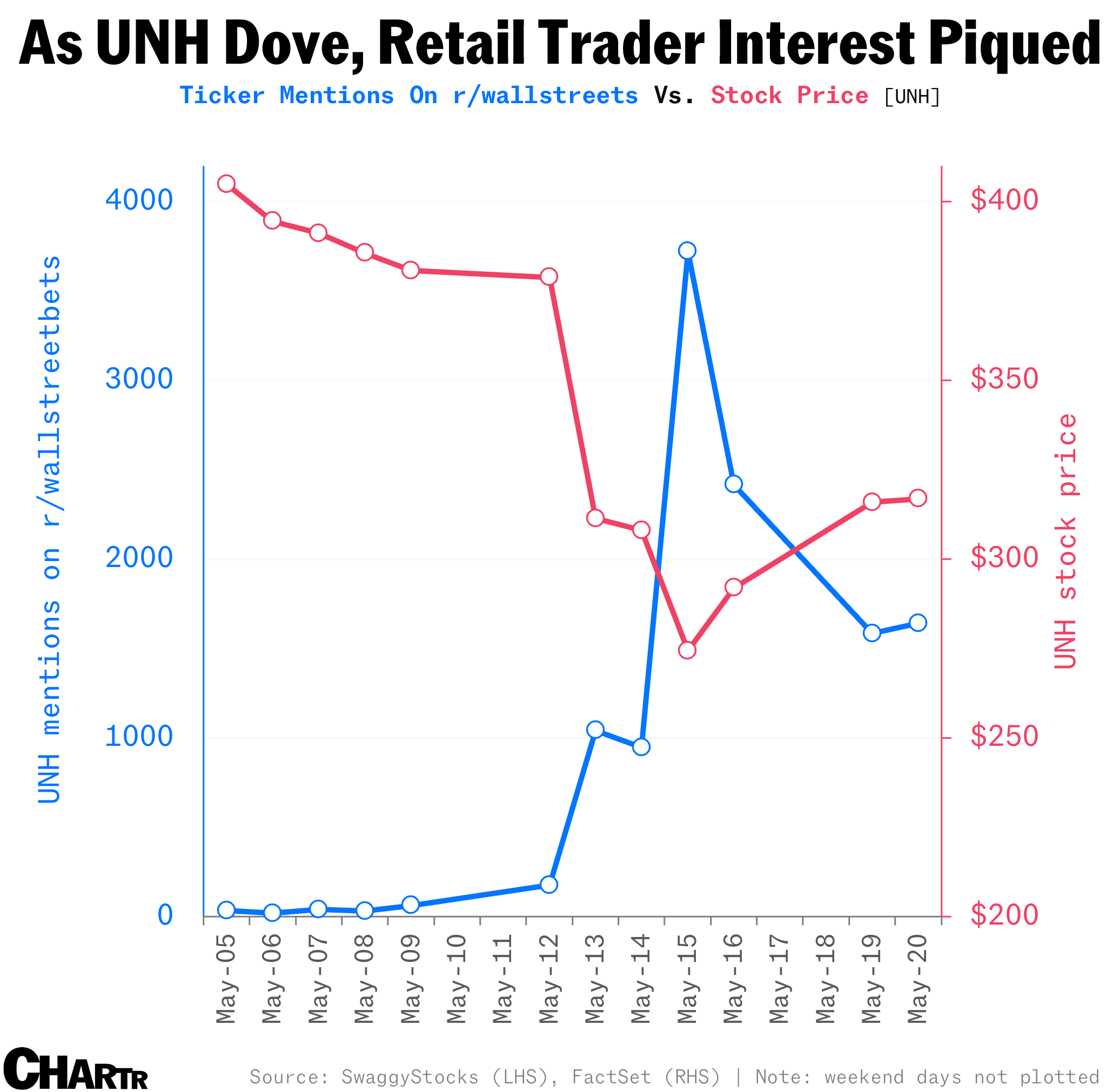
UNH stock
Sherwood News

So, why has UNH grabbed retail traders’ attention?

The simplest answer is that it’s been super volatile, and traders with short-term investing horizons like the opportunity that volatility brings, even if it also means a lot of risk. Data from Bloomberg confirms that a lot of action has spilled over into the options markets, with put and call volumes spiking 820% in the five days leading up to May 19, relative to the previous week of trading.

But, of course, plenty of stocks are volatile, so why has UNH captured the retail zeitgeist so strongly?

One explanation might be that UnitedHealth’s business — or perhaps more accurately, criticisms thereof — is increasingly prominent in internet culture, and therefore the minds of retail traders. Luigi Mangione, the prime suspect in the killing of UnitedHealth’s CEO Brian Thompson, has become something of a folk hero for people railing against corporate greed and America’s health system.

Could it be that Main Street investors have decided to put their money where their mouth is, betting against the American healthcare machine?

It’s a nice theory, but it doesn’t seem to quite add up. Options volumes jumped modestly around the time of Brian Thompson’s murder, and on Luigi Mangione’s subsequent arrest five days later in December of last year, but they didn’t do anything like what we’ve seen in the last week when the UNH price action was much more extreme. If this were a counterculture “Main Street vs. Wall Street” moment, it feels like the most plausible time for it to have happened would have been four to five months ago.

Furthermore, while it’s true that bets against the company have risen, so have bullish trades. Indeed, the put/call volume ratio for the last five days of trading is just 0.68 — a fairly unremarkable figure that means traders are still buying more calls than puts.

Data from Robinhood all but kills the idea that the spike in trading is politically motivated, with Robinhood’s tracking of retail traders revealing that they have mostly been bullish on UNH stock. Customers have been net buyers in each of the last 10 trading sessions.

(Sherwood Media is an editorially independent subsidiary of Robinhood Markets Inc.)
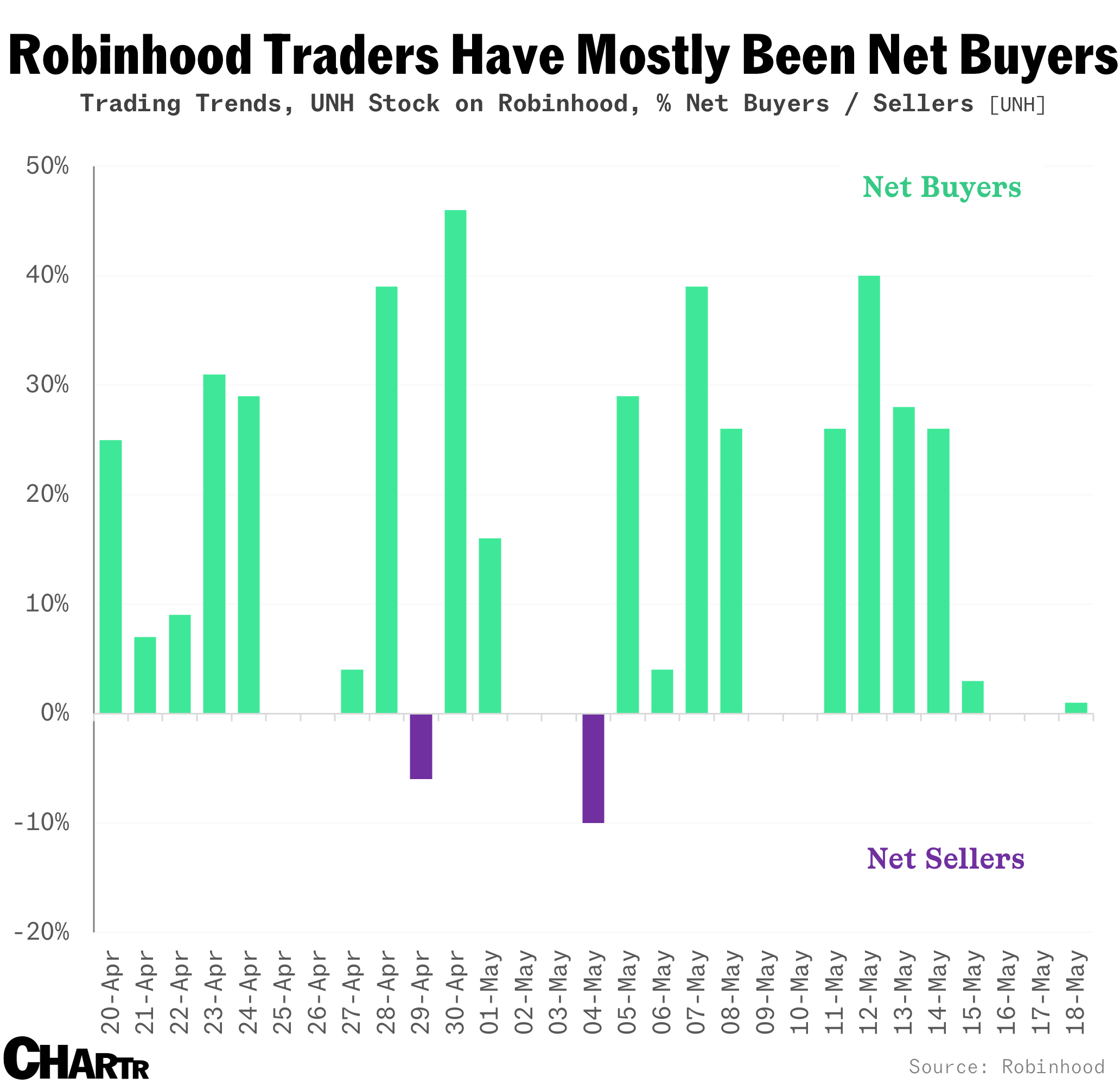
Robinhood Trading Trends
Sherwood News

A spate of large insider buys — most notably by the company’s new CEO, Stephen Hemsley, who reportedly spent $25 million acquiring UNH shares — helped to turn the stock around on Monday.

More likely, then, it seems that UNH was simply a candidate for old-fashioned dip-buying: an historically stable, (now) well-known company that’s hit a rough patch. Of course, the dip can always resume dipping.

More Markets

See all Markets
markets

United beats Q1 earnings and revenue estimates, lowers full-year profit guidance amid surging jet fuel prices

United Airlines reported its first-quarter earnings results after the bell on Tuesday. The carrier’s shares ticked down in after-hours trading.

For Q1, United reported:

  • Adjusted earnings of $1.19 per share, compared to the Wall Street estimate of $1.08 per share compiled by FactSet.

  • $14.6 billion in revenue, compared to the $14.39 billion consensus estimate.

In the first quarter, United’s fuel expense grew 12.6% from the same period last year to $3.04 billion.

For the second quarter, United expects adjusted earnings per share of between $1 and $2, shy of Wall Street expectations of $2.08. For the full year ahead, United said it expects earnings between $7 and $11 per share, compared to its prior guidance of between $12 and $14 per share.

“Guidance assumes United’s revenue recovers 40% to 50% of the fuel price increases in the second quarter, 70% to 80% of the fuel price increases in the third quarter and 85% to 100% of the fuel price increases in the fourth quarter 2026,” read the company’s investor update.

Earlier this month, United was among the first major US airlines to hike its bag fees amid higher fuel costs. Its shares have fallen more than 15% from a February high days before the war in Iran began.

United has also made waves this month following reports that CEO Scott Kirby had floated the idea of a merger with American Airlines to President Trump. A merger between two of the big four airlines would create a true US behemoth, controlling more than a third of the American market. American Air last week said it wasn’t interested in merging with United and hadn’t held talks on the idea. On Tuesday, Trump told CNBC that he doesn’t like the idea either.

markets

Hedge funds are following retail traders into the Magnificent 7

Hedge funds are following retail traders into the stocks the masses never stopped buying.

“As we kick off earnings for megacap tech stocks, this stood out: [hedge funds] have started buying Mag7 stocks again this month though positioning remains well below the peak levels seen in early 2016,” wrote Goldman Sachs’ Cullen Morgan.

Goldman PB Mag 7
Source: Goldman Sachs

In early April, JPMorgan strategist Arun Jain noted that retail investors had basically been selling everything but the Magnificent 7 stocks as part of a more cautious stance due to the Iran war.

(Apple has been a long-standing exception to this trend, presumably because retail traders arent fond of its hands-off approach to AI.)

JPM Retail flows

Last August, Jain discussed how retail activity tended to “crowd in” institutional buyers in meme stocks, while Goldman’s John Marshall advised clients to piggyback on stocks beloved by retail traders. Speculative, retail-geared assets proceeded to go on a tremendous run that soured in October.

But there are some early indications that a similar bout of speculative fervor is bubbling up once more.

markets

POET Technologies surges above $10 for first time in 4 years amid explosion in call volumes

POET Technologies is up nearly 40% this week as options market activity goes haywire in a faint echo of what got the stock on retail traders’ radars in October.

As of 11:12 a.m. ET, more than 10 calls have changed hands for every put traded. This bullish impulse has propelled the stock above the $10 threshold for the first time since March 2022.

Shares of the optical communications firm briefly dipped last week after Wolfpack Research said it was short the company because its investors would be exposed to an “IRS tax nightmare.”

The company responded that day saying it was taking measures for US shareholders that “should mitigate certain potential adverse US federal income tax consequences to it that could otherwise result from the Company’s status as a passive foreign investment company.”

Latest Stories

Sherwood Media, LLC produces fresh and unique perspectives on topical financial news and is a fully owned subsidiary of Robinhood Markets, Inc., and any views expressed here do not necessarily reflect the views of any other Robinhood affiliate, including Robinhood Markets, Inc., Robinhood Financial LLC, Robinhood Securities, LLC, Robinhood Crypto, LLC, Robinhood Derivatives, LLC, or Robinhood Money, LLC. Futures and event contracts are offered through Robinhood Derivatives, LLC.

