
Markets
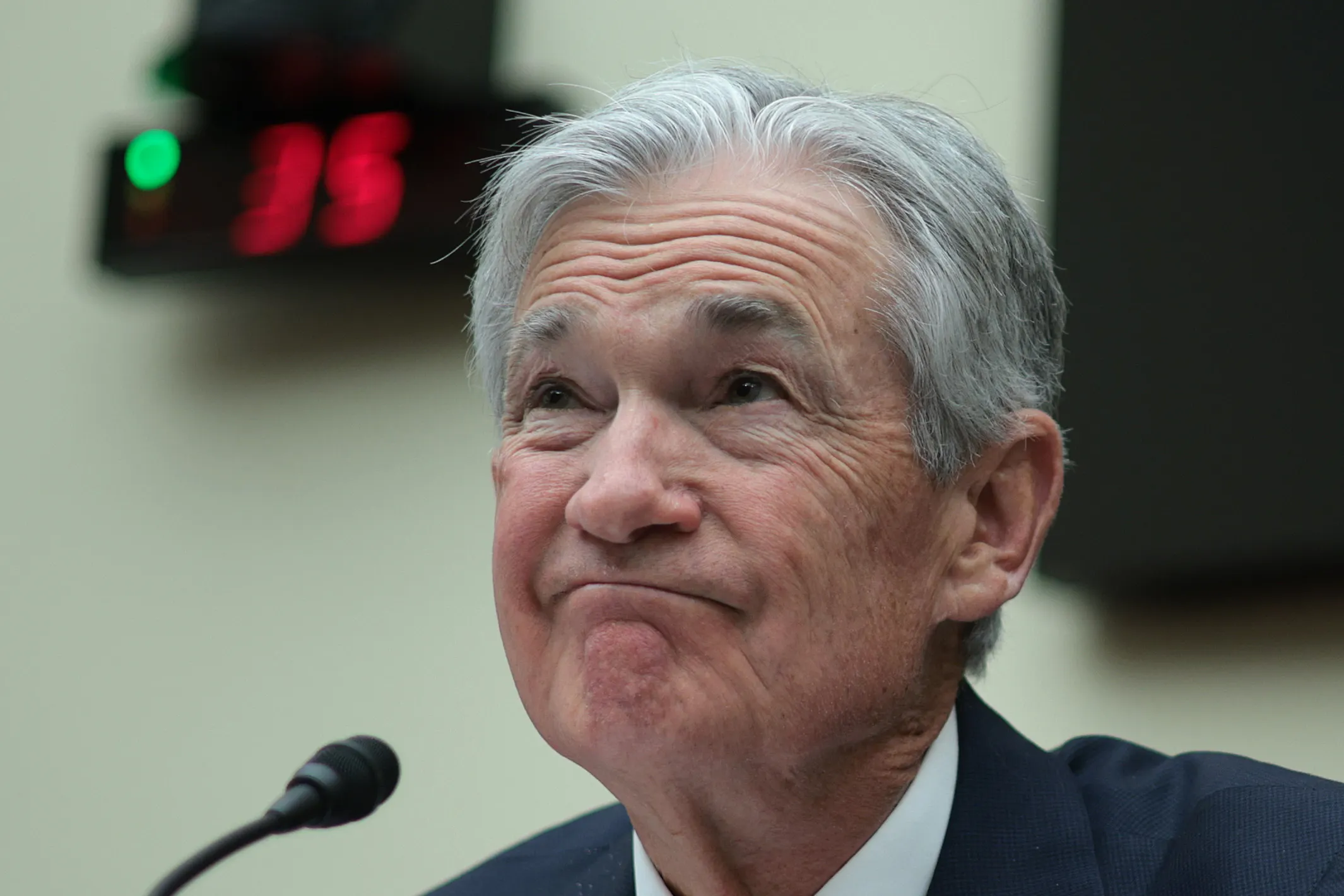
Federal Reserve Chairman Jerome H. Powell
(Alex Wong/Getty Images)

Rate cuts have entered the chat

Investor expectations, or maybe just their hopes, for a rate cut by June have risen since mid-February.

Well here we are again.

The stock market is negative for the year and has now erased all of its gains since the presidential election, with the SPDR S&P 500 Trust down 0.8% since President Trump’s victory on November 5.

But America’s flagship index did pare its losses yesterday, from as much as 2% down to a slightly more palatable decline of 1.2% on the day.

Much of that snap back can be attributed to what looked like a pretty substantial short-covering scramble spotlighted yesterday.

There were also signs of life in the AI energy trade, with some of those names — Broadcom, Palantir, Vistra, and Constellation Energy — cutting big early losses on the day to help buttress the market.

Where has this resurgence in optimism about AI come from? It’s tough to say for sure. It could just be that the momentum of the sell-off played itself out.

But I would note that some of these same stocks have tended to be great performers over the last year when the market was pricing in and absorbing rate cuts from the Federal Reserve — and, with stocks retreating, the path of the Fed’s base rate will be scrutinized even more intensely by the president, and the market.

Indeed, rate cuts are starting to return to some market conversations, as the sell-off over the last two weeks has coincided with expectations that the Fed — currently on pause due to still elevated inflation — will swing into action over the next few months. Probabilities derived from the market for Fed funds futures reveal that on February 12, the market was pricing that the odds of the Fed cutting by June was just 34% — a figure that’s now at 85%.

“Markets are now putting more weight on scenarios with deteriorating demand that warrant multiple rate cuts and less on those involving an extended hold or even hikes,” analysts with Barclays wrote in a note out Tuesday, a sentiment echoed by researchers at Citi Group who wrote that tariffs could hasten rate cuts.

Deutsche Bank analysts spotlighted a similar dynamic in a Tuesday note:

“The market is now split between pricing two-to-three, 25-basis point rate cuts for the year, a significant change compared to where market pricing was in mid-February with only 1 rate cut then being priced. The first rate cut is projected at the June meeting.”

Of course, inflation is still annoyingly high. (Eggs!) That might make the Fed less likely to cut. And it’s unclear how shouting from Trump, who doesn’t think much of old-fashioned notions like central bank independence, may make the Fed more or less likely to cut.

Still, it’s an interesting dynamic to watch, especially given what we’ve called the first commandment of the stock market.

More Markets

See all Markets
markets

Nvidia and SK Hynix strike multiyear partnership on memory chips, AI data center build-out

Nvidia shares are modestly higher after it announced a multiyear partnership with SK Hynix on memory chips and building out AI data centers.

The agreement secures a long-term pipeline of memory chips for Nvidia. At the center of the partnership is the integration of SK Hynix’s high-bandwidth memory chips into Nvidia’s newly unveiled Vera central processing units. The Vera processor is Nvidia’s first stand-alone data center microprocessor designed to compete directly against traditional enterprise server lines.

The collaboration is also structured to reshape how semiconductors are manufactured. Under the terms of the agreement, SK Hynix will implement Nvidia’s CUDA-X library and PhysicsNeMo framework directly into its memory design and manufacturing workflows.

The announcement happened during a high-profile visit to Seoul by Nvidia CEO Jensen Huang, who arrived on June 5 to align with core infrastructure partners. Over the weekend, Huang met with SK Group Chairman Chey Tae-won, SK Hynix CEO Kwak Noh-Jung, and other top South Korean technology executives during a dinner meeting, according to Nvidia’s blog posts and Reuters.

Last week, SK Hynix told investors that its proposed US listing has received strong backing, which would potentially give US investors an alternative way to play the memory chip crunch.

markets

FuelCell Energy rises as AI data center pipeline overshadows Q2 miss

FuelCell Energy shares rebounded into positive territory during premarket trading, reversing an initial dip sparked by Q2 results that showed widening net losses and a year-over-year revenue decline.

Key numbers:

  • Revenue of $35.6 million (compared to analyst estimates of $40.56 million).

  • An adjusted loss per share of $1.45 (estimate: a $0.50 loss).

That revenue number marks a 5% decrease from the $37.4 million generated during the same quarter last year.

The company’s net loss expanded to $78.7 million, or $1.45 per share, compared to a loss of $38.8 million in the prior-year period. Management attributed the deeper loss primarily to a $42.6 million one-time impairment expense linked to essential equipment upgrades at its Groton Project facility.

While a 9.9% drop in total backlog initially added to the shares’ downward momentum, investors appeared to quickly pivot their attention to the company’s forward-looking metrics. FuelCell highlighted a 267% sequential jump in its sales pipeline, which has reached 4 gigawatts. The surge is driven by demand for its packaged 12.5-megawatt utility-grade power block solution tailored specifically for the booming AI data center market.

To support this high-growth data center strategy, FuelCell announced a major capacity expansion at its Torrington, Connecticut, manufacturing facility. The company plans to raise its annualized production ceiling from 350 MW to 500 MW, an infrastructure upgrade estimated to cost between $200 million and $275 million over the next 24 months.

Driven by the AI data center narrative, FuelCell Energy’s stock has risen over 130% year to date.

markets

Lilly says its next-gen GLP-1 shot drove 28.3% weight loss, reduced comorbidities

Eli Lilly has risen around 4% in premarket trading after reporting impressive trial results for its next-generation weight-loss drug over the weekend.

According to the results unveiled on Saturday, Lilly’s experimental weight-loss shot, retatrutide, helped patients lose 28.3% of their body weight at 80 weeks. That’s more than tirzepatide, Lilly’s weight-loss shot currently considered the most effective in the market, which helped people lose 26% of their weight over 88 weeks.

Retatrutide is a triple agonist, meaning it mimics three different hormones that promote weight loss, compared to one by Novo Nordisk’s semaglutide and two by tirzepatide. Lilly says it helps preserve more muscle mass than other weight-loss shots and also helped improve knee osteoarthritis pain and obstructive sleep apnea.

Lilly has said it would submit the drug for approval this year with the goal of getting it out to market in 2027. The jab could be the next big moneymaker for Lilly, which currently sells the most lucrative drug in the world but has had an underwhelming rollout of its oral weight-loss pill, which came to market earlier this year.

Retatrutide is already quite popular among those who experiment with peptides, or unapproved injectable drugs often sold online “for research purposes only.” For gym bros trying to attain a certain physique, a drug that has shown it can melt fat while preserving muscle is enticing.

But in a market full of knockoff drugs, will retatrutide enthusiasts pay full price for the drug when it officially goes to market?

markets

Marvell and Flex rise on S&P 500 inclusion announcement

Chipmaker Marvell Technology and electronics manufacturer Flex are jumping 7% and 3%, respectively, in premarket trading on Monday after S&P Dow Jones Indices announced late on Friday that the two companies are set to join the S&P 500 benchmark index.

Replacing Pool Corp. and Campbell’s in the S&P 500, Marvell and Flex’s addition will be effective from June 22, per a press release from the provider, which assesses and updates the index on a quarterly basis.

Marvell has been one of the leading candidates for inclusion across the last few quarterly index rebalances. The company has ballooned into a $230 billion chip giant of late, thanks to the wider AI boom, investors chasing momentum, and, yes, Jensen Huang. Flex, which has been part of the S&P MidCap 400 Index since 2024, has also grown recently, having played a part in the data center boom with a portfolio that spans across infrastructure and cooling systems.

With today’s premarket movement taken into account, MRVL has now risen almost 40% in the last week alone.

Latest Stories

Sherwood Media, LLC and Chartr Limited produce fresh and unique perspectives on topical financial news and are fully owned subsidiaries of Robinhood Markets, Inc., and any views expressed here do not necessarily reflect the views of any other Robinhood affiliate, including Robinhood Markets, Inc., Robinhood Financial LLC, Robinhood Securities, LLC, Robinhood Crypto, LLC, Robinhood Money, LLC, Robinhood U.K. Ltd, Robinhood Derivatives, LLC, Robinhood Gold, LLC, Robinhood Asset Management, LLC, Robinhood Credit, Inc., Robinhood Ventures DE, LLC and, where applicable, its managed investment vehicles.

