


Unhappy, old, online Americans are spoiling the national economic mood
In April, the University of Michigan survey of consumers — a long-running gauge of the national economic mood that goes back to the 1940s — began to not only collect data from telephone interviews, but also those conducted online.
The overall measure of consumer sentiment has tumbled from about 80 in March to below 70, which is lower than any point during 2020.
In the release of the final April 2024 report, survey director Dr. Joanne Hsu wrote that all the results (from both phone and web interviews) were represented when examining only the data received by phone interviews. The implication was that this new method of data collection was no biggie.
But according to Ryan Cummings and Ernie Tedeschi, who analyzed the impact of including interviews conducted over the world wide web over at the Briefing Book, it turns out the online respondents are purveyors of pessimism. From the piece, emphasis theirs:
While we agree with UMich’s own analysis that the online interviews themselves display similar trends across time as phone interviews, we believe online respondents are resulting in the level of the overall sentiment and current conditions indices being meaningfully lower, making more recent UMich data points inconsistent with pre-April 2024 data points. Specifically, we use a simple statistical model to estimate that the effect of the methodological switch from phone to online is currently resulting in sentiment being 8.9 index points –or more than 11 percent–lower than it would be if interviews were still collected through the phone... The mechanism for this bias primarily runs through the “current conditions” questions, especially on durables and personal finance experiences, rather than through the “expectations” questions.
At Sherwood, we’ve often detailed how not just the University of Michigan’s gauge, but also other measures of households’ perception of the economy, have been running way, way below what you’d expect given how US growth, the job market, and inflation are actually doing.
My colleague Matt Phillips has even called BS on Americans’ self-professed displeasure with the state of the economy, pointing to the surge in gambling as proof that sentiment couldn’t be too sour.
Cummings and Tedeschi, both of whom worked at the White House Council of Economic Advisers in the current administration, don’t attempt to play Sherlock Holmes on the perception-versus-reality gap. But their analysis does offer some compelling evidence that online respondents were not as demographically diverse during the transition months for the UMich survey: they skewed toward older people, who also had a more negative view on current economic conditions, particularly related to buying conditions for durable goods and personal-financial conditions.
The two note that this dynamic is not uncommon, pointing to other studies that found online surveys have more negativity than ones done by phone.
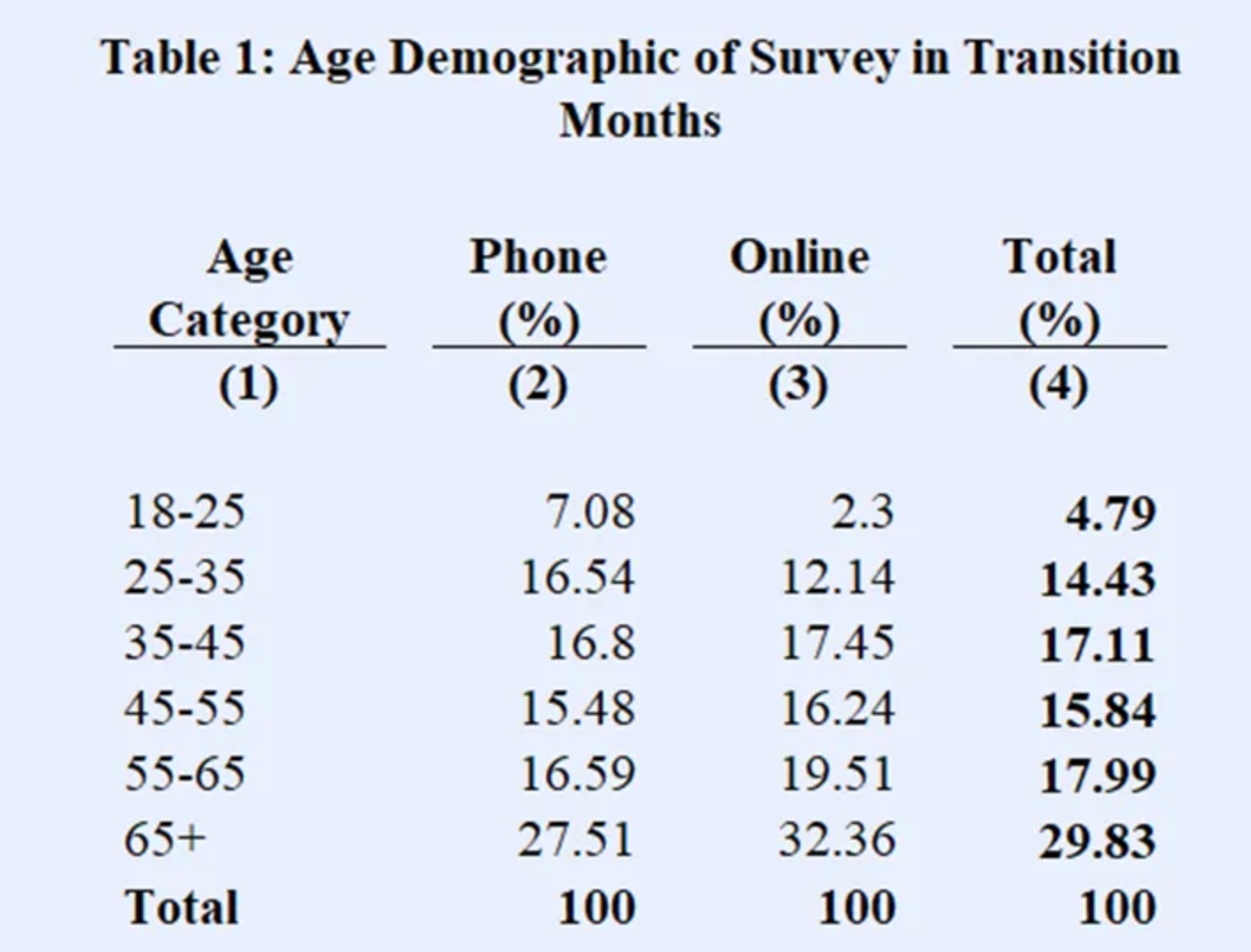
Weird how, in this case, making a survey More Online makes it older. I guess this is like how your Facebook is now dominated by boomer parents, aunts, and uncles.
Anyways, if you’re reading this, you’re definitely online. Hope you’re not part of the problem!

In the release of the final April 2024 report, survey director Dr. Joanne Hsu wrote that all the results (from both phone and web interviews) were represented when examining only the data received by phone interviews. The implication was that this new method of data collection was no biggie.
But according to Ryan Cummings and Ernie Tedeschi, who analyzed the impact of including interviews conducted over the world wide web over at the Briefing Book, it turns out the online respondents are purveyors of pessimism. From the piece, emphasis theirs:
While we agree with UMich’s own analysis that the online interviews themselves display similar trends across time as phone interviews, we believe online respondents are resulting in the level of the overall sentiment and current conditions indices being meaningfully lower, making more recent UMich data points inconsistent with pre-April 2024 data points. Specifically, we use a simple statistical model to estimate that the effect of the methodological switch from phone to online is currently resulting in sentiment being 8.9 index points –or more than 11 percent–lower than it would be if interviews were still collected through the phone... The mechanism for this bias primarily runs through the “current conditions” questions, especially on durables and personal finance experiences, rather than through the “expectations” questions.
At Sherwood, we’ve often detailed how not just the University of Michigan’s gauge, but also other measures of households’ perception of the economy, have been running way, way below what you’d expect given how US growth, the job market, and inflation are actually doing.
My colleague Matt Phillips has even called BS on Americans’ self-professed displeasure with the state of the economy, pointing to the surge in gambling as proof that sentiment couldn’t be too sour.
Cummings and Tedeschi, both of whom worked at the White House Council of Economic Advisers in the current administration, don’t attempt to play Sherlock Holmes on the perception-versus-reality gap. But their analysis does offer some compelling evidence that online respondents were not as demographically diverse during the transition months for the UMich survey: they skewed toward older people, who also had a more negative view on current economic conditions, particularly related to buying conditions for durable goods and personal-financial conditions.
The two note that this dynamic is not uncommon, pointing to other studies that found online surveys have more negativity than ones done by phone.
Weird how, in this case, making a survey More Online makes it older. I guess this is like how your Facebook is now dominated by boomer parents, aunts, and uncles.
Anyways, if you’re reading this, you’re definitely online. Hope you’re not part of the problem!



