World
Maker Of Popular Beers Modelo And Corona, Constellation Brands Reports Quarterly Earnings
(Justin Sullivan/Getty Images)
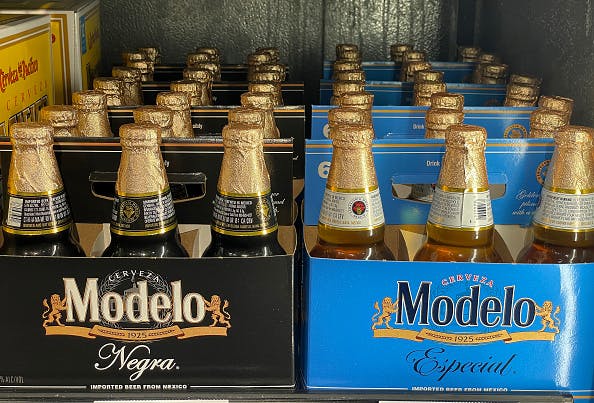
beer shot combo

Americans love Mexican booze. Will they get a tariff hangover?

The US now imports more than $10 billion in Mexican booze each year.

J. Edward Moreno

The economies of the United States and Mexico are more intertwined than theyve ever been. So are their drinking habits. With the threat of tariffs on the table but postponed for now, beer drinkers’ wallets hang in the balance.

President Trump and Mexican President Claudia Sheinbaum said Monday that theyd reached an agreement to postpone 25% tariffs on Mexican goods for at least a month while they work to hash out a deal. That caused many stocks to claw back their losses from the morning, when investors were having a mini freak-out over tariffs. (My colleague, Luke Kawa, has an excellent, highly sophisticated visual that aptly explains this complex geopolitical phenomenon and its impact on financial markets.)

While the tariffs were averted for now, uncertainty lingers. The US auto sector, for example, is highly integrated with Mexico and Canada, and many of Americans favorite foods, like avocados and mangoes, come from Mexico. But few stocks illustrate the concern that came over Wall Street and pub owners on Monday better than Constellation Brands, which sells Modelo, Corona, and Pacifico in the US. Its share price fell by more than 7% at market open, only to regain most of those losses by the afternoon.

An important reminder on how tariffs work: in Constellations case, it would be charged by the US government a 25% fee on kegs and cases of Modelo it brings from Mexico to sell in the US. Like any increased cost, its typically passed on to consumers in the form of higher prices. Mexico has also threatened its own tariffs, which would be charged by the Mexican government on American barley thats imported into Mexico to brew Modelo beer.

That does not mean consumer prices will increase by 25%. The looming threat of tariffs has decreased the value of the Mexican peso and Canadian loonie against the US dollar, which softens the blow for US importers. Also, beer served this month and next is likely already purchased: most distributors for Constellation Brands and Heineken — which sells Dos Equis and Tecate — took on 90 to 120 days of inventory, said Bump Williams, a beer industry consultant.

Williams estimated that a 25% tariff would result in a 5% to 7% increase in the price for consumers. That would mean a $12 six-pack would cost about $12.84.

I have faith that the Trump administration will dial back the tariff percentage on beer when he sees how many blue- and white-collar voters he’s impacting with an I win, you lose position, Williams said. After all, he proclaimed to be a man of the people, by the people, and for the people.

How did we get here?

Grupo Modelo was bought by AB InBev, the largest brewer in the world, in 2012. But after an antitrust lawsuit from the Obama administration, AB InBev agreed to sell the rights to distribute Modelo and its sister brands in the US. It was bought by Constellation, which at the time didnt have any beer in its portfolio.

Soon after, American consumers palates quickly shifted to prefer Mexican beers, and free-trade agreements kept it affordable. By 2023, Modelo Especial beat Bud Light as the most sold beer in the US. And even as Americans are drinking less beer, imports of Mexican brews keep going up.

Constellation has by far been the biggest beneficiary of this shift. The companys beer segment brought in $8 billion in revenue in 2023, compared to $3.5 billion in 2015.

Mexican liquors (tequila and mezcal, for the most part) have also grown in popularity in the US, though the beneficiaries are more fragmented than in beer.

Becle SA, which makes Jose Cuervo, is majority family-owned. Diageo bought Don Julio in 2014 and Casamigos in 2017. Bacardi acquired Patrón in 2018. And theres no shortage of celebrity tequila brands.

More World

See all World
world

US and Iran trade strikes overnight amid peace talks

Hours after President Donald Trump dismissed a report regarding a deal to restore traffic through the Strait of Hormuz, the US and Iran exchanged fresh strikes early on Thursday.

Despite an ongoing ceasefire as the countries hold talks to end the conflict, the US carried out new strikes inside Iran, The Guardian reports, prompting a retaliatory attack from Iran on a US airbase in Kuwait.

world
Tom Jones

The UAE’s OPEC exit will hit the group in the barrels

After just shy of 60 years in OPEC, its membership even predating its status as a nation-state, the United Arab Emirates yesterday announced its shocking departure from the oil production group, effective May 1, as the knock-on effects of the Iran war continue to play out across the Middle East and the energy landscape.

For context, the UAE produces the third-highest amount of oil in the group, per April data and OPEC’s latest set of annual statistics.

According to the cartel’s 2025 Annual Statistical Bulletin, the OPEC group was collectively exporting some 19 million barrels of crude oil a day last year, with the United Arab Emirates accounting for some 14% of that daily output.

UAExit means UAExit

The nation, whose energy minister told Reuters yesterday that the decision was taken “after a careful look at current and future policies related to level of production” and wasn’t made following discussions with any other country, made up a healthy share of the group’s total confirmed crude oil reserves, as well.

OPEC exports chart
Sherwood News

Of the 12 nations in the core group, which was founded by just five oil superpowers back in September 1960, only two (Iraq and Saudi Arabia) exported more barrels of crude oil daily, pumping out 3.36 million and 6.05 million barrels, respectively, each day to nations around the world.

For its part, the UAE said it will “continue its responsible role by gradually and thoughtfully increasing production, in line with demand and market conditions,” per the official state news agency. Clearly, the nation now wants a little more control of just how much oil it can pump around the world, with the UAE having to eat a large proportion of lost revenues due to its healthy abundance and OPEC restrictions.

According to the cartel’s 2025 Annual Statistical Bulletin, the OPEC group was collectively exporting some 19 million barrels of crude oil a day last year, with the United Arab Emirates accounting for some 14% of that daily output.

UAExit means UAExit

The nation, whose energy minister told Reuters yesterday that the decision was taken “after a careful look at current and future policies related to level of production” and wasn’t made following discussions with any other country, made up a healthy share of the group’s total confirmed crude oil reserves, as well.

OPEC exports chart
Sherwood News

Of the 12 nations in the core group, which was founded by just five oil superpowers back in September 1960, only two (Iraq and Saudi Arabia) exported more barrels of crude oil daily, pumping out 3.36 million and 6.05 million barrels, respectively, each day to nations around the world.

For its part, the UAE said it will “continue its responsible role by gradually and thoughtfully increasing production, in line with demand and market conditions,” per the official state news agency. Clearly, the nation now wants a little more control of just how much oil it can pump around the world, with the UAE having to eat a large proportion of lost revenues due to its healthy abundance and OPEC restrictions.

Latest Stories

Sherwood Media, LLC and Chartr Limited produce fresh and unique perspectives on topical financial news and are fully owned subsidiaries of Robinhood Markets, Inc., and any views expressed here do not necessarily reflect the views of any other Robinhood affiliate, including Robinhood Markets, Inc., Robinhood Financial LLC, Robinhood Securities, LLC, Robinhood Crypto, LLC, Robinhood Money, LLC, Robinhood U.K. Ltd, Robinhood Derivatives, LLC, Robinhood Gold, LLC, Robinhood Asset Management, LLC, Robinhood Credit, Inc., Robinhood Ventures DE, LLC and, where applicable, its managed investment vehicles.