
World
Capital punishment: America's severest penalty has sparked debate once again

Capital punishment: America's severest penalty has sparked debate once again

Capital punishment

The US Supreme Court declined to block the execution of an Alabama death row inmate using nitrogen gas, making Kenneth Eugene Smith, who was convicted of murder in 1989, the first American to be executed by the untested method on Thursday evening.

Alabama had previously tried to execute Smith by lethal injection 2 years ago, but officials failed to locate a vein before the warrant expired. Now, a nationwide debate has been sparked about whether using nitrogen asphyxiation is ethical. The UN had called on Alabama to stop the execution, warning that it might cause "grave suffering".

While nitrogen makes up 78% of the air we breathe, when inhaled at a high concentration it causes cell breakdown due to oxygen depletion. As the drugs used in lethal injections have become harder to source due to pharmaceutical sales restrictions, Alabama is 1 of 3 states where using the inert gas has been legalized, alongside Oklahoma and Mississippi; however, a formal execution protocol was only established last August.

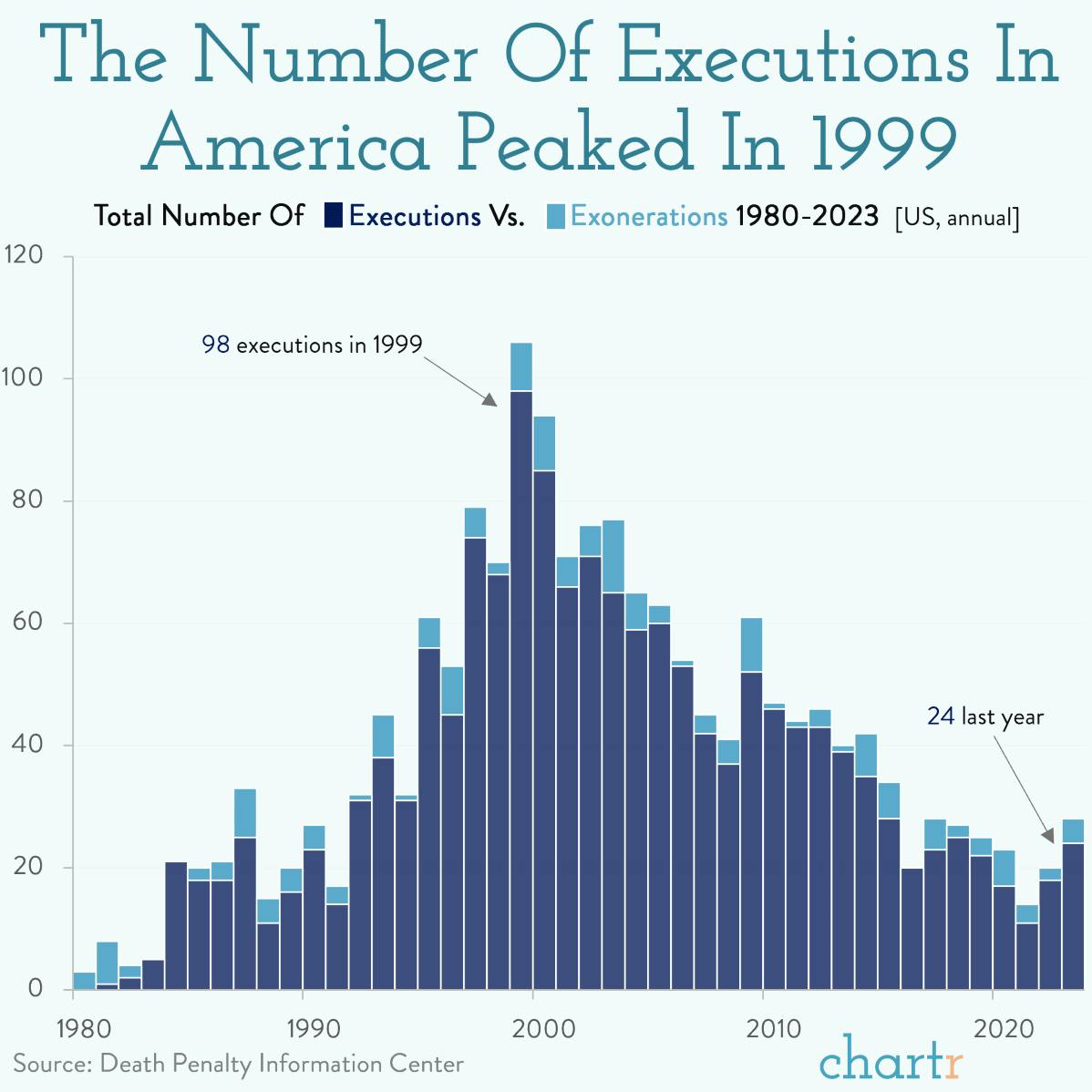
More broadly, in part due to the pitfalls of the widely-used injection method, America’s death row has shrunk considerably since the turn of the century: the execution-awaiting inmate population sank from 3,593 in 2000 to 2,331 in 2022, according to data from the Death Penalty Information Center. The actual number of executions has also declined: in 1999, there were 98 executions, a figure that has fallen to an average of ~18 in the last 5 years, although there are 26 executions scheduled in the US this year.

More World

See all World
world

US and Iran trade strikes overnight amid peace talks

Hours after President Donald Trump dismissed a report regarding a deal to restore traffic through the Strait of Hormuz, the US and Iran exchanged fresh strikes early on Thursday.

Despite an ongoing ceasefire as the countries hold talks to end the conflict, the US carried out new strikes inside Iran, The Guardian reports, prompting a retaliatory attack from Iran on a US airbase in Kuwait.

world
Tom Jones

The UAE’s OPEC exit will hit the group in the barrels

After just shy of 60 years in OPEC, its membership even predating its status as a nation-state, the United Arab Emirates yesterday announced its shocking departure from the oil production group, effective May 1, as the knock-on effects of the Iran war continue to play out across the Middle East and the energy landscape.

For context, the UAE produces the third-highest amount of oil in the group, per April data and OPEC’s latest set of annual statistics.

According to the cartel’s 2025 Annual Statistical Bulletin, the OPEC group was collectively exporting some 19 million barrels of crude oil a day last year, with the United Arab Emirates accounting for some 14% of that daily output.

UAExit means UAExit

The nation, whose energy minister told Reuters yesterday that the decision was taken “after a careful look at current and future policies related to level of production” and wasn’t made following discussions with any other country, made up a healthy share of the group’s total confirmed crude oil reserves, as well.

OPEC exports chart
Sherwood News

Of the 12 nations in the core group, which was founded by just five oil superpowers back in September 1960, only two (Iraq and Saudi Arabia) exported more barrels of crude oil daily, pumping out 3.36 million and 6.05 million barrels, respectively, each day to nations around the world.

For its part, the UAE said it will “continue its responsible role by gradually and thoughtfully increasing production, in line with demand and market conditions,” per the official state news agency. Clearly, the nation now wants a little more control of just how much oil it can pump around the world, with the UAE having to eat a large proportion of lost revenues due to its healthy abundance and OPEC restrictions.

According to the cartel’s 2025 Annual Statistical Bulletin, the OPEC group was collectively exporting some 19 million barrels of crude oil a day last year, with the United Arab Emirates accounting for some 14% of that daily output.

UAExit means UAExit

The nation, whose energy minister told Reuters yesterday that the decision was taken “after a careful look at current and future policies related to level of production” and wasn’t made following discussions with any other country, made up a healthy share of the group’s total confirmed crude oil reserves, as well.

OPEC exports chart
Sherwood News

Of the 12 nations in the core group, which was founded by just five oil superpowers back in September 1960, only two (Iraq and Saudi Arabia) exported more barrels of crude oil daily, pumping out 3.36 million and 6.05 million barrels, respectively, each day to nations around the world.

For its part, the UAE said it will “continue its responsible role by gradually and thoughtfully increasing production, in line with demand and market conditions,” per the official state news agency. Clearly, the nation now wants a little more control of just how much oil it can pump around the world, with the UAE having to eat a large proportion of lost revenues due to its healthy abundance and OPEC restrictions.

Latest Stories

Sherwood Media, LLC and Chartr Limited produce fresh and unique perspectives on topical financial news and are fully owned subsidiaries of Robinhood Markets, Inc., and any views expressed here do not necessarily reflect the views of any other Robinhood affiliate, including Robinhood Markets, Inc., Robinhood Financial LLC, Robinhood Securities, LLC, Robinhood Crypto, LLC, Robinhood Money, LLC, Robinhood U.K. Ltd, Robinhood Derivatives, LLC, Robinhood Gold, LLC, Robinhood Asset Management, LLC, Robinhood Credit, Inc., Robinhood Ventures DE, LLC and, where applicable, its managed investment vehicles.