
World
Multi-colored townhouses in Primrose Hill, London, UK
(Getty Images)
very british problems

UK house prices have dropped. They’re still not affordable.

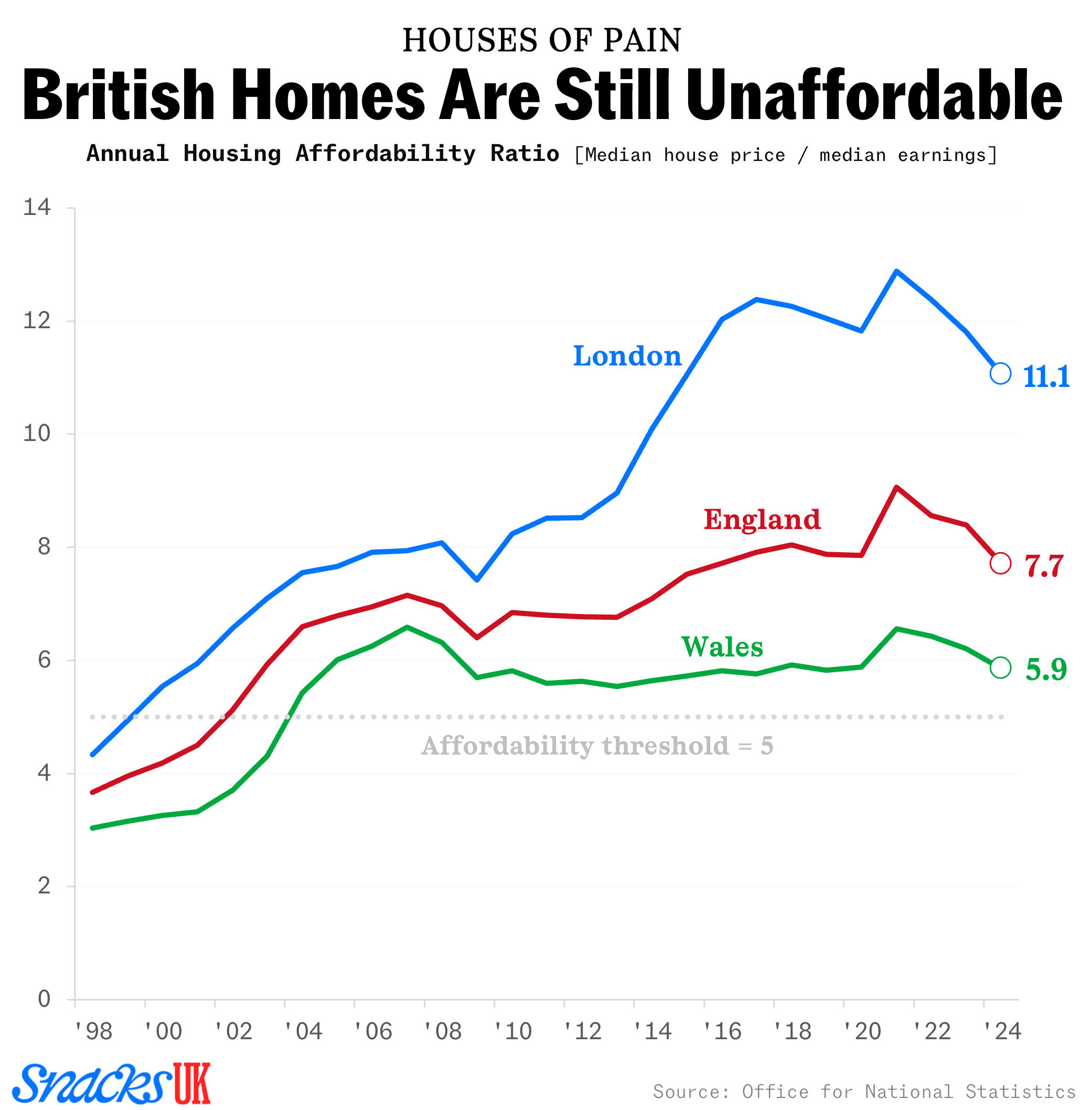
The median cost of a London home is more than 11x the city’s median wage.

Tom Jones

June data from Nationwide showed that UK house prices took their biggest monthly tumble in two years, while property website Rightmove this month said it had shown the steepest decline in two decades. However, as any Briton even flirting with the idea of clambering onto the property ladder anytime soon will tell you, they’re still looking very expensive. 

Per annual figures from the Office for National Statistics published in March, housing affordability across the UK — while down from pandemic-era highs, when prices were going up and earnings were going down — remains a foundational problem.
UK housing affordability chart
Sherwood News

Indeed, though activity in Britain’s housing market has remained “surprisingly resilient,” per Nationwide’s chief economist, buyers around the country still face home prices that far outstrip their wages. In Wales, for instance, the median house price sat at £201,000 — 5.9x more than the median annual pay packet. The median wage in England was £37,600, while the median cost of a house was £290,000. House prices in the capital, meanwhile, cost 11.06x more than Londoners’ median wages.

The obvious question — “what’s the right level?” — is a bit like asking “how long’s a piece of string?” But, for what it’s worth, the ONS uses a 5x earnings ratio for affordability to reflect the fact that mortgages are typically offered at “multiples of four to five times income.” Even after the recent declines, that ratio looks very far away for the UK’s would-be homebuyers.

More World

See all World
world
Tom Jones

The UAE’s OPEC exit will hit the group in the barrels

After just shy of 60 years in OPEC, its membership even predating its status as a nation-state, the United Arab Emirates yesterday announced its shocking departure from the oil production group, effective May 1, as the knock-on effects of the Iran war continue to play out across the Middle East and the energy landscape.

For context, the UAE produces the third-highest amount of oil in the group, per April data and OPEC’s latest set of annual statistics.

According to the cartel’s 2025 Annual Statistical Bulletin, the OPEC group was collectively exporting some 19 million barrels of crude oil a day last year, with the United Arab Emirates accounting for some 14% of that daily output.

UAExit means UAExit

The nation, whose energy minister told Reuters yesterday that the decision was taken “after a careful look at current and future policies related to level of production” and wasn’t made following discussions with any other country, made up a healthy share of the group’s total confirmed crude oil reserves, as well.

OPEC exports chart
Sherwood News

Of the 12 nations in the core group, which was founded by just five oil superpowers back in September 1960, only two (Iraq and Saudi Arabia) exported more barrels of crude oil daily, pumping out 3.36 million and 6.05 million barrels, respectively, each day to nations around the world.

For its part, the UAE said it will “continue its responsible role by gradually and thoughtfully increasing production, in line with demand and market conditions,” per the official state news agency. Clearly, the nation now wants a little more control of just how much oil it can pump around the world, with the UAE having to eat a large proportion of lost revenues due to its healthy abundance and OPEC restrictions.

According to the cartel’s 2025 Annual Statistical Bulletin, the OPEC group was collectively exporting some 19 million barrels of crude oil a day last year, with the United Arab Emirates accounting for some 14% of that daily output.

UAExit means UAExit

The nation, whose energy minister told Reuters yesterday that the decision was taken “after a careful look at current and future policies related to level of production” and wasn’t made following discussions with any other country, made up a healthy share of the group’s total confirmed crude oil reserves, as well.

OPEC exports chart
Sherwood News

Of the 12 nations in the core group, which was founded by just five oil superpowers back in September 1960, only two (Iraq and Saudi Arabia) exported more barrels of crude oil daily, pumping out 3.36 million and 6.05 million barrels, respectively, each day to nations around the world.

For its part, the UAE said it will “continue its responsible role by gradually and thoughtfully increasing production, in line with demand and market conditions,” per the official state news agency. Clearly, the nation now wants a little more control of just how much oil it can pump around the world, with the UAE having to eat a large proportion of lost revenues due to its healthy abundance and OPEC restrictions.

Latest Stories

Sherwood Media, LLC and Chartr Limited produce fresh and unique perspectives on topical financial news and are fully owned subsidiaries of Robinhood Markets, Inc., and any views expressed here do not necessarily reflect the views of any other Robinhood affiliate, including Robinhood Markets, Inc., Robinhood Financial LLC, Robinhood Securities, LLC, Robinhood Crypto, LLC, Robinhood Money, LLC, Robinhood U.K. Ltd, Robinhood Derivatives, LLC, Robinhood Gold, LLC, Robinhood Asset Management, LLC, Robinhood Credit, Inc., Robinhood Ventures DE, LLC and, where applicable, its managed investment vehicles.