
Business
"Transforming at Scale" - SXSW London 2025 - Conference - Day Three
Mark Read, CEO of WPP, speaking in London, June 4, 2025 (Jeff Spicer/Getty Images)
madder men

The ad agencies are staring down the barrel of AI

WPP’s CEO is stepping down as artificial intelligence threatens some of the core functions of the agency model.

David Crowther

The world of advertising feels like one that we all know intimately, with each of us faced with an almost overwhelming bombardment of logos, promos, and ads every single day.

But how many advertising firms can you actually name? If the answer is “not many,” you’re not alone.

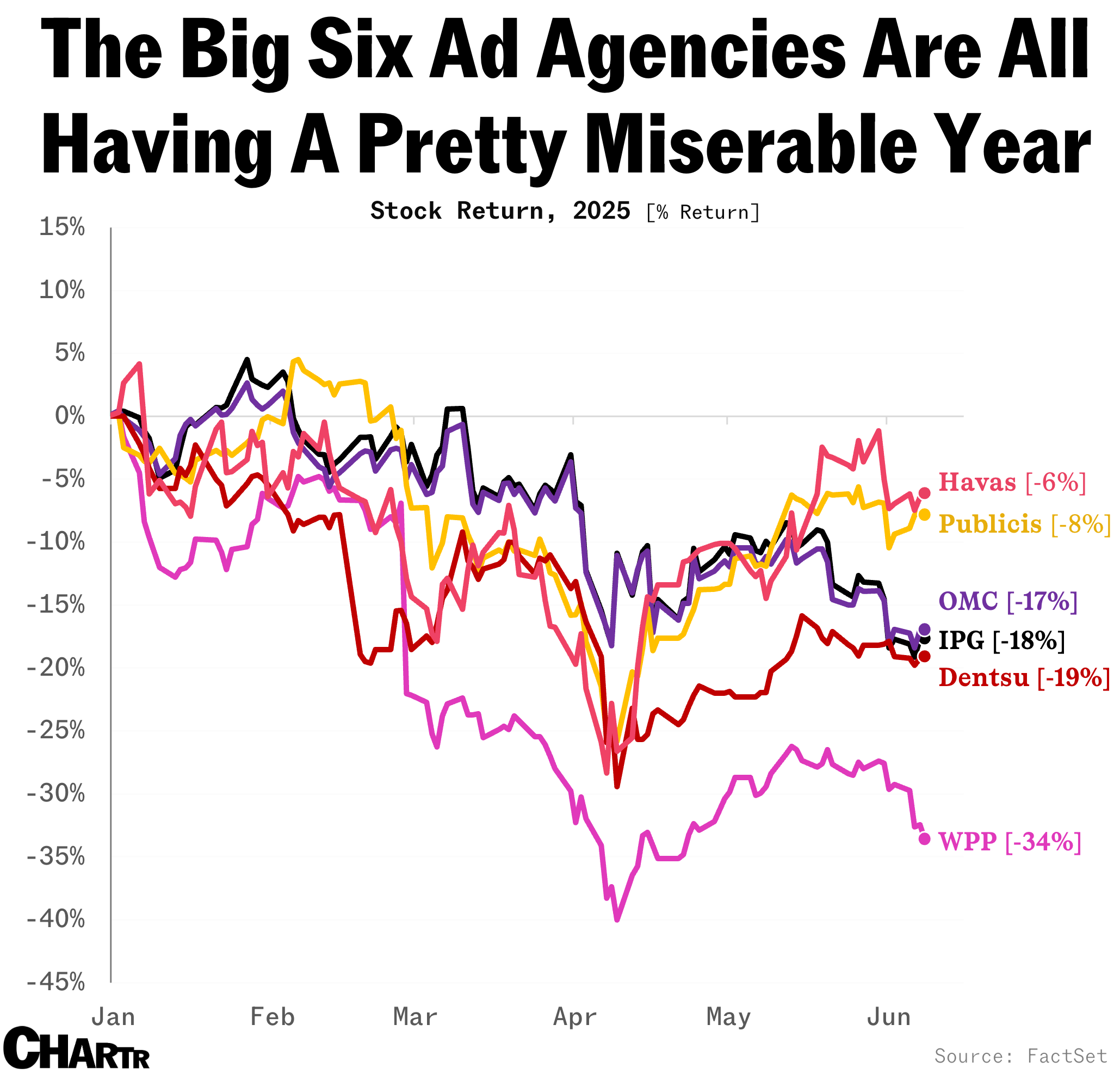
That’s because there are thousands of advertising agencies, each bursting with creative individuals looking to nudge our collective consciousness to be a little bit more sympathetic to the brands they’re tasked with representing on billboards, screens, and in print. Many of those agencies are owned by one of six major players that dominate the landscape — each one is having a tough 2025.
Ad Agencies
Sherwood News

The “big six,” the parent companies of dozens of smaller outlets, have all seen shares drop this year, but the largest — UK-based WPP — is hurting the most, with CEO Mark Read announcing his departure this morning, as the company’s stock has slumped by more than one-third so far this year.

Winter is coming

In the competitive world of advertising, industry execs are comfortable campaigning against each other for mandates to run all things advertising for major brands like Coca-Cola, Starbucks, and Nike. With the advent and popularization of AI, however, a new threat has emerged.

Just last week, Meta rocked the big six after The Wall Street Journal reported that the social media giant was planning to launch tools that would completely automate ad creation and targeting. That could mean the same product being shown in completely different settings to different users. For instance, an ad for a watch might show one user the timepiece on the wrist of a climber ascending to great heights, while someone else might see the same model on someone stepping out of a beautiful car, at a concert, playing a sport, or reading a newsletter on their phone.

With many other parts of the agency-brand relationship, like project management and media planning, already susceptible to AI tools, the creative part of the job was perhaps seen as one aspect that might be harder to replace. I’m not sure I’m ready for the ads on my Instagram to get any worse, but here we are.

More Business

See all Business
Family Watching Baseball On Tv

Netflix and Disney+ probably only added ad-tier subscribers this year, says Morgan Stanley

As streaming prices climb, ad-free subscribers are becoming a rarity.

Aldi Grand Opening

Discount stores are having a moment in America, drawing high- and low-income consumers alike

Everyone loves a deal in 2025 — and Aldi, Walmart, and Dollar Tree are all cashing in.

Millie Giles12/17/25
business

Report: OpenAI won’t pay a dime in cash for its 3-year licensing deal for Disney IP

More financial details behind the landmark deal that will grant OpenAI three years of access to Disney intellectual property are coming out, and they’re pretty surprising.

The deal will reportedly see OpenAI pay zero dollars in licensing fees, instead compensating Disney in stock warrants. It was previously reported that Disney would invest $1 billion into OpenAI as part of the agreement.

It’s very abnormal for Disney to grant anyone access to its massive IP library without a cash payment, and the entertainment juggernaut has been known to strike down even crocheted Etsy Yodas for infringing on its turf. In its fiscal year 2025, Disney booked more than $10 billion in revenue from licensing fees across merchandising, television, and theatrical distribution.

It’s very abnormal for Disney to grant anyone access to its massive IP library without a cash payment, and the entertainment juggernaut has been known to strike down even crocheted Etsy Yodas for infringing on its turf. In its fiscal year 2025, Disney booked more than $10 billion in revenue from licensing fees across merchandising, television, and theatrical distribution.

business

Ford says it will take $19.5 billion in charges in a massive EV write-down

The EV business has marked a long stretch of losing for Ford, and today the automaker announced it will take $19.5 billion in charges tied, for the most part, to its EV division.

Ford said it’s launching a battery energy storage business, leveraging battery plants in Kentucky and Michigan to “provide solutions for energy infrastructure and growing data center demand.”

According to Ford, the changes will drive Ford’s electrified division to profitability by 2029. The company will stop making its electric F-150, the Lightning, and instead shift to an “extended-range electric vehicle” that includes a gas-powered generator.

The Detroit automaker also raised its adjusted earnings before interest and taxes outlook to “about $7 billion” from a range of $6 billion to $6.5 billion.

Ford’s write-down is one of the largest taken by a company as legacy automakers scale back on EVs, giving EV-only automakers a market share boost.

Latest Stories

Sherwood Media, LLC produces fresh and unique perspectives on topical financial news and is a fully owned subsidiary of Robinhood Markets, Inc., and any views expressed here do not necessarily reflect the views of any other Robinhood affiliate, including Robinhood Markets, Inc., Robinhood Financial LLC, Robinhood Securities, LLC, Robinhood Crypto, LLC, or Robinhood Money, LLC.