
Business
BlackBerry sales

BlackBerry: Back in the black?

The once-iconic phonemaker expects to be profitable again

We’ll be fine

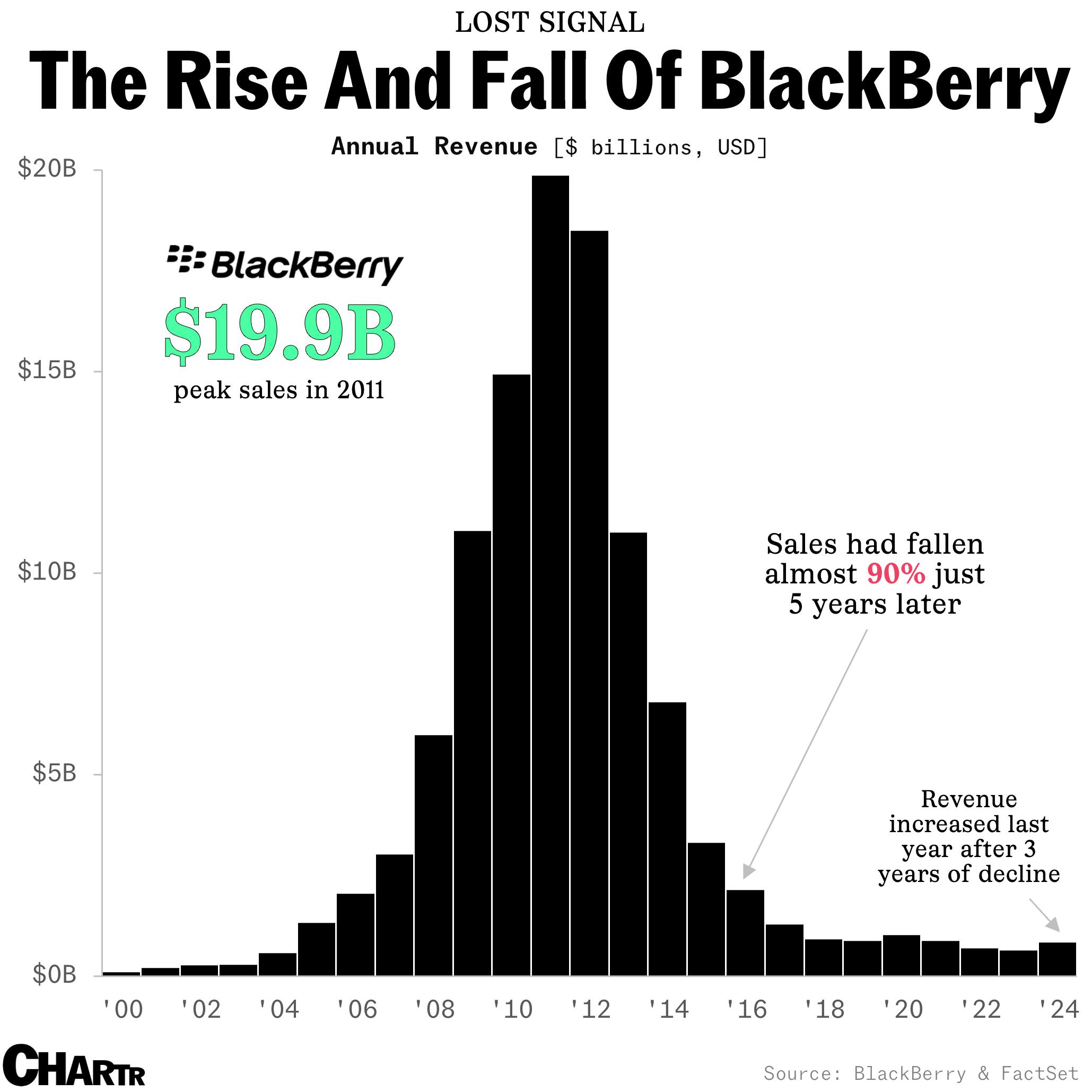
Shares of BlackBerry rose 11% yesterday after the company posted a smaller than expected loss, edging the once world-beating company back towards profitability, with the CEO expecting BlackBerry to be “generating positive cash flow in the fourth quarter”.

The results had nothing to do with shipping phones, however. Since its dramatic fall from grace, the company has pivoted towards selling the software and security features that helped make its phones so popular with security-conscious white-collar workers in the first place.

BlackBerry, along with other 2000s classics like Nokia, TomTom, and pretty much the entire MP3 market, was decimated by the release of the iPhone in 2007. The company’s revenue peaked just shy of $20 billion in 2011, but as the iPhone and other smartphones went mainstream, its sales plummeted. Just five years later, BlackBerry's revenue had dropped to around $2 billion, a period that included a staggering $4.4 billion loss in a single quarter due to a massive inventory writedown.

Realizing that its co-CEO’s famous words — "we'll be fine" — after the iPhone launch were, shall we say, a bit optimistic, the company eventually abandoned selling hardware in 2016. That shift has hardly restored BlackBerry into the global leader that it once was, its most recent annual sales amounted to just 4% of its record, but some version of the company remains alive and kicking. In fact, there’s a good chance you’ve recently used a BlackBerry product indirectly: the company reports that its software is in more than 235 million vehicles around the world.

More Business

See all Business
business

The Trump administration is reportedly planning a 50% made-in-America requirement for USMCA tariff relief

Qualifying for USMCA-related lower tariffs may soon require more US-made vehicle components, according to reporting by the Wall Street Journal.

The Trump administration is reportedly planning to introduce a 50% US content requirement for vehicles covered by the trade pact to receive lower tariffs. The content would be measured by cost, according to the WSJ.

There currently isn’t any US-specific requirement for those lower tariff rates, but in order to receive preferential tariffs, vehicles are must contain at least 75% regional content (components made in North America). Per Reuters reporting, the Trump admin is seeking to raise the Regional requirement to 82%.

These reported plans are subject to change as the US negotiates USMCA terms with Mexico over the next few months.

Overall, Tesla will likely have the easiest time qualifying for any stricter requirements. The automaker’s vehicles contained the highest amount of US/Canadian content in 2025, according to American University research. Ford, GM, and Stellantis all scored lower. Notably: the underlying government data that many domestic content measurements rely on intentionally combines US and Canadian components, so it’s difficult to know exactly how much of any given vehicle is specifically US-made.

There currently isn’t any US-specific requirement for those lower tariff rates, but in order to receive preferential tariffs, vehicles are must contain at least 75% regional content (components made in North America). Per Reuters reporting, the Trump admin is seeking to raise the Regional requirement to 82%.

These reported plans are subject to change as the US negotiates USMCA terms with Mexico over the next few months.

Overall, Tesla will likely have the easiest time qualifying for any stricter requirements. The automaker’s vehicles contained the highest amount of US/Canadian content in 2025, according to American University research. Ford, GM, and Stellantis all scored lower. Notably: the underlying government data that many domestic content measurements rely on intentionally combines US and Canadian components, so it’s difficult to know exactly how much of any given vehicle is specifically US-made.

business

The $640,000 Luce makes the average Ferrari look like a bargain

Put aside the shape; put aside the smoothing out of Ferrari’s iconic sharp edges; put aside, even, the calls from former Chairman and President Luca Cordero di Montezemolo to “take the Prancing Horse off.” On the grounds of price alone, Luce detractors might have a point.

By now, many of us will have read the criticisms of Ferrari’s first fully electric vehicle, as the Luce — which was unveiled to the world earlier this week and promptly saw the company’s shares crash out in New York and Milan — gets subtly shaded by competitors online and not-so-subtly shaded by basically everyone else.

What makes all of this worse for Ferrari is that, even by the luxury car maker’s notoriously high standards, they’ve slapped a pretty hefty price tag on the Luce, and the company’s CEO, Benedetto Vigna, has already been forced to defend the €550,000 ($640,000) price point, saying yesterday that it’s “fair to pay for innovation,” per Reuters.

While Ferrari’s cars have been getting more expensive of late, as recently as 2022, Ferrari’s average revenue per car sold was around $340,000. At nearly twice that price, this new electric model is obviously proving a little much (visually, conceptually, and financially) for many loyal and long-standing fans of the Prancing Horse to stomach.

Ferrari Luce cost chart
Sherwood News

By now, many of us will have read the criticisms of Ferrari’s first fully electric vehicle, as the Luce — which was unveiled to the world earlier this week and promptly saw the company’s shares crash out in New York and Milan — gets subtly shaded by competitors online and not-so-subtly shaded by basically everyone else.

What makes all of this worse for Ferrari is that, even by the luxury car maker’s notoriously high standards, they’ve slapped a pretty hefty price tag on the Luce, and the company’s CEO, Benedetto Vigna, has already been forced to defend the €550,000 ($640,000) price point, saying yesterday that it’s “fair to pay for innovation,” per Reuters.

While Ferrari’s cars have been getting more expensive of late, as recently as 2022, Ferrari’s average revenue per car sold was around $340,000. At nearly twice that price, this new electric model is obviously proving a little much (visually, conceptually, and financially) for many loyal and long-standing fans of the Prancing Horse to stomach.

Ferrari Luce cost chart
Sherwood News

Latest Stories

Sherwood Media, LLC and Chartr Limited produce fresh and unique perspectives on topical financial news and are fully owned subsidiaries of Robinhood Markets, Inc., and any views expressed here do not necessarily reflect the views of any other Robinhood affiliate, including Robinhood Markets, Inc., Robinhood Financial LLC, Robinhood Securities, LLC, Robinhood Crypto, LLC, Robinhood Money, LLC, Robinhood U.K. Ltd, Robinhood Derivatives, LLC, Robinhood Gold, LLC, Robinhood Asset Management, LLC, Robinhood Credit, Inc., Robinhood Ventures DE, LLC and, where applicable, its managed investment vehicles.
