
Business
Amazon company truck driving on a highway, side view.
(Getty Images)
PRIME LOCATIONS

Amazon is spending over $4 billion to boost small-town deliveries

The company already accounts for more than one-quarter of US parcel volumes.

Tom Jones

Yesterday, Amazon announced that its doubling down on small-town America, revealing plans to invest more than $4 billion into its delivery service in rural locations by the end of next year, as it attempts to speed up delivery times across less populated areas.

The announcement — which came a day before the company’s earnings, expected after the bell today — was packed with big-if-true figures. For example, the expansion will apparently let Amazon ship over 1 billion extra packages a year, add 200 delivery stations, create 100,000 new jobs, and improve its service in more than 13,000 rural ZIP codes across more than 1.2 million square miles. 

Boxing match

Elsewhere in the delivery business, UPS said on Tuesday that it would be cutting 20,000 positions (~4% of its workforce) in 2025 and closing 73 US locations by the end of June. While some jumped to tariffs as a potential explanation, the layoffs are more a result of UPS distancing itself from Amazon. The company is planning to halve the business it does with the online giant by mid-2026, with CEO Carol Tome explaining that fulfilling outbound shipments from Amazon centers is not profitable for us, nor a healthy fit for our network.” 

As Jeff Bezos’ retailer looks to bolster its parcel force where others are pulling back, it’ll likely carry on a yearslong trend and only pull further ahead of of its competition in the logistics industry.
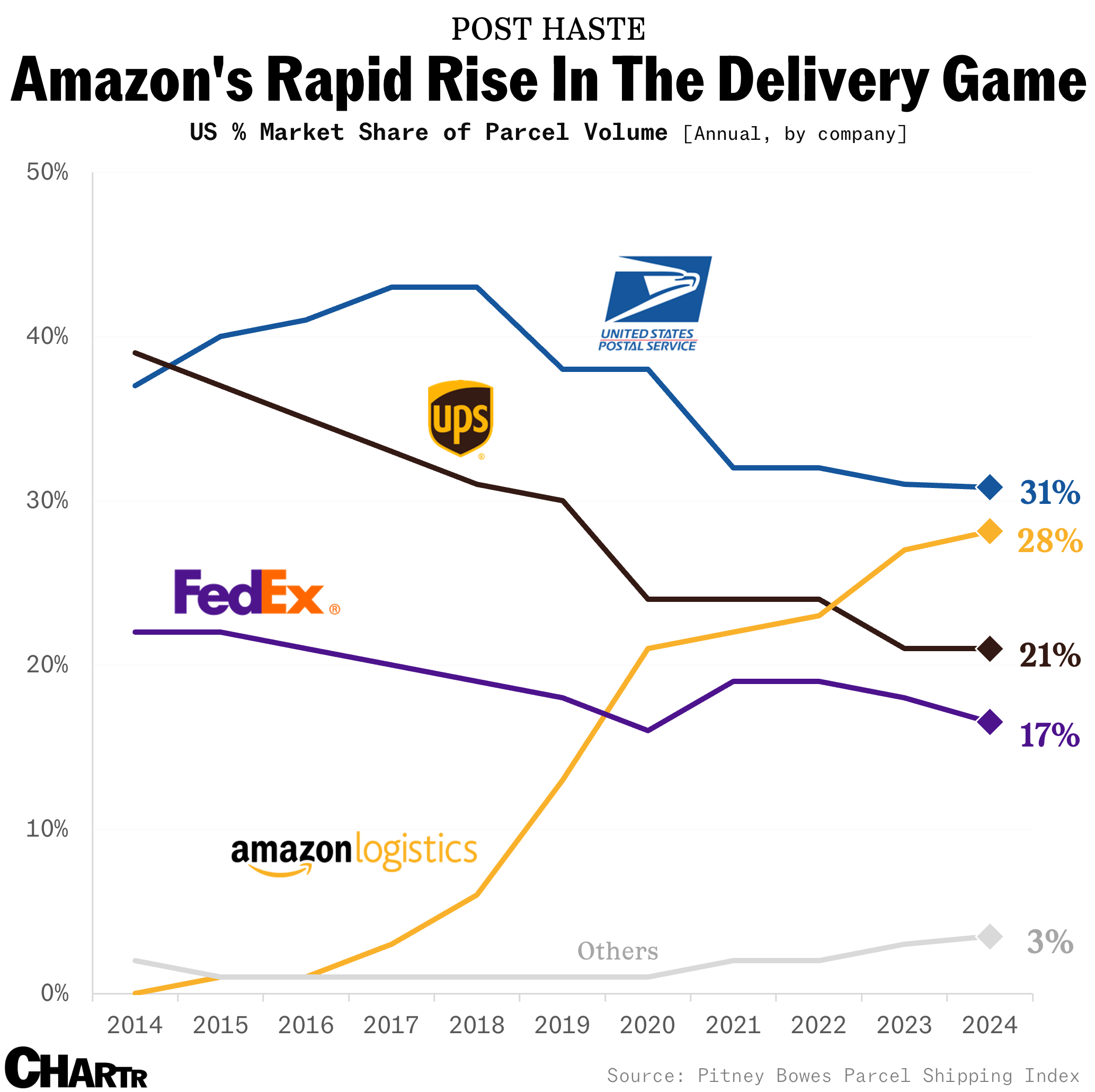
US parcel volumes chart
Sherwood News

According to the annual Pitney Bowes Parcel Shipping Index, Amazon Logistics delivered a whopping 6.3 billion parcels across the US in 2024, up 7.3% from the year before and second only to the US Postal Service’s 6.9 billion figure. Amazon now looks clear as the biggest private delivery business in America, taking an impressive 28% share of the market, while UPS and FedEx have both declined in recent years.

More Business

See all Business
business

China’s EV startup trio have all become profitable

China’s EV startup trio, Nio, Li Auto, and XPeng, are now all profitable, following the latter’s Q4 results released Friday.

XPeng reported a quarterly net profit of about $55 million, compared to rival Nio’s Q4 net profit (also its first) of about $40 million. Li Auto posted Q4 net profit of less than $1 million.

All three companies being profitable offers a stark contrast to the EV market in the US, where Rivian quietly delayed its 2027 profitability target in a filing about its Uber robotaxi partnership yesterday. Lucid is likely further away, and last month cut 12% of its US workforce as part of its “path toward profitability.”

Still, it’s not all rosy for China’s EV startups, either. XPeng ADRs were down more than 6% in Friday morning trading as its Q1 sales forecast came in below estimates. As China rolls back subsidies, auto sales are slumping. Chinese retail EV and hybrid sales fell 32% in February from the same month last year.

9.3%

As the war with Iran produces the biggest spike in US gas prices since Hurricane Katrina, car retailer CarMax is continuing to see heightened interest in EVs, hybrids, and plug-in hybrids.

“From Feb 1st - March 1st (inclusive), compared to March 2nd to March 15th (inclusive), we saw a 9.3% lift in page views for these vehicles,” a spokesperson for the company told Sherwood News.

As industry insiders recently told us, EV interest climbs when gas prices rise. That appears to be holding true even without EV tax credits, which the Trump administration ended under its new budget package.

CarMax also saw EV searches spike in 2022, amid Russia’s invasion of Ukraine and the resulting oil price spike.

Walt Disney Chairman And CEO Bob Iger Rings Opening Bell At NY Stock Exchange

It’s the end of Disney’s Iger era (again)

Incoming CEO Josh D’Amaro is replacing Bob Iger on Wednesday, though Iger will remain a senior adviser through the end of the year.

$35.4B

The tariffs imposed by the Trump administration have cost automakers at least $35.4 billion since the start of 2025, according to a new analysis by Automotive News.

That total will continue to climb this year, since the Supreme Court’s February tariff ruling largely leaves the 25% levy on vehicles and auto parts untouched.

Toyota has taken the biggest hit, projecting more than $9 billion in tariff costs in its fiscal year ending this month, while Detroit’s big three automakers — Ford, GM, and Stellantis — were hit with a combined $6.5 billion tariff charge in 2025.

In the fourth quarter, automakers sold about 8% fewer imported vehicles in the US compared to the same period a year ago, per the Automotive News Research & Data Center.

Tariff charges come at a rough time for legacy carmakers, which are also scaling back EV plans following the Trump administration’s elimination of tax credits and fuel standard goals. According to Automotive News, the cost of EV write-downs and restructuring is, so far, nearly $70 billion.

Latest Stories

Sherwood Media, LLC produces fresh and unique perspectives on topical financial news and is a fully owned subsidiary of Robinhood Markets, Inc., and any views expressed here do not necessarily reflect the views of any other Robinhood affiliate, including Robinhood Markets, Inc., Robinhood Financial LLC, Robinhood Securities, LLC, Robinhood Crypto, LLC, Robinhood Derivatives, LLC, or Robinhood Money, LLC. Futures and event contracts are offered through Robinhood Derivatives, LLC.