
Business
US-AEROSPACE-SPACE-NASA-BOEING
Photo by MARK FELIX via Getty Images

Boeing landed its Starliner, and a tentative union agreement, over the weekend

William Coulman

Boeing has had quite a dramatic weekend. First, on Saturday, Boeing's problem-plagued Starliner spacecraft finally returned to Earth — three months late and without its two astronauts after NASA deemed the trip too risky for human passengers. Then, on Sunday, Boeing averted a looming strike by reaching a tentative agreement with union leaders that promises a 25% pay increase over four years for thousands of Boeing employees in its U.S. Pacific Northwest commercial division.

Those union members will vote on Thursday to ratify the deal. If waved through it would mark a significant win for Boeing’s new CEO, Robert “Kelly” Ortberg, who took the helm just a month ago and inherited a business that is battling a quality control crisis, reputational damage, and ongoing regulatory scrutiny. Boeing shares are up 4% in early trading but have shed 35% of their value in the year to date, and are down 57% in the last 5 years.

Boeing’s business is obviously getting things airborne. But selling passenger-carrying airplanes, like the iconic 737, has actually been less than one-third of the company’s revenue so far this year. The union deal comes with a commitment that the company will build its next commercial model in the Seattle area.
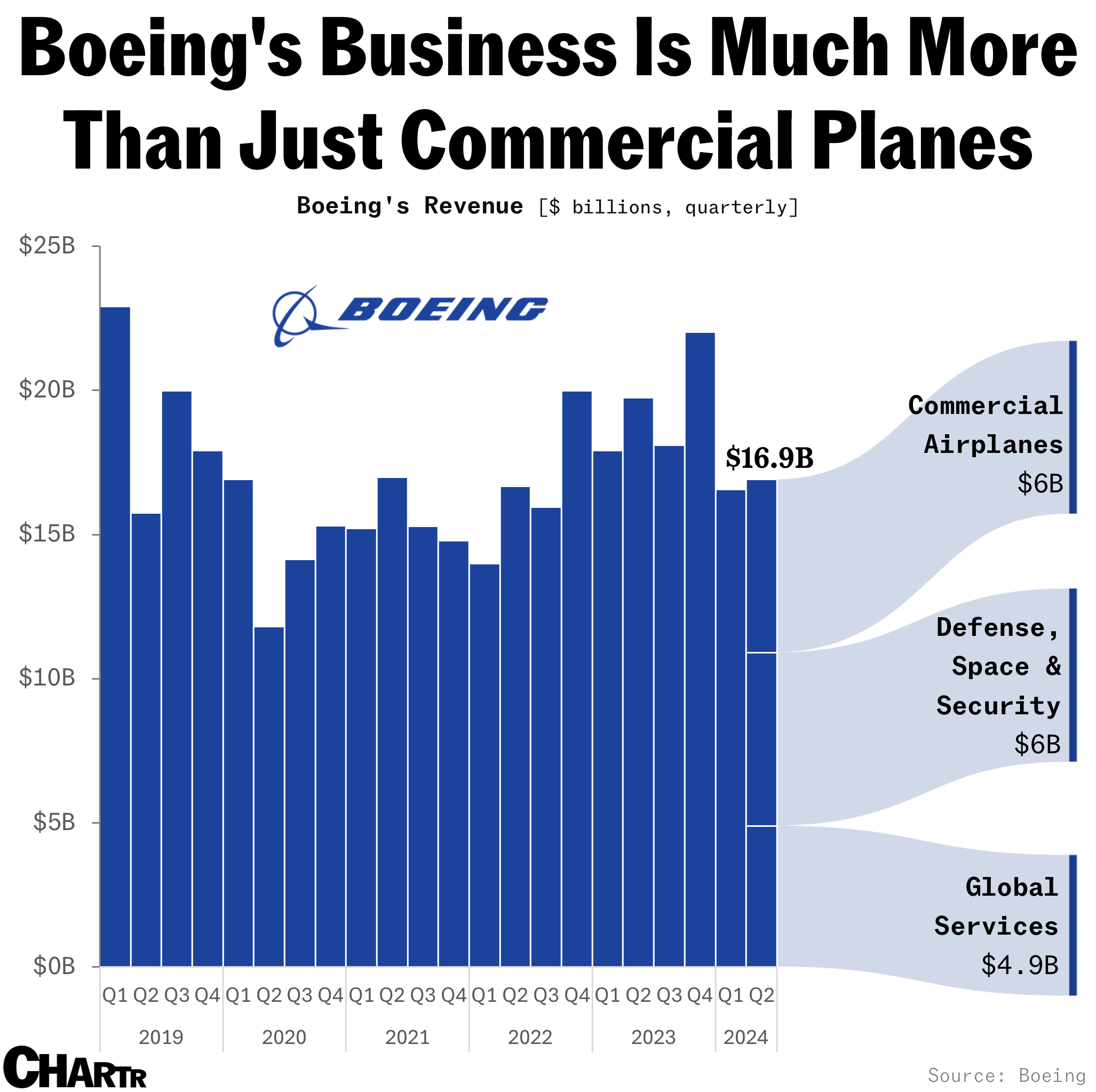
Boeing revenue breakdown
Sherwood News

Its defense, space, and security segment also pulled in $6 billion in Q2, though the troubled spacecraft division plays a relatively minor role compared to military aircraft and equipment sales. The company's services division, focused on maintenance and upgrades, contributed an additional $4.9 billion.

With a background as a mechanical engineer and years of experience in the aerospace supply chain, investors are hoping that Ortberg will be the one to get Boeing back on the right trajectory.

More Business

See all Business
business

The $640,000 Luce makes the average Ferrari look like a bargain

Put aside the shape; put aside the smoothing out of Ferrari’s iconic sharp edges; put aside, even, the calls from former Chairman and President Luca Cordero di Montezemolo to “take the Prancing Horse off.” On the grounds of price alone, Luce detractors might have a point.

By now, many of us will have read the criticisms of Ferrari’s first fully electric vehicle, as the Luce — which was unveiled to the world earlier this week and promptly saw the company’s shares crash out in New York and Milan — gets subtly shaded by competitors online and not-so-subtly shaded by basically everyone else.

What makes all of this worse for Ferrari is that, even by the luxury car maker’s notoriously high standards, they’ve slapped a pretty hefty price tag on the Luce, and the company’s CEO, Benedetto Vigna, has already been forced to defend the €550,000 ($640,000) price point, saying yesterday that it’s “fair to pay for innovation,” per Reuters.

While Ferrari’s cars have been getting more expensive of late, as recently as 2022, Ferrari’s average revenue per car sold was around $340,000. At nearly twice that price, this new electric model is obviously proving a little much (visually, conceptually, and financially) for many loyal and long-standing fans of the Prancing Horse to stomach.

Ferrari Luce cost chart
Sherwood News

By now, many of us will have read the criticisms of Ferrari’s first fully electric vehicle, as the Luce — which was unveiled to the world earlier this week and promptly saw the company’s shares crash out in New York and Milan — gets subtly shaded by competitors online and not-so-subtly shaded by basically everyone else.

What makes all of this worse for Ferrari is that, even by the luxury car maker’s notoriously high standards, they’ve slapped a pretty hefty price tag on the Luce, and the company’s CEO, Benedetto Vigna, has already been forced to defend the €550,000 ($640,000) price point, saying yesterday that it’s “fair to pay for innovation,” per Reuters.

While Ferrari’s cars have been getting more expensive of late, as recently as 2022, Ferrari’s average revenue per car sold was around $340,000. At nearly twice that price, this new electric model is obviously proving a little much (visually, conceptually, and financially) for many loyal and long-standing fans of the Prancing Horse to stomach.

Ferrari Luce cost chart
Sherwood News

Latest Stories

Sherwood Media, LLC and Chartr Limited produce fresh and unique perspectives on topical financial news and are fully owned subsidiaries of Robinhood Markets, Inc., and any views expressed here do not necessarily reflect the views of any other Robinhood affiliate, including Robinhood Markets, Inc., Robinhood Financial LLC, Robinhood Securities, LLC, Robinhood Crypto, LLC, Robinhood Money, LLC, Robinhood U.K. Ltd, Robinhood Derivatives, LLC, Robinhood Gold, LLC, Robinhood Asset Management, LLC, Robinhood Credit, Inc., Robinhood Ventures DE, LLC and, where applicable, its managed investment vehicles.
