
Business
Red Lobster Files For Bankruptcy Protection
(Brandon Bell/Getty Images)

Casual dining is eating fast food’s lunch right now

Americans don’t see fast food as good value anymore. Now, even Red Lobster is feeling confident enough to try some old tricks.

After shelling out to the point of self-destruction on its $20 “Endless Shrimp” deal, and thus learning the true meaning of “all you can eat,” Red Lobster is back, having emerged from Chapter 11 bankruptcy last September.

This time, though, the company’s new management is betting on a different (limited) crustacean to lure consumers back, on Monday announcing the return of “Crabfest” following a four-year hiatus — not to be confused with “Endless Crab,” another financially devastating promotion that the company ran in 2003. 

But if ever there were a time to revive a casual dining business with a familiar playbook, it’s now.

As reported by The Wall Street Journal last Friday, brands like Red Lobster and Cracker Barrel that have seen traffic slump in recent years are planning to spend millions to overhaul their locations and offerings. Their goal? To emulate the success of some of their casual dining peers.

At breadstick-renowned Olive Garden, same-store sales were up 7% year over year in its most recent quarter. Over at Brinker, flagship brand Chili’s is red hot, with same-store sales up a whopping 32% in the first three months of the year. At McDonald’s, traffic is going the other way, with same-store sales dropping 3.6% last quarter.
Casual dining YouGov survey
Sherwood News

Dine a dozen 

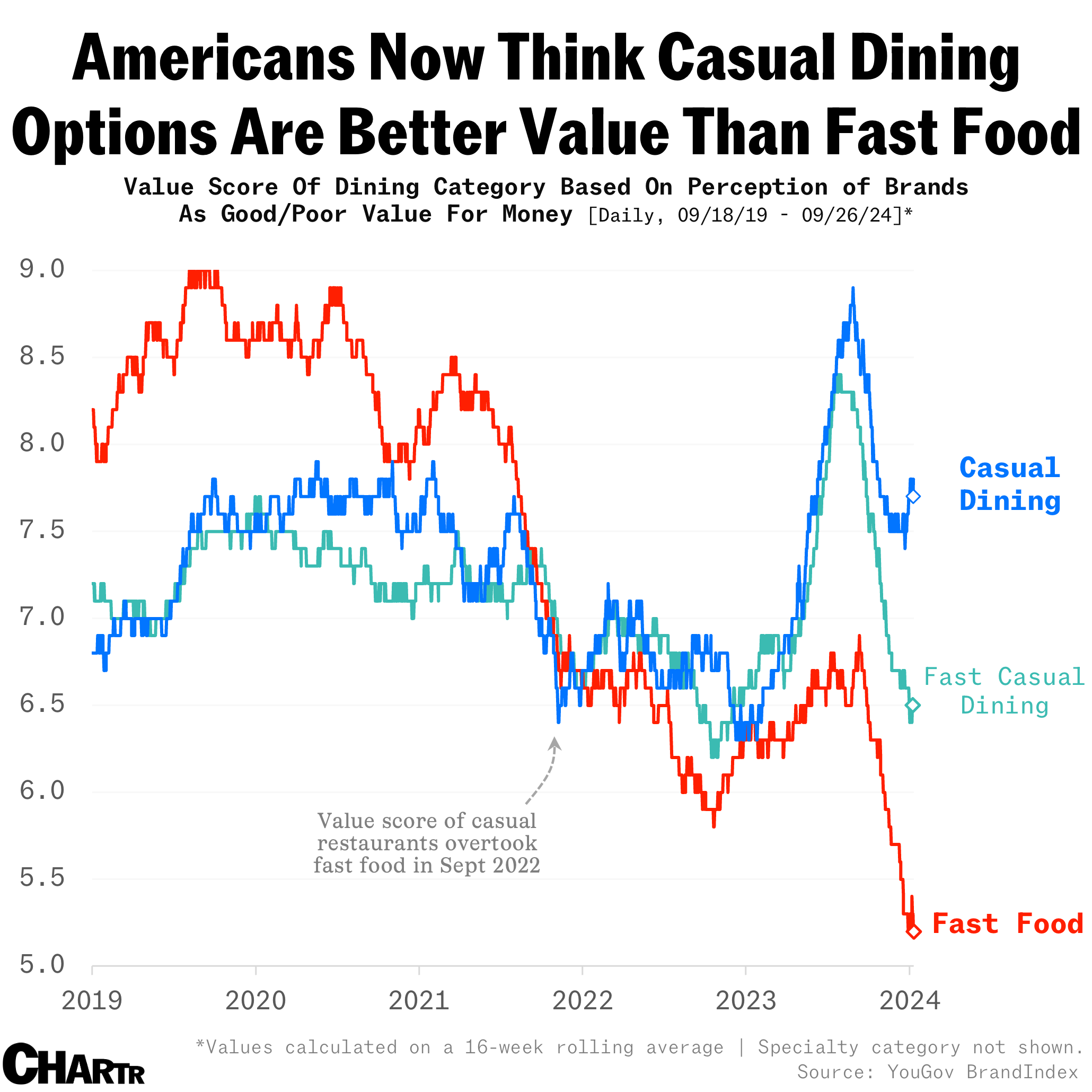
Indeed, as cost-conscious customers have been put off by inflation-spiked fast-food menus, they’ve been drawn toward household name casual restaurants by a combination of good service, good atmosphere, and good prices. A survey conducted by YouGov at the end of last year found that casual chains had soared in US consumers’ approximations as the best-value option for dining, while value scores for the fast-food and fast-casual categories sank throughout 2024.

Olive Garden topped the list of the brands considered the best for value, with Wendy’s the only fast-food category restaurant to break the top 10. Meanwhile, fast-food outlets dominated the list of poorest-value restaurants… but it was Starbucks, home of numerous ~$7 drinks, that was named the worst-value option overall.

More Business

See all Business
business

The Trump administration is reportedly planning a 50% made-in-America requirement for USMCA tariff relief

Qualifying for USMCA-related lower tariffs may soon require more US-made vehicle components, according to reporting by The Wall Street Journal.

The Trump administration is reportedly planning to introduce a 50% US content requirement for vehicles covered by the trade pact to receive lower tariffs. The content would be measured by cost, according to the WSJ.

There currently isn’t any US-specific requirement for those lower tariff rates, but in order to receive preferential tariffs, vehicles are must contain at least 75% regional content (components made in North America). Per Reuters reporting, the Trump admin is seeking to raise the regional requirement to 82%.

These reported plans are subject to change as the US negotiates USMCA terms with Mexico over the next few months.

Overall, Tesla will likely have the easiest time qualifying for any stricter requirements. The automaker’s vehicles contained the highest amount of US/Canadian content in 2025, according to American University research. Ford, GM, and Stellantis all scored lower.

Notably: the underlying government data that many domestic content measurements rely on intentionally combines US and Canadian components, so it’s difficult to know exactly how much of any given vehicle is specifically US-made.

There currently isn’t any US-specific requirement for those lower tariff rates, but in order to receive preferential tariffs, vehicles are must contain at least 75% regional content (components made in North America). Per Reuters reporting, the Trump admin is seeking to raise the regional requirement to 82%.

These reported plans are subject to change as the US negotiates USMCA terms with Mexico over the next few months.

Overall, Tesla will likely have the easiest time qualifying for any stricter requirements. The automaker’s vehicles contained the highest amount of US/Canadian content in 2025, according to American University research. Ford, GM, and Stellantis all scored lower.

Notably: the underlying government data that many domestic content measurements rely on intentionally combines US and Canadian components, so it’s difficult to know exactly how much of any given vehicle is specifically US-made.

business

The $640,000 Luce makes the average Ferrari look like a bargain

Put aside the shape; put aside the smoothing out of Ferrari’s iconic sharp edges; put aside, even, the calls from former Chairman and President Luca Cordero di Montezemolo to “take the Prancing Horse off.” On the grounds of price alone, Luce detractors might have a point.

By now, many of us will have read the criticisms of Ferrari’s first fully electric vehicle, as the Luce — which was unveiled to the world earlier this week and promptly saw the company’s shares crash out in New York and Milan — gets subtly shaded by competitors online and not-so-subtly shaded by basically everyone else.

What makes all of this worse for Ferrari is that, even by the luxury car maker’s notoriously high standards, they’ve slapped a pretty hefty price tag on the Luce, and the company’s CEO, Benedetto Vigna, has already been forced to defend the €550,000 ($640,000) price point, saying yesterday that it’s “fair to pay for innovation,” per Reuters.

While Ferrari’s cars have been getting more expensive of late, as recently as 2022, Ferrari’s average revenue per car sold was around $340,000. At nearly twice that price, this new electric model is obviously proving a little much (visually, conceptually, and financially) for many loyal and long-standing fans of the Prancing Horse to stomach.

Ferrari Luce cost chart
Sherwood News

By now, many of us will have read the criticisms of Ferrari’s first fully electric vehicle, as the Luce — which was unveiled to the world earlier this week and promptly saw the company’s shares crash out in New York and Milan — gets subtly shaded by competitors online and not-so-subtly shaded by basically everyone else.

What makes all of this worse for Ferrari is that, even by the luxury car maker’s notoriously high standards, they’ve slapped a pretty hefty price tag on the Luce, and the company’s CEO, Benedetto Vigna, has already been forced to defend the €550,000 ($640,000) price point, saying yesterday that it’s “fair to pay for innovation,” per Reuters.

While Ferrari’s cars have been getting more expensive of late, as recently as 2022, Ferrari’s average revenue per car sold was around $340,000. At nearly twice that price, this new electric model is obviously proving a little much (visually, conceptually, and financially) for many loyal and long-standing fans of the Prancing Horse to stomach.

Ferrari Luce cost chart
Sherwood News

Latest Stories

Sherwood Media, LLC and Chartr Limited produce fresh and unique perspectives on topical financial news and are fully owned subsidiaries of Robinhood Markets, Inc., and any views expressed here do not necessarily reflect the views of any other Robinhood affiliate, including Robinhood Markets, Inc., Robinhood Financial LLC, Robinhood Securities, LLC, Robinhood Crypto, LLC, Robinhood Money, LLC, Robinhood U.K. Ltd, Robinhood Derivatives, LLC, Robinhood Gold, LLC, Robinhood Asset Management, LLC, Robinhood Credit, Inc., Robinhood Ventures DE, LLC and, where applicable, its managed investment vehicles.
