CFO Mandy Fields sees e.l.f. Beauty in growth mode, as company beats on sales and earnings
The new owner of rhode beat estimates for its fiscal third quarter and boosted its guidance for the full year, even as headwinds in the UK and Germany continued.
When e.l.f. Beauty dropped more than 35% in a single trading session — following its earnings results in November — the market’s strong response came as a “surprise” for the company’s CEO, Tarang Amin, who thought the response was an “overreaction.”
It was the first full quarter since rhode, the Hailey Bieber-founded brand, had joined e.l.f.’s beauty empire in a balmy billion-dollar deal. But any excitement over the deal quickly faded, as tariffs weighed on the company’s margins and a weaker growth outlook for the company’s OG brand translated into an underwhelming sales outlook. Investors slammed the stock.
But e.l.f.’s fiscal third-quarter results, reported this afternoon, are a little prettier. Here’s how the beauty company did in the quarter ended December 31, 2025 (the company’s fiscal Q3):
Revenue of $489.5 million vs. the $459 million expected by Wall Street (Bloomberg-compiled consensus).
Adjusted earnings per share of $1.24 vs. the $0.72 expected.
The company also hiked its outlook for its 2026 fiscal year, ending March 31, 2026. It now expects revenue to come in between $1.6 billion and $1.612 billion, up from its previous forecast of $1.55 billion to $1.57 billion.
That faster top-line growth translates into a better outlook for earnings as well, with e.l.f. now expecting adjusted EPS of $3.05 to $3.10 — up from a range of $2.80 to $2.85 and ahead of estimates for $2.90.
Ahead of its earnings call on Wednesday, we sat down with e.l.f. CFO Mandy Fields to discuss the beauty company’s results, its expectations for rhode, and growth plans for the future.
This conversation has been edited for clarity and length.
Sherwood News: You’re going to release results in a couple hours — could you run through the top trends from your perspective? It looks like sales growth has been reaccelerating recently.
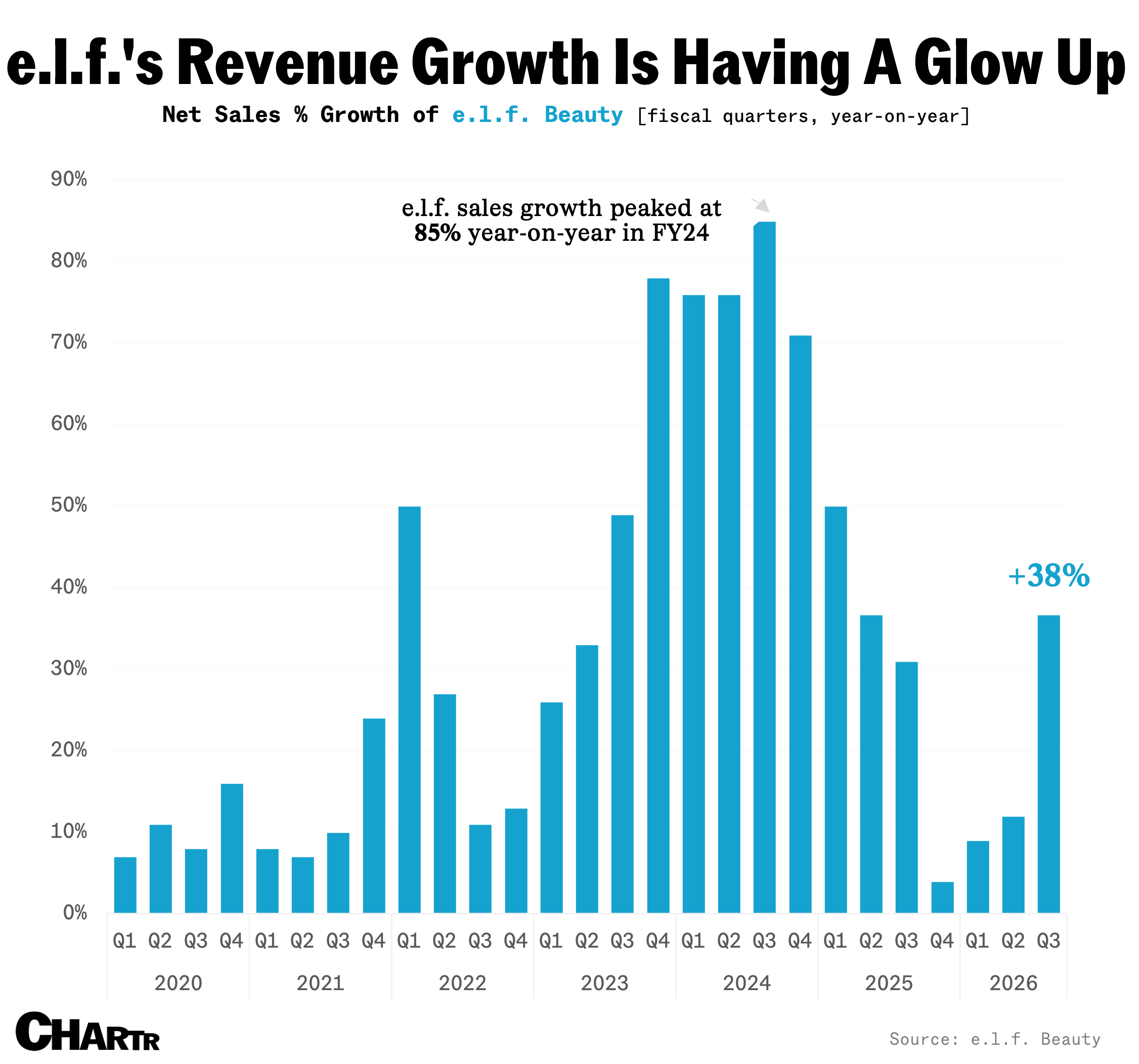
Mandy Fields: Yeah, we’re very pleased with this quarter’s results. We’re reporting 38% net sales growth and 79% growth in adjusted EBITDA, which is very impressive. This is our 28th consecutive quarter of net sales and market share growth. And really, no other beauty company has been able to deliver such share gains, so we’re very proud of that.
Sherwood: Last year’s big news was the rhode acquisition. How’s that going? Do you still expect rhode to grow 40% during this fiscal year?
Fields: We’re actually raising our estimates this quarter on net sales and adjusted EBITDA, and we’re also raising estimates on rhode specifically. Previously we said about 40% growth for rhode — now we expect to see about 70% growth on an annualized basis. They delivered $128 million to the quarter, and our prior expectation was for about $200 million of net sales contribution to our fiscal year. Now we’ve raised that to $260 million to $265 million. We’re very pleased with what we’re seeing out of rhode.
Sherwood: Zooming out from rhode, do you see any other major acquisitions on the horizon? How you think about allocating capital for organic versus inorganic growth?
Fields: We have been very judicious on the acquisition front. We’ve really only had two acquisitions of size: Naturium a few years ago, and then just rhode, which closed back in August. So that’s what you’re going to continue to see us be focused on — our existing portfolio of brands — and if we happen to find another rhode, we’d be happy to add it to our portfolio. But really we’re going to stay focused on driving the growth in our brands that we have today.
Sherwood: Going back to earnings, I want to focus on e.l.f.’s big marketing focus, with what the company describes is a “disruptive marketing engine.” You’ve also said that you’re prioritizing your marketing spend on the latter half of the fiscal year. What are some marketing priorities for the remaining year?
Fields: We’re maintaining our outlook on marketing spend, so we have said that we would spend about 24% to 26% of net sales behind marketing.
You’ve seen the incredible marketing engine that we have. I mean, just to start this year: our collaboration with Liquid Death; the collaboration with H&M with fragrances; the Super Bowl ad that is now out in the public with Melissa McCarthy and really speaking to our Hispanic demographic.
We continue to stay at the center of culture when it comes to our marketing. We want to move at the speed of culture, so that’s what you’ll see a lot from our marketing efforts. And the ROIs that we’re seeing on our marketing are incredible, and it would tell us that we should continue to spend on marketing.
Sherwood: I also want to look at how e.l.f. has maintained this really good relationship with Target. Especially with the price increase recently, how are consumers at these types of big-box retailers reacting, and how are the retailers themselves reacting?
Fields: Target is our longest-standing retailer. We’re the top beauty brand in Target, so we’re the No. 1 brand that’s sold in Target, and they are a great partner to us.
As we look and see, consumers have just become more choiceful with how they’re spending their dollars. And the great news is they continue to choose e.l.f. — even after our one-dollar price increase that we took in August, 75% of our portfolio is at $10 or less.
Our value proposition is consistent across retailers, whether you shop at Target, Dollar General, Walmart, drug channels — our pricing is all the same. So what we’ve seen from an elasticity standpoint is around a mid-single-digit decline in units, but we took about a 15% price increase, so relatively inelastic if you think about it from that perspective.
Sherwood: On your point about how you keep the same strategy across different retailers, from Dollar General to others, could you talk a bit more about how this actually works?
Fields: The thing that is so special about e.l.f. is that we are one of — we might be the only brand, I haven’t fact-checked that — that can be sold in a Dollar General and a Sephora. We have such elasticity across the consumer base, because our mission is to make the best of beauty accessible. So whether you’re shopping at Dollar General or in any of our Sephora stores down in Mexico or in the GCC, that’s what we really focus on: this everyday value, these accessible price points, and just jaw-dropping value on prestige quality items.
Note: The GCC is the Gulf Cooperation Council, a region consisting of six countries — Bahrain, Kuwait, Oman, Qatar, Saudi Arabia, and the United Arab Emirates.
Sherwood: Talking about the GCC, obviously e.l.f. has done great across international channels, but last quarter it softened slightly. This quarter it looks like it has recovered a bit?
Fields: Yeah. International remains a big growth driver and key area of white space for the company. About 20% of our sales are outside of the US today, so that means there is a phenomenal opportunity for us to go after additional markets.
The great thing that we have observed is that, before we even enter these countries, the consumers are already on social media asking for our products in those markets, so that demonstrates the opportunity that we have ahead of us. And now we have a portfolio of brands that we can take internationally with rhode and Naturium, so we really have a lot of ambition internationally.
Germany and the UK have been a little bit of a headwind for us — just a little bit more of a price-competitive environment, value-seeking from a promotion standpoint. But all other international markets have remained quite strong for us. We delivered 44% growth in international sales this quarter.
Sherwood: That’s impressive. Last question: quarter across quarter, you emphasize growth in your earnings calls. Could you share some big plans for growth in the future?
Fields: Yeah. So we have three key areas of growth ahead of us. One is in color cosmetics. We are currently the No. 2 brand in color cosmetics and we want that No. 1 spot, so we’re going to continue to chip away at getting into the No. 1 spot with color cosmetics. Skin care has been a portfolio priority, so you can see with the acquisitions of Naturium and rhode and with our own e.l.f. Skin, we’ve continued to make progress in skin care. And you’ll continue to hear us talk about growth plans there. Then internationally, which we just spoke about, remains a key growth driver for the company.