
Business
Crocs: How the footwear brand turned its business around

Crocs: How the footwear brand turned its business around

Crocs: How the footwear brand turned its business around

Crocs (footwear brand, not the animal) had a really good year. The brand with a distinctive style, known for their foam clogs and sandals, sold just under $1.4bn of shoes last year. That marks Crocs third straight year of revenue growth, revitalising a company that looked like it was in trouble in 2017.

Forget Amazon, Microsoft, Google, Facebook or Apple — if you'd correctly predicted Crocs would make a comeback and bought shares in them at the start of 2017 you'd have made more than 10x on your money, more than what you would have made from owning shares in any of those 5 tech companies over the same time frame.

Make Crocs cool... again(?)

Uncool can become cool, and vice versa, very quickly in the fashion world. No better example is in 2017 when luxury fashion brand Balenciaga sent a model down the runway in huge platform Crocs, fully embracing the clunky ugliness — and selling out of $850 pairs of similar platform Crocs by Feb 2018.

It's probably a stretch to say that a few fashion shows are entirely responsible for turning the brand around but they underpin a strategy at Crocs that has been in motion since new CEO Andrew Rees took the reins halfway through 2017. Collaborations with celebrities, influencers and limited edition "drops" of custom Crocs have all helped the company engage with younger buyers and turned the clunky design of the main clog into an asset.
Crocs: How the footwear brand turned its business around

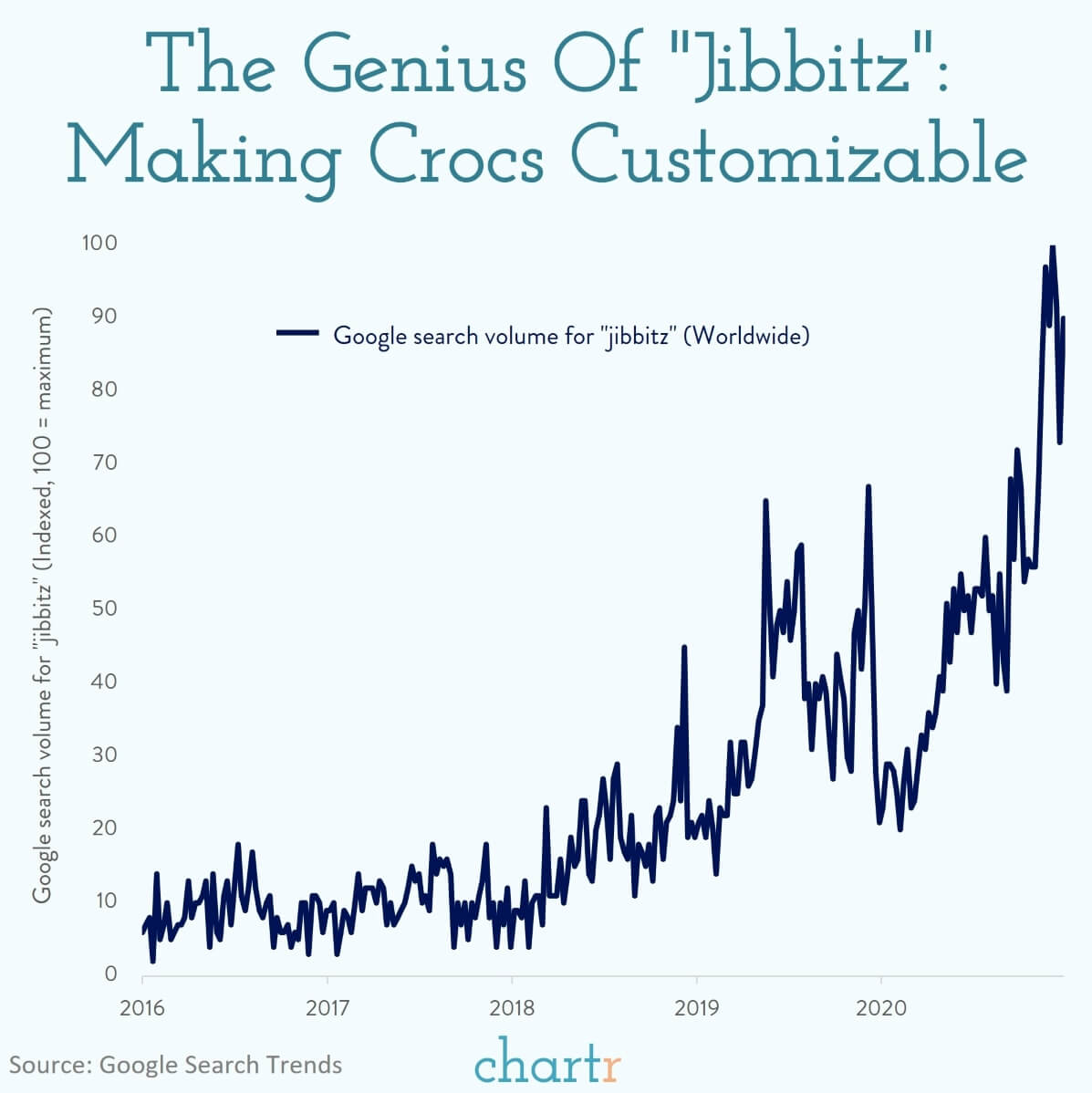
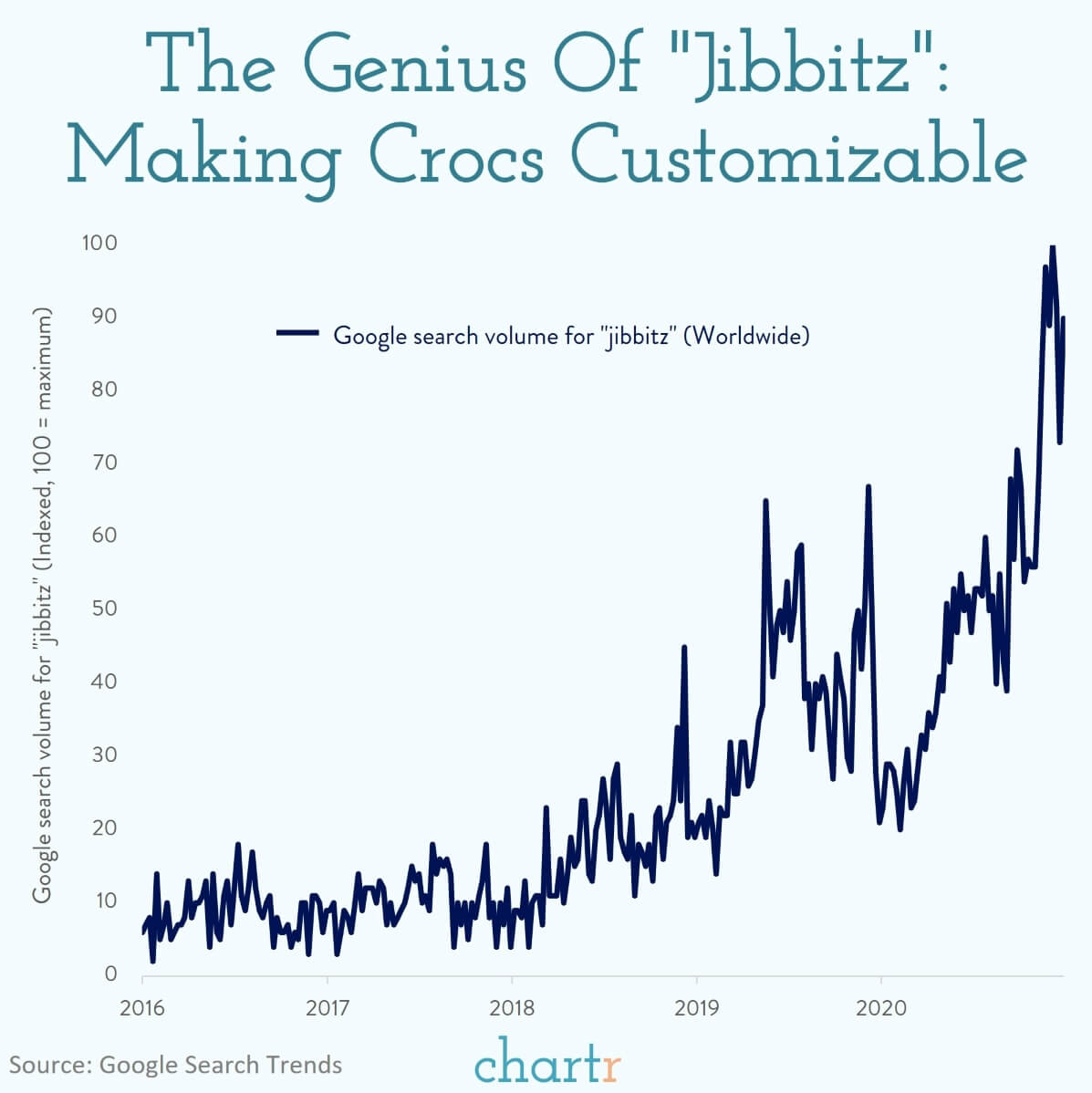
The new marketing effort came with ancillary benefits for Crocs as well. Back in 2006 the company had acquired Jibbitz, which make little charms that you can stick onto your Crocs (through all those holes they have on them) to let you customize them. It's easier just to show you rather than explain what they look like at this point — but buyers absolutely loved them. As Crocs got more popular with younger customers, they wanted to stamp their own style onto them — and search interest for Jibbitz has exploded accordingly.

A year to be comfy

Of course, it's easy to forget amidst all of this marketing hype that Crocs main feature remains the fact that they are just insanely comfy. Indeed, there's certainly a strong argument to be made that if any shoe was going to thrive in a global pandemic it was going to be one that was really comfortable, even if you didn't love the look. No-one is looking at your shoes on Zoom.

More Business

See all Business
Family Watching Baseball On Tv

Netflix and Disney+ probably only added ad-tier subscribers this year, says Morgan Stanley

As streaming prices climb, ad-free subscribers are becoming a rarity.

Aldi Grand Opening

Discount stores are having a moment in America, drawing high- and low-income consumers alike

Everyone loves a deal in 2025 — and Aldi, Walmart, and Dollar Tree are all cashing in.

Millie Giles12/17/25
business

Report: OpenAI won’t pay a dime in cash for its 3-year licensing deal for Disney IP

More financial details behind the landmark deal that will grant OpenAI three years of access to Disney intellectual property are coming out, and they’re pretty surprising.

The deal will reportedly see OpenAI pay zero dollars in licensing fees, instead compensating Disney in stock warrants. It was previously reported that Disney would invest $1 billion into OpenAI as part of the agreement.

It’s very abnormal for Disney to grant anyone access to its massive IP library without a cash payment, and the entertainment juggernaut has been known to strike down even crocheted Etsy Yodas for infringing on its turf. In its fiscal year 2025, Disney booked more than $10 billion in revenue from licensing fees across merchandising, television, and theatrical distribution.

It’s very abnormal for Disney to grant anyone access to its massive IP library without a cash payment, and the entertainment juggernaut has been known to strike down even crocheted Etsy Yodas for infringing on its turf. In its fiscal year 2025, Disney booked more than $10 billion in revenue from licensing fees across merchandising, television, and theatrical distribution.

business

Ford says it will take $19.5 billion in charges in a massive EV write-down

The EV business has marked a long stretch of losing for Ford, and today the automaker announced it will take $19.5 billion in charges tied, for the most part, to its EV division.

Ford said it’s launching a battery energy storage business, leveraging battery plants in Kentucky and Michigan to “provide solutions for energy infrastructure and growing data center demand.”

According to Ford, the changes will drive Ford’s electrified division to profitability by 2029. The company will stop making its electric F-150, the Lightning, and instead shift to an “extended-range electric vehicle” that includes a gas-powered generator.

The Detroit automaker also raised its adjusted earnings before interest and taxes outlook to “about $7 billion” from a range of $6 billion to $6.5 billion.

Ford’s write-down is one of the largest taken by a company as legacy automakers scale back on EVs, giving EV-only automakers a market share boost.

Latest Stories

Sherwood Media, LLC produces fresh and unique perspectives on topical financial news and is a fully owned subsidiary of Robinhood Markets, Inc., and any views expressed here do not necessarily reflect the views of any other Robinhood affiliate, including Robinhood Markets, Inc., Robinhood Financial LLC, Robinhood Securities, LLC, Robinhood Crypto, LLC, or Robinhood Money, LLC.
