Business
Empty glass of guinness on pub table
(Bryn Colton/Getty Images)
closing out

Diageo is considering selling parts of its struggling China business

The Guinness and Johnnie Walker giant has its work cut out in the nation, where drinking has sunk since 2015.

Tom Jones

According to recent Bloomberg reporting, Diageo — the beverage behemoth that counts Guinness, Johnnie Walker whisky, Don Julio tequila, and more in its expansive drinks cabinet — is mulling the options for its assets in China, including potentially selling them off.

Cheers, China

The rumored move comes roughly two weeks into the tenure of new CEO Sir David Lewis, known colloquially by the British press as “Drastic Dave,” owing to his severe turnaround efforts in executive positions at companies like Unilever and UK supermarket Tesco. Under Lewis’ leadership, Diageo is looking to trim its global portfolio. China, a market that the drinks maker pointed to for dragging down net sales by around 2.5% in its first quarter of FY26, seems like quite a sensible place to start.

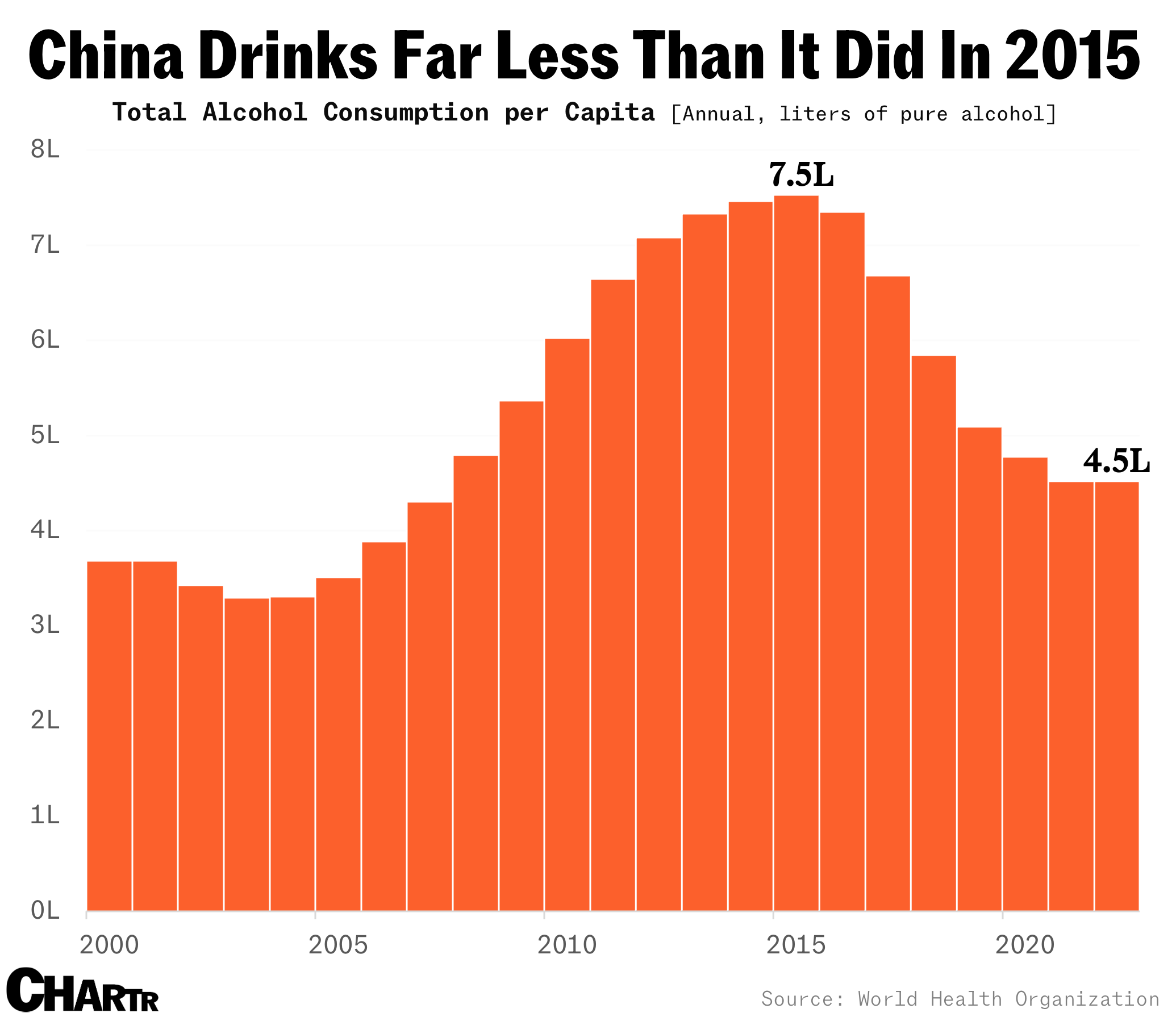
The fact that nationals don’t seem to be drinking nearly as much as they did 10 years ago probably hasn’t helped Diageo’s China plight, either.
China alcohol consumption chart
Sherwood News

Though Diageo specifically singled out declining consumption of Chinese white spirit, or Baijiu, the country’s 5,000-year-old national alcoholic beverage of choice, to explain slumping sales in the region, China’s alcohol consumption rates more broadly have been slipping in recent years. Per figures from the World Health Organization, the average Chinese person over 15 drank the equivalent of 7.53 liters of pure alcohol in 2015; in 2022, the latest year the health body has numbers for, that consumption rate had shrunk to just 4.52 liters.

One recent study of China’s drinking drop-off picked out public health campaigns, stricter taxes and market regulations, shifting demographics, and more stringent government policies — just last summer the state cracked down on government workers drinking at official engagements as part of a wider “anti-extravagance” movement — as key contributors to the national decline.

More Business

See all Business
business

The Trump administration is reportedly planning a 50% made-in-America requirement for USMCA tariff relief

Qualifying for USMCA-related lower tariffs may soon require more US-made vehicle components, according to reporting by The Wall Street Journal.

The Trump administration is reportedly planning to introduce a 50% US content requirement for vehicles covered by the trade pact to receive lower tariffs. The content would be measured by cost, according to the WSJ.

There currently isn’t any US-specific requirement for those lower tariff rates, but in order to receive preferential tariffs, vehicles are must contain at least 75% regional content (components made in North America). Per Reuters reporting, the Trump admin is seeking to raise the regional requirement to 82%.

These reported plans are subject to change as the US negotiates USMCA terms with Mexico over the next few months.

Overall, Tesla will likely have the easiest time qualifying for any stricter requirements. The automaker’s vehicles contained the highest amount of US/Canadian content in 2025, according to American University research. Ford, GM, and Stellantis all scored lower.

Notably: the underlying government data that many domestic content measurements rely on intentionally combines US and Canadian components, so it’s difficult to know exactly how much of any given vehicle is specifically US-made.

There currently isn’t any US-specific requirement for those lower tariff rates, but in order to receive preferential tariffs, vehicles are must contain at least 75% regional content (components made in North America). Per Reuters reporting, the Trump admin is seeking to raise the regional requirement to 82%.

These reported plans are subject to change as the US negotiates USMCA terms with Mexico over the next few months.

Overall, Tesla will likely have the easiest time qualifying for any stricter requirements. The automaker’s vehicles contained the highest amount of US/Canadian content in 2025, according to American University research. Ford, GM, and Stellantis all scored lower.

Notably: the underlying government data that many domestic content measurements rely on intentionally combines US and Canadian components, so it’s difficult to know exactly how much of any given vehicle is specifically US-made.

business
Tom Jones

The $640,000 Luce makes the average Ferrari look like a bargain

Put aside the shape; put aside the smoothing out of Ferrari’s iconic sharp edges; put aside, even, the calls from former Chairman and President Luca Cordero di Montezemolo to “take the Prancing Horse off.” On the grounds of price alone, Luce detractors might have a point.

By now, many of us will have read the criticisms of Ferrari’s first fully electric vehicle, as the Luce — which was unveiled to the world earlier this week and promptly saw the company’s shares crash out in New York and Milan — gets subtly shaded by competitors online and not-so-subtly shaded by basically everyone else.

What makes all of this worse for Ferrari is that, even by the luxury car maker’s notoriously high standards, they’ve slapped a pretty hefty price tag on the Luce, and the company’s CEO, Benedetto Vigna, has already been forced to defend the €550,000 ($640,000) price point, saying yesterday that it’s “fair to pay for innovation,” per Reuters.

While Ferrari’s cars have been getting more expensive of late, as recently as 2022, Ferrari’s average revenue per car sold was around $340,000. At nearly twice that price, this new electric model is obviously proving a little much (visually, conceptually, and financially) for many loyal and long-standing fans of the Prancing Horse to stomach.

Ferrari Luce cost chart
Sherwood News

By now, many of us will have read the criticisms of Ferrari’s first fully electric vehicle, as the Luce — which was unveiled to the world earlier this week and promptly saw the company’s shares crash out in New York and Milan — gets subtly shaded by competitors online and not-so-subtly shaded by basically everyone else.

What makes all of this worse for Ferrari is that, even by the luxury car maker’s notoriously high standards, they’ve slapped a pretty hefty price tag on the Luce, and the company’s CEO, Benedetto Vigna, has already been forced to defend the €550,000 ($640,000) price point, saying yesterday that it’s “fair to pay for innovation,” per Reuters.

While Ferrari’s cars have been getting more expensive of late, as recently as 2022, Ferrari’s average revenue per car sold was around $340,000. At nearly twice that price, this new electric model is obviously proving a little much (visually, conceptually, and financially) for many loyal and long-standing fans of the Prancing Horse to stomach.

Ferrari Luce cost chart
Sherwood News

Latest Stories

Sherwood Media, LLC and Chartr Limited produce fresh and unique perspectives on topical financial news and are fully owned subsidiaries of Robinhood Markets, Inc., and any views expressed here do not necessarily reflect the views of any other Robinhood affiliate, including Robinhood Markets, Inc., Robinhood Financial LLC, Robinhood Securities, LLC, Robinhood Crypto, LLC, Robinhood Money, LLC, Robinhood U.K. Ltd, Robinhood Derivatives, LLC, Robinhood Gold, LLC, Robinhood Asset Management, LLC, Robinhood Credit, Inc., Robinhood Ventures DE, LLC and, where applicable, its managed investment vehicles.