Business
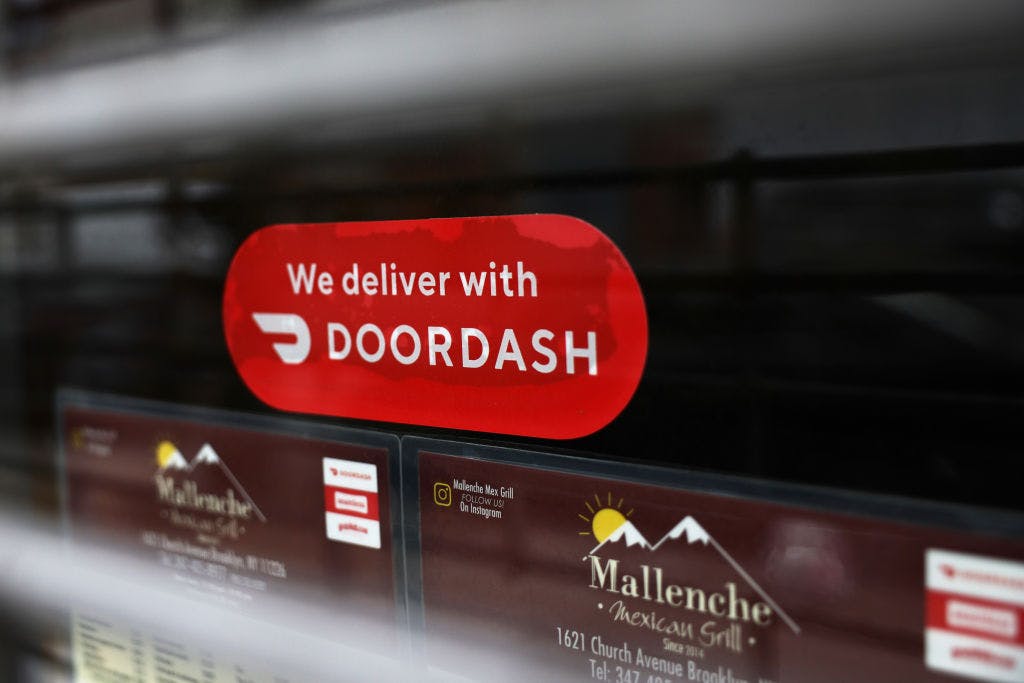
DoorDash sticker on door
(Michael M. Santiago/Getty Images)

DoorDash took $80 billion in orders and subscriptions in 2024, but still operated at a loss

What’s eating all the profits?

Tom Jones, David Crowther
2/12/25 11:58AM

Much of the discourse around “private burrito taxi” economics, which crops up every six months when people get really bored on Twitter, suggests that the companies bringing us our expensive (but convenient) goods must be making a fortune from our everything-now appetites. In DoorDash’s case, though, profit has proved tricky to deliver.

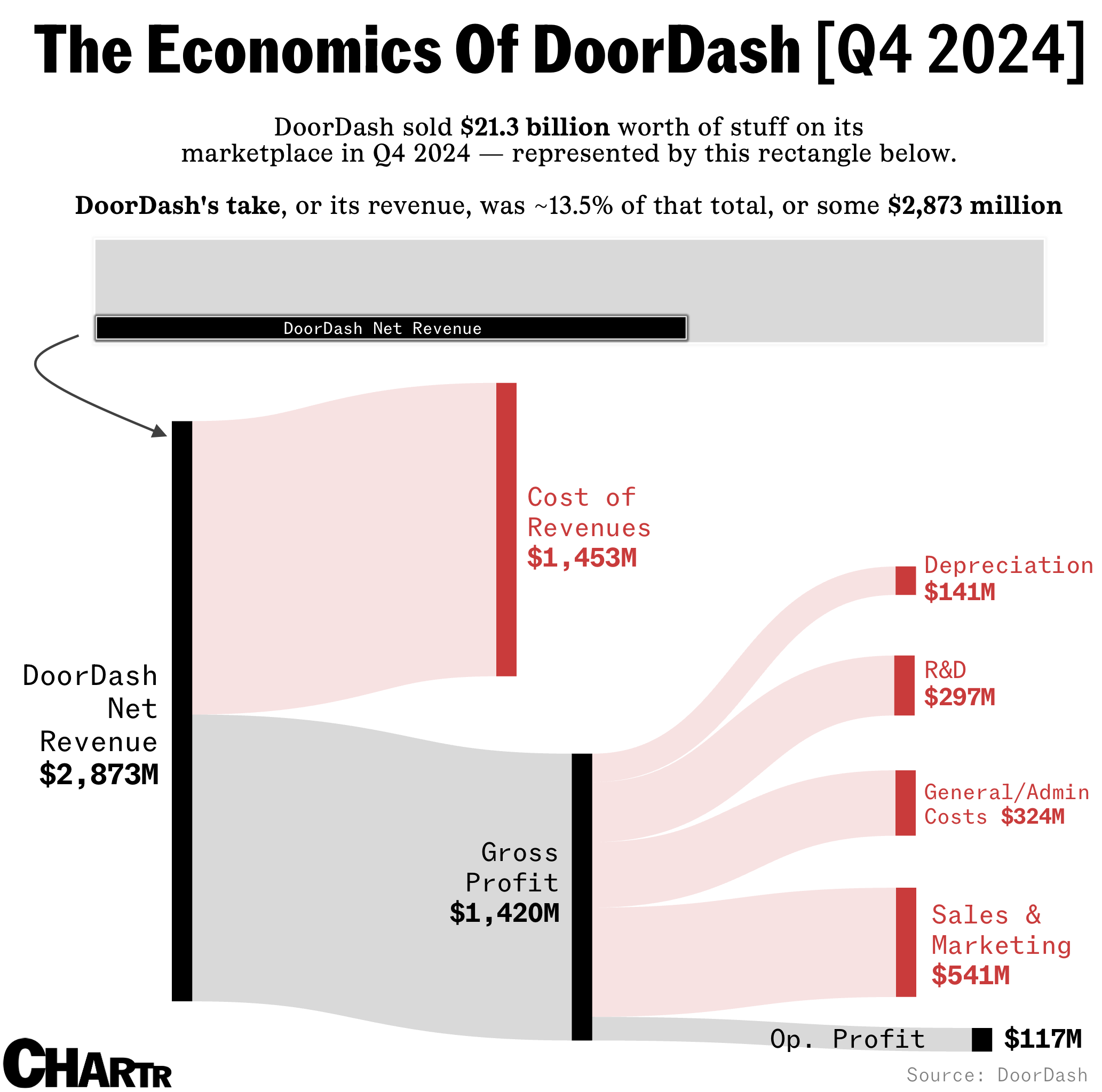
In the last quarter alone, DoorDash took almost $21.3 billion in subscription fees and deliveries — from essentials picked at the local grocery store to booze and take-out burgers — bringing its gross order value for the year to ~$80.2 billion.

After the restaurants, shops, and drivers took their share of the total order figure, DoorDash posted some $10.7 billion in revenues in 2024, but still operated at a $38 million loss through the year. Even in Q4 specifically, when the company did turn an operating profit, it was pretty miniscule, at just over 4% of revenues. All of this begs the question: who, or what, is devouring DoorDash’s profits?
DoorDash Economics
Sherwood News

Big bites

Sales & Marketing was one of DoorDash’s biggest outlays in 2024, at more than $2 billion for the year and some $541 million in Q4 (those 30-second Super Bowl ad slots don’t come cheap), while the company also racked up ~$100 million Research & Development spend each month as it upped efforts to increase the range of stuff you can get directly to your door. 

While the bottom line understandably remains a key concern for DoorDash investors, with total operating losses in the region of $3.25 billion over the last five years, the absence of enormous profits isn’t hurting the stock this morning — shares are up about 2% in early trading, thanks to its better-than-expected Q4.

Interestingly, DoorDash delivery drivers who worked the Super Bowl shift earned over $50 million across the US this year, with Philly-based Dashers alone taking $390,000, per data shared with Axios.


More Business

See all Business
$1T

Tesla jumped more than 2% premarket on Friday after the company proposed an unprecedented roughly $1 trillion pay package for CEO Elon Musk, according to proxy filings.

To receive the massive payout, Musk will have to increase the company’s market cap to $8.5 trillion from the approximately $1 trillion it is today over the next 10 years.

The pay package also requires that Musk expand Tesla’s product offerings to include 1 million Robotaxis in commercial operation and the “delivery of 1 million AI Bots.” Currently the company has about 30 autonomous robotaxis in its invite-only Austin ride-hailing service, though this week the company expanded the waitlist for the service to everyone. Tesla's Optimus robots are still under development.

Musk would also have to take part in his own succession planning and develop a framework for who’s to follow him.

Investors have historically tied the fate of Tesla with Musk, so holding on to him for an extended period of time and having his blessing for the succession plan is typically seen as good news for the stock.

“We believe that Elon’s singular vision is vital to navigating this critical inflection point,” the filing reads. “Simply put, retaining and incentivizing Elon is fundamental to Tesla achieving these goals and becoming the most valuable company in history.”

A judge twice struck down Musk’s previous $56 billion compensation package. Last month the board approved a $30 billion interim pay package, saying that “retaining Elon is more important than ever.”

Shareholders will vote on the pay package at their annual meeting on November 6.

Old Navy store on 34th street in New York City, U.S.

Gap pops as the denim giant takes a big swing into beauty and accessories

The retailer is piloting beauty through shop-in-shops at Old Navy before rolling it out to Gap stores next year.

business

JetBlue boosts its third-quarter revenue forecast after strong late summer travel demand

Empty August offices gave JetBlue a boost, and the carrier on Thursday announced improved guidance for its current quarter.

The carrier now expects operating revenue per available seat mile to decline between 1.5% and 4% in the third quarter, an improvement from its previous forecast that it would drop between 2% and 6%. JetBlue also lifted the floor on its capacity guidance, from a 1% drop to flat.

“Momentum from earlier in the summer carried forward into August and through the Labor Day holiday, both of which were marked by strength for bookings,” the company said.

JetBlue posted an earnings beat in its second quarter, though it reported its fourth straight quarterly net loss. The carrier has made a profit in just four out of its last 14 quarters.

The company on Thursday also announced a new deal with Amazon to adopt its Project Kuiper satellite broadband network to power in-flight Wi-Fi on some planes beginning in 2027.

business

EVs power Ford to its sixth straight month of sales growth as tax credits wind down

Ford sales grew 3.9% year over year in August, the automaker’s sixth consecutive month of US growth.

Electric vehicles, which saw more than 19% sales growth on the month, led the charge, while hybrid sales climbed by more than 14%. Buyers have rushed to scoop up electric vehicles ahead of the end of the $7,500 EV tax credit, which was scrapped as part of the Trump administration’s One Big Beautiful Bill Act and ends after September 30.

About half of Ford EV owners said they wouldn’t have bought their vehicle without the credit, according to recent survey data. Despite the August boost, Ford EV sales are still down from last year eight months into the year.

Ford’s EV growth comes as the company has shifted its electric production strategy, leaving the single assembly line behind to speed up manufacturing and utilize fewer workers. Last month, the company announced that the first vehicle built through its new system will be an electric truck starting at $30,000.

Fast Food Restaurant McDonald's

McDonald’s is bringing the value back to value meals — but Wall Street is watching

The Big Mac maker is leaning back into value deals as traffic cools and Goldman bets on a rebound.

Latest Stories

Sherwood Media, LLC produces fresh and unique perspectives on topical financial news and is a fully owned subsidiary of Robinhood Markets, Inc., and any views expressed here do not necessarily reflect the views of any other Robinhood affiliate, including Robinhood Markets, Inc., Robinhood Financial LLC, Robinhood Securities, LLC, Robinhood Crypto, LLC, or Robinhood Money, LLC.