
Business
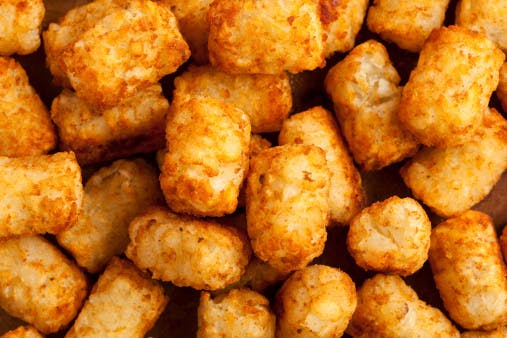
Organic Fried Tater Tots
(Getty Images)

Did Big Potato collude to keep tater tots expensive? One grocery store thinks so

Prices for frozen potato products have shot up, but one chart casts doubt on price-gouging accusations.

Four of the companies that control most of the country’s frozen-potato supply have been accused of brokering backdoor deals to keep their products expensive.

In a lawsuit filed last week, a Pennsylvania-based small grocery chain, Redner’s Markets, said a small group of companies that sell products like hash browns and tater tots colluded to artificially inflate prices starting in 2021. These companies — Cavendish Farms, Lamb Weston, McCain Foods, and the JR Simplot Company — control nearly all of the $68 billion frozen-potato market.

It’s true that the price of frozen potato products has skyrocketed and stayed high relative to other products, according to the Bureau of Labor Statistics Producer Price Index.

This is how the scheme went down, Redners alleges: the potato processors saw their costs shoot up in 2021, so they rose prices, but in 2022 when their costs started coming down, they all agreed to keep their prices high and pocket the wider margin.

Lamb Weston is the only company from the group that is publicly traded. As such, it’s the only one that allows us a peek under the hood. 

Looking at their financials, it’s clear that there was a shift after the pandemic, which is true for most companies. Its profit margins declined in 2020, 2021, and 2022. But after that, they jumped back up to over 25%, just over where they were before the pandemic. 

The company has said that its faced rising costs of production — the raw potatoes and labor are more expensive than they used to be. Their costs did go up, and so did their sales.

Lamb Westons financial results alone are by no means a clear indication whether price fixing or price gouging is taking place or not. But on its face, at least for this specific company, there doesnt seem to be a smoking gun.

In a statement to Sherwood, a Lamb Weston spokesperson said they believe the claims are without merit and intend to vigorously defend our position. Cavendish Farms, McCain Foods, and the JR Simplot Company did not immediately respond to requests for comment.

More Business

See all Business
Family Watching Baseball On Tv

Netflix and Disney+ probably only added ad-tier subscribers this year, says Morgan Stanley

As streaming prices climb, ad-free subscribers are becoming a rarity.

Aldi Grand Opening

Discount stores are having a moment in America, drawing high- and low-income consumers alike

Everyone loves a deal in 2025 — and Aldi, Walmart, and Dollar Tree are all cashing in.

Millie Giles12/17/25
business

Report: OpenAI won’t pay a dime in cash for its 3-year licensing deal for Disney IP

More financial details behind the landmark deal that will grant OpenAI three years of access to Disney intellectual property are coming out, and they’re pretty surprising.

The deal will reportedly see OpenAI pay zero dollars in licensing fees, instead compensating Disney in stock warrants. It was previously reported that Disney would invest $1 billion into OpenAI as part of the agreement.

It’s very abnormal for Disney to grant anyone access to its massive IP library without a cash payment, and the entertainment juggernaut has been known to strike down even crocheted Etsy Yodas for infringing on its turf. In its fiscal year 2025, Disney booked more than $10 billion in revenue from licensing fees across merchandising, television, and theatrical distribution.

It’s very abnormal for Disney to grant anyone access to its massive IP library without a cash payment, and the entertainment juggernaut has been known to strike down even crocheted Etsy Yodas for infringing on its turf. In its fiscal year 2025, Disney booked more than $10 billion in revenue from licensing fees across merchandising, television, and theatrical distribution.

business

Ford says it will take $19.5 billion in charges in a massive EV write-down

The EV business has marked a long stretch of losing for Ford, and today the automaker announced it will take $19.5 billion in charges tied, for the most part, to its EV division.

Ford said it’s launching a battery energy storage business, leveraging battery plants in Kentucky and Michigan to “provide solutions for energy infrastructure and growing data center demand.”

According to Ford, the changes will drive Ford’s electrified division to profitability by 2029. The company will stop making its electric F-150, the Lightning, and instead shift to an “extended-range electric vehicle” that includes a gas-powered generator.

The Detroit automaker also raised its adjusted earnings before interest and taxes outlook to “about $7 billion” from a range of $6 billion to $6.5 billion.

Ford’s write-down is one of the largest taken by a company as legacy automakers scale back on EVs, giving EV-only automakers a market share boost.

Latest Stories

Sherwood Media, LLC produces fresh and unique perspectives on topical financial news and is a fully owned subsidiary of Robinhood Markets, Inc., and any views expressed here do not necessarily reflect the views of any other Robinhood affiliate, including Robinhood Markets, Inc., Robinhood Financial LLC, Robinhood Securities, LLC, Robinhood Crypto, LLC, or Robinhood Money, LLC.
