Business
Electrically powered Harley-Davidson
A woman sits on an electric-powered Harley-Davidson “Livewire One” (Boris Roessler/Getty Images)
NO JUICE

You thought electric cars were having a tough time? Harley-Davidson’s electric bike brand is getting crushed

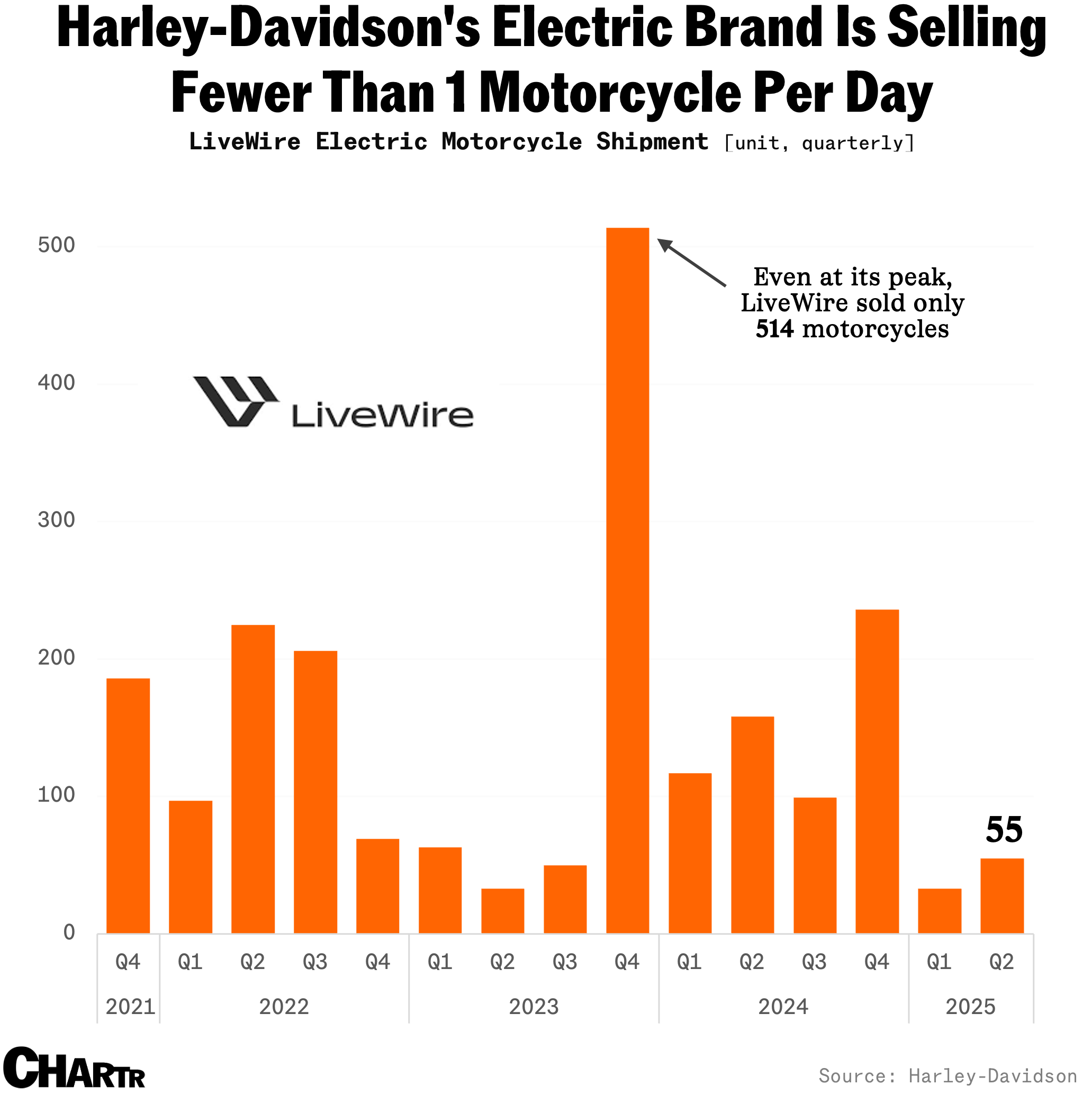
LiveWire wanted to sell 101,000 bikes by 2026 — in the latest quarter they sold 55.

When Harley-Davidson decided to spin off its electric bikes division in 2021, the iconic motorbike maker had high hopes about the new LiveWire business, looking to sell some 101,000 units by 2026.

But despite the legacy automaker’s expertise in all things with two wheels, the electric market is proving to be shockingly tough. In the second quarter, LiveWire sold just 55 electric motorcycles, racking up more than $18 million in operating losses. That works out to fewer than one bike per day.
Harley Davidson's electric brand is struggling
Sherwood News

With Harley still owning a controlling share of LiveWire’s lagging business, those losses are weighing on Harley’s already pressured bottom line.

Back in 2021, when electric vehicle companies were racing to go public through Special Purpose Acquisition Companies (SPACs), Harley-Davidson merged its in-house electric bikes division with a blank check company to bring in a fresh $500 million of external capital through private and SPAC investments. 

Nobody asked for this

The theory was that — unlike eventual SPAC EV tragedies like Lucid Motors (down 75% since IPO) and Nikola (down 99% since IPO) — Harley’s history as a reliable manufacturer would set LiveWire apart from its nascent four-wheeled electric peers, allowing the company to serve the millions of people who, presumably, they thought would want to ride an electric motorbike.

Unfortunately, millions of people ended up being more like hundreds of people. Were Harley-Davidson customers crying out for an electric bike with a combined range of just 95 miles? Probably not.

Interestingly, there is one part of LiveWire’s business that’s thriving: selling electric balance bikes for kids. Indeed, the company’s STACYC brand accounted for ~85% of LiveWire’s revenue, and it grew its sales 25% in the latest quarter, while its electric bike sales for adults dropped 65%.

Harley CEO Jochen Zeitz commented in the first-quarter earnings call that the EV adoption is “just not happening as originally anticipated.” Harley has not made any additional investment agreements into LiveWire since Q1 2024, instead focusing on restructuring its own business: Harley’s stock rose 13% on Wednesday after securing a cash infusion from KKR and Pimco.

More Business

See all Business
Capsule Pill and Dots

Justice Department accuses telehealth Zealthy of fraud, says remedy may bankrupt it

The feds say they don’t think Zealthy has the liquidity to pay what it owes customers.

Netflix playground

Will investing in kids games finally make Netflix Games “the Netflix of games”?

Netflix is launching a game for preschoolers, its latest foray into stuff-you-play instead of stuff-you-watch.

business

American Airlines joins the flock, hiking bag fees amid higher jet fuel prices

American Airlines on Thursday announced that it, too, will be hiking the fees it charges customers to check luggage.

With the move, all four of the major US airlines, which together control about 80% of the US market, have now hiked their baggage fees in recent days amid surging jet fuel prices.

The change will go into effect on tickets bought on or after Thursday, the same day Southwest’s hike begins.

Since late March, JetBlue, Delta Air Lines, United Airlines, Canada’s WestJet, and Southwest have hiked their fees. Experts expect more major carriers to follow, and to potentially tweak the pricing of other ancillary revenue sources like seat assignments and carry-on luggage.

The change will go into effect on tickets bought on or after Thursday, the same day Southwest’s hike begins.

Since late March, JetBlue, Delta Air Lines, United Airlines, Canada’s WestJet, and Southwest have hiked their fees. Experts expect more major carriers to follow, and to potentially tweak the pricing of other ancillary revenue sources like seat assignments and carry-on luggage.

business

Less than a year after implementing them, Southwest is also hiking its bag fees

Southwest Airlines has joined the growing list of airlines opting to hike their bag fees amid sustained higher jet fuel costs.

Starting today, the first checked bag at the carrier — which implemented bag fees less than a year ago — will jump from $35 to $45, and the second from $45 to $55. Southwest quietly disclosed the change Tuesday.

Southwest assigned the decision to “part of an ongoing analysis of the business and against the evolving global backdrop.”

As of Wednesday, jet fuel prices dropped to $4.16 a gallon, per the Argus US Jet Fuel Index, down from $4.81 on Tuesday following President Trump’s ceasefire announcement, which sent travel stocks soaring. Major airlines have shed some of those gains in premarket trading Thursday.

With the move to hike bag fees, Southwest joins JetBlue, United Airlines, Delta Air Lines, and Canada’s WestJet, all of which also boosted fees this month. Experts expect more major carriers to follow, and to potentially tweak the pricing of other ancillary revenue sources like seat assignments and carry-on luggage.

Southwest assigned the decision to “part of an ongoing analysis of the business and against the evolving global backdrop.”

As of Wednesday, jet fuel prices dropped to $4.16 a gallon, per the Argus US Jet Fuel Index, down from $4.81 on Tuesday following President Trump’s ceasefire announcement, which sent travel stocks soaring. Major airlines have shed some of those gains in premarket trading Thursday.

With the move to hike bag fees, Southwest joins JetBlue, United Airlines, Delta Air Lines, and Canada’s WestJet, all of which also boosted fees this month. Experts expect more major carriers to follow, and to potentially tweak the pricing of other ancillary revenue sources like seat assignments and carry-on luggage.

Latest Stories

Sherwood Media, LLC produces fresh and unique perspectives on topical financial news and is a fully owned subsidiary of Robinhood Markets, Inc., and any views expressed here do not necessarily reflect the views of any other Robinhood affiliate, including Robinhood Markets, Inc., Robinhood Financial LLC, Robinhood Securities, LLC, Robinhood Crypto, LLC, Robinhood Derivatives, LLC, or Robinhood Money, LLC. Futures and event contracts are offered through Robinhood Derivatives, LLC.