Business
Middle Man Running on Mountain Road
(Getty Images)
footrace

Hoka running shoes have been right on Ugg’s heels, but growth is slowing and the future looks uncertain

Deckers’ stock dropped after not providing guidance for its coming fiscal year as Hoka sales slow.

Tom Jones

You may have noticed that almost everyone you know is into running now. People pad along sidewalks like never before, share Strava highlights to their stories like nobody’s business, and even use running to find love.

Naturally, that vibe shift has played into the hands (or feet) of one of America’s biggest footwear companies.

Positive splits

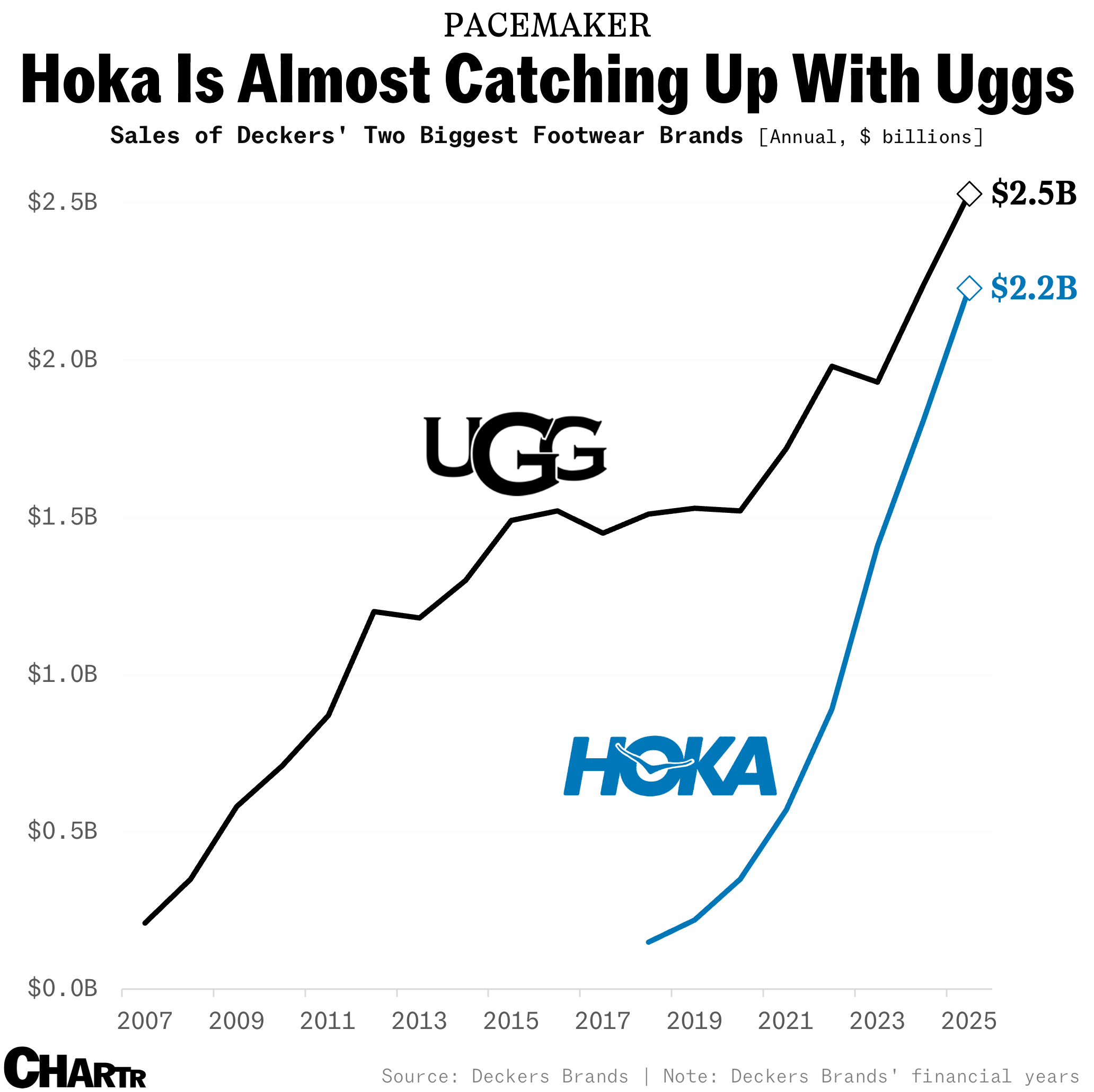
Ugg, the brand best known for its sheepskin, fleece-lined boots, has long occupied the top shelf in the Deckers shoe closet, posting almost $20 billion in revenues over the last 10 years. However, ultra-cushioned running sneaker brand Hoka has sprinted in recent years to almost catch up with Ugg’s bumper sales figures, pulling in $2.23 billion for Deckers Outdoor in the last fiscal year.
Hoka and Ugg sales chart
Sherwood News

Recently, though, the lightning pace Hoka had set is slowing, with annual sales growth dropping from 58% to 28% to 23% in the last three fiscal years. And looking ahead, the trajectory of Deckers’ all-important ascendent brand is uncertain, with the company declining to provide any financial guidance for the coming year in its results, blaming “macroeconomic uncertainty related to evolving global trade policies.” Traders have been dumping the stock in response, which dropped as much as 22% in early trading on Friday.

Alongside Swiss giant On, buzz has built around Hoka in the running community for years now, with mainstream publications now putting out pieces every few months about how the two have come to challenge established names like Nike and Adidas.

Still, with shares down more than 50% so far this year, investors have lost faith in the journey recently.

More Business

See all Business
Luigi Mangione And His Lawyers Attends Hearing In Manhattan Court

Health giants and other S&P 500 companies spent big on executive security in 2025

Major health insurers spent over $3 million on protecting executives last year, as security budgets at S&P 500 companies across various sectors hit new highs.

business

Lucid climbs after Uber revealed to be its second-largest shareholder following recent investment

Shares of luxury EV maker Lucid are up more than 7% in premarket trading on Tuesday, following the release of a regulatory filing that revealed Uber is now its second-largest shareholder, trailing only Saudi Arabia’s PIF sovereign wealth fund.

The news follows an announcement earlier this month that Uber and Lucid would expand their robotaxi partnership from 20,000 planned vehicles to 35,000. Along with the expansion, Uber also said it would invest an additional $200 million into the EV maker.

Per Monday afternoon’s filing, it seems that investment pushed Uber’s ownership stake in Lucid to 11.52%.

Lucid’s stock is down 29% in April. It hit an all-time low of $6.75 on Monday ahead of the regulatory filing becoming public.

In a mark of just how painful the slide has been for Lucid shareholders, as of Monday, the company’s market cap had dropped to a quarter of the approximately $9.5 billion that Saudi Arabia’s PIF has sunk into it.

Latest Stories

Sherwood Media, LLC produces fresh and unique perspectives on topical financial news and is a fully owned subsidiary of Robinhood Markets, Inc., and any views expressed here do not necessarily reflect the views of any other Robinhood affiliate, including Robinhood Markets, Inc., Robinhood Financial LLC, Robinhood Securities, LLC, Robinhood Crypto, LLC, Robinhood Derivatives, LLC, or Robinhood Money, LLC. Futures and event contracts are offered through Robinhood Derivatives, LLC.