
Business
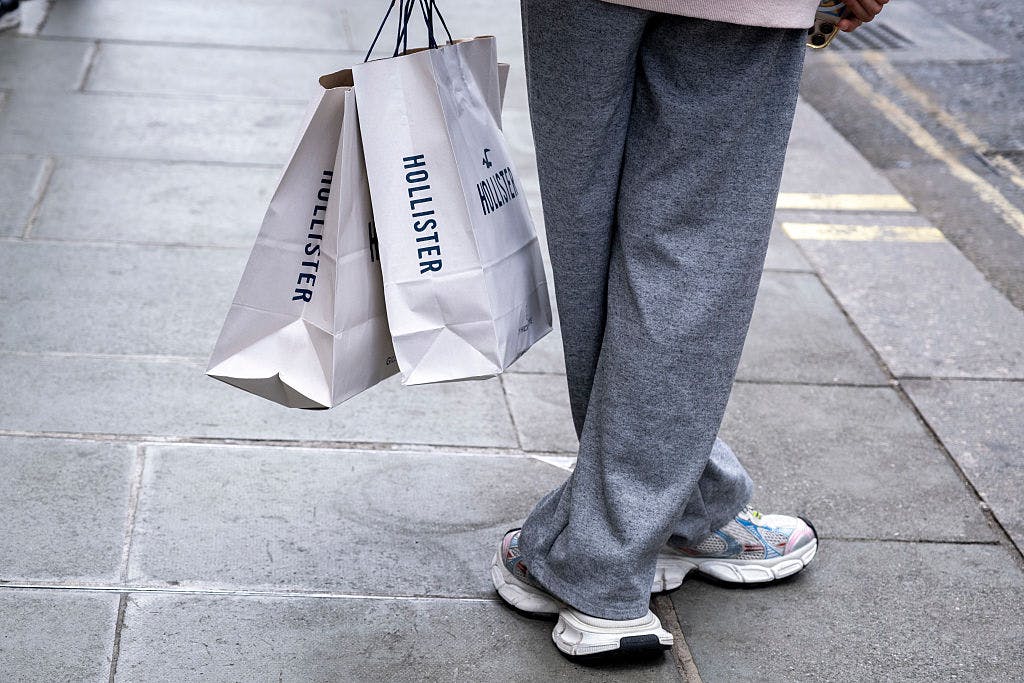
Oxford Street shopper with Hollister bag in London
(Mike Kemp/Getty Images)
millennial core

Hollister is the hottest thing in Abercrombie & Fitch’s wardrobe again

A new Y2K Taco Bell collaboration could spice things up further.

Tom Jones

The stage in life where you start saying, “That was in fashion when I was your age!” sadly comes for us all, as trend cycles continue to spin — spitting everything from iPods and wired headphones to froyo and baggy jeans back into mainstream culture. 

One brand that’s well positioned (and seemingly very willing) to capitalize on this nostalgia-driven appetite for all things 2000s? Hollister, the coastal-inspired mall staple launched by Abercrombie & Fitch at the turn of the millennium.

Aughts to do

Younger consumers might never understand the uniquely jarring sensory experience of walking into a dimly lit Hollister in the 2000s, to be greeted by shirtless male store assistants and blasted by overwhelming pop chart fodder, since the company revamped its stores around the mid-2010s.

But the brand hasn’t ditched all of its heritage, leaning into its roots with a Y2K revival collection in the summer and a new noughties-tinged Taco Bell collab.

It appears to be paying off, too: a day after announcing the new Taco Bell line, Abercrombie & Fitch reported earnings that crushed expectations and sent shares soaring, with Hollister’s growth cementing its position, once again, as the prize item in Abercrombie’s closet.
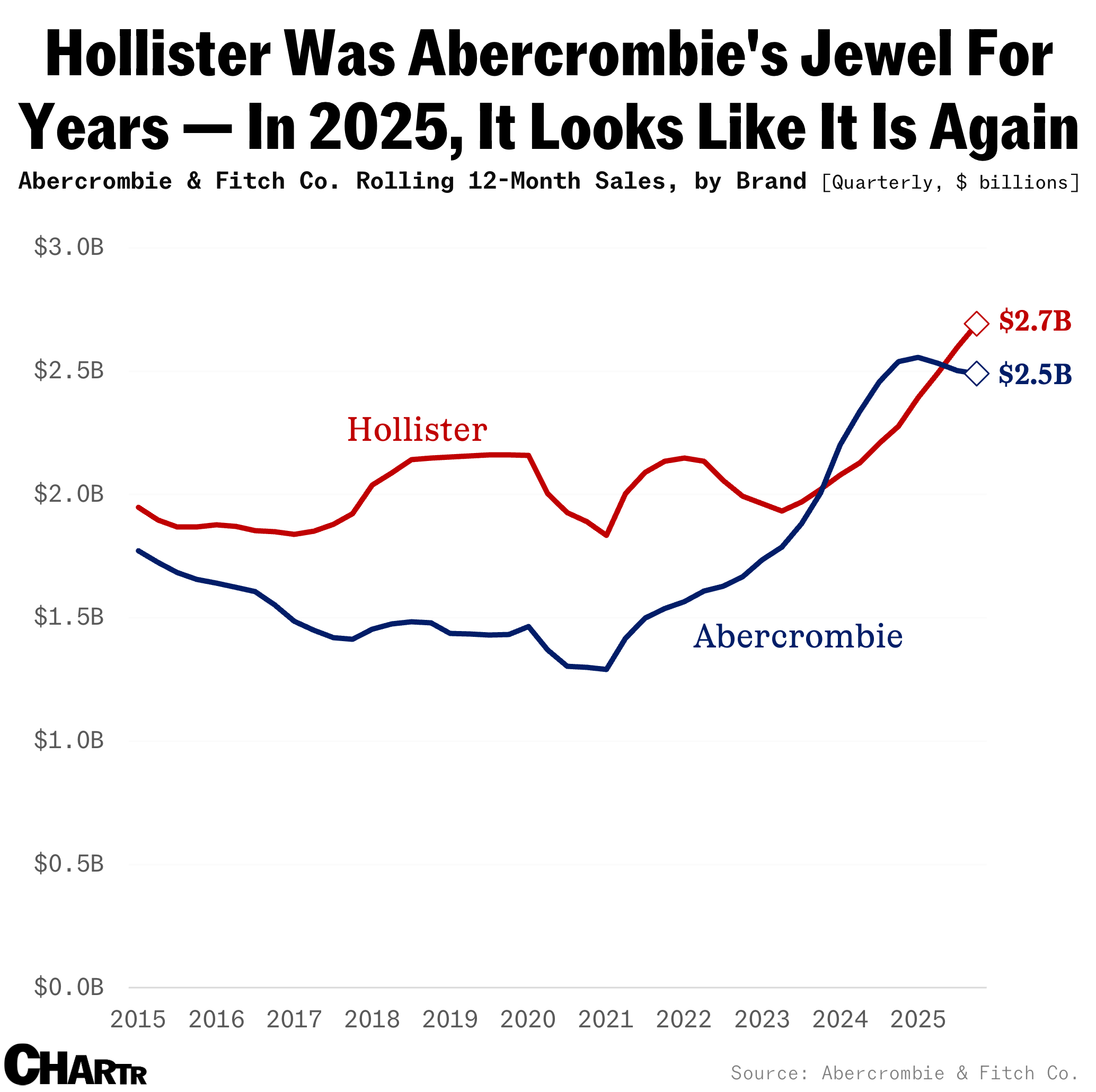
Abercrombie Hollister sales chart
Sherwood News

Hollister and its parent company more broadly have faced the dilemma: do you age your products with the people who liked them initially — ditching teens for millennials who are starting families and buying houses — or stick to your guns and hope you can still appeal to teenagers today?

Between its two biggest brands, A&F has managed to do a bit of both. It’s added more diversified offerings for men’s and women’s wear across Abercrombie; it’s also doubled down on the younger demographic through Hollister, having enlisted Gen Z favorite Benson Boone for a promo campaign and pumped money into influencer programs, cultivating demand for youth-targeted ranges.

With Hollister now the number 1 apparel brand for female teens, disrupting Nikes dominance,” according to a Piper Sandler survey from earlier this year, A&F’s efforts to modernize the brand seem to be working.

More Business

See all Business
business

The Trump administration is reportedly planning a 50% made-in-America requirement for USMCA tariff relief

Qualifying for USMCA-related lower tariffs may soon require more US-made vehicle components, according to reporting by The Wall Street Journal.

The Trump administration is reportedly planning to introduce a 50% US content requirement for vehicles covered by the trade pact to receive lower tariffs. The content would be measured by cost, according to the WSJ.

There currently isn’t any US-specific requirement for those lower tariff rates, but in order to receive preferential tariffs, vehicles are must contain at least 75% regional content (components made in North America). Per Reuters reporting, the Trump admin is seeking to raise the regional requirement to 82%.

These reported plans are subject to change as the US negotiates USMCA terms with Mexico over the next few months.

Overall, Tesla will likely have the easiest time qualifying for any stricter requirements. The automaker’s vehicles contained the highest amount of US/Canadian content in 2025, according to American University research. Ford, GM, and Stellantis all scored lower.

Notably: the underlying government data that many domestic content measurements rely on intentionally combines US and Canadian components, so it’s difficult to know exactly how much of any given vehicle is specifically US-made.

There currently isn’t any US-specific requirement for those lower tariff rates, but in order to receive preferential tariffs, vehicles are must contain at least 75% regional content (components made in North America). Per Reuters reporting, the Trump admin is seeking to raise the regional requirement to 82%.

These reported plans are subject to change as the US negotiates USMCA terms with Mexico over the next few months.

Overall, Tesla will likely have the easiest time qualifying for any stricter requirements. The automaker’s vehicles contained the highest amount of US/Canadian content in 2025, according to American University research. Ford, GM, and Stellantis all scored lower.

Notably: the underlying government data that many domestic content measurements rely on intentionally combines US and Canadian components, so it’s difficult to know exactly how much of any given vehicle is specifically US-made.

business
Tom Jones

The $640,000 Luce makes the average Ferrari look like a bargain

Put aside the shape; put aside the smoothing out of Ferrari’s iconic sharp edges; put aside, even, the calls from former Chairman and President Luca Cordero di Montezemolo to “take the Prancing Horse off.” On the grounds of price alone, Luce detractors might have a point.

By now, many of us will have read the criticisms of Ferrari’s first fully electric vehicle, as the Luce — which was unveiled to the world earlier this week and promptly saw the company’s shares crash out in New York and Milan — gets subtly shaded by competitors online and not-so-subtly shaded by basically everyone else.

What makes all of this worse for Ferrari is that, even by the luxury car maker’s notoriously high standards, they’ve slapped a pretty hefty price tag on the Luce, and the company’s CEO, Benedetto Vigna, has already been forced to defend the €550,000 ($640,000) price point, saying yesterday that it’s “fair to pay for innovation,” per Reuters.

While Ferrari’s cars have been getting more expensive of late, as recently as 2022, Ferrari’s average revenue per car sold was around $340,000. At nearly twice that price, this new electric model is obviously proving a little much (visually, conceptually, and financially) for many loyal and long-standing fans of the Prancing Horse to stomach.

Ferrari Luce cost chart
Sherwood News

By now, many of us will have read the criticisms of Ferrari’s first fully electric vehicle, as the Luce — which was unveiled to the world earlier this week and promptly saw the company’s shares crash out in New York and Milan — gets subtly shaded by competitors online and not-so-subtly shaded by basically everyone else.

What makes all of this worse for Ferrari is that, even by the luxury car maker’s notoriously high standards, they’ve slapped a pretty hefty price tag on the Luce, and the company’s CEO, Benedetto Vigna, has already been forced to defend the €550,000 ($640,000) price point, saying yesterday that it’s “fair to pay for innovation,” per Reuters.

While Ferrari’s cars have been getting more expensive of late, as recently as 2022, Ferrari’s average revenue per car sold was around $340,000. At nearly twice that price, this new electric model is obviously proving a little much (visually, conceptually, and financially) for many loyal and long-standing fans of the Prancing Horse to stomach.

Ferrari Luce cost chart
Sherwood News

Latest Stories

Sherwood Media, LLC and Chartr Limited produce fresh and unique perspectives on topical financial news and are fully owned subsidiaries of Robinhood Markets, Inc., and any views expressed here do not necessarily reflect the views of any other Robinhood affiliate, including Robinhood Markets, Inc., Robinhood Financial LLC, Robinhood Securities, LLC, Robinhood Crypto, LLC, Robinhood Money, LLC, Robinhood U.K. Ltd, Robinhood Derivatives, LLC, Robinhood Gold, LLC, Robinhood Asset Management, LLC, Robinhood Credit, Inc., Robinhood Ventures DE, LLC and, where applicable, its managed investment vehicles.
