
Business
US-COMPUTERS-INTERNET-TECHNOLOGY-CES
An attendee climbs into an autonomous tractor at John Deere’s booth during CES on Jan. 7, 2025 (Ian Maule/AFP via Getty Images)

John Deere wants self-driving tractors to help with America’s farmhand shortage

The 188-year-old agriculture giant is doubling down on its autonomous range.

Oh, Deere

The largest farming-equipment manufacturer in the world, John Deere, unveiled a new crop of autonomous tractors and trucks at CES 2025 earlier this week, as the heavy-machinery giant looks to capitalize on the buzz around all things self-driving.

If your immediate thought is that this sounds like a job killer... it is. John Deere has talked up its machines’ capabilities for precisely that purpose: to help alleviate some of the labor-shortage issues that farming faces, with the company’s chief technology officer, Jahmy Hindman, saying that “there is not enough available and skilled labor” to do the kind of agricultural and construction work that its customers do.

Though John Deere introduced its first fully autonomous tractor three years ago, the latest suite — which includes a couple of tractors, a lawnmower for commercial landscaping, and a driverless dump truck — comes plowing into a world where attitudes toward self-driving vehicles have softened.

Whether John Deere’s goal for fully autonomous farming by 2030 — outlined in a September blog post from Nvidia (we know: AI royalty Nvidia proudly touting its collaboration with a lowly multibillion-dollar minnow like JD rather than the other way around? Who’d have thought it?) — comes to fruition or not, the company will hope the new fleet reinvigorates sales after a slightly fallow year.
John Deere Revenue
Sherwood News

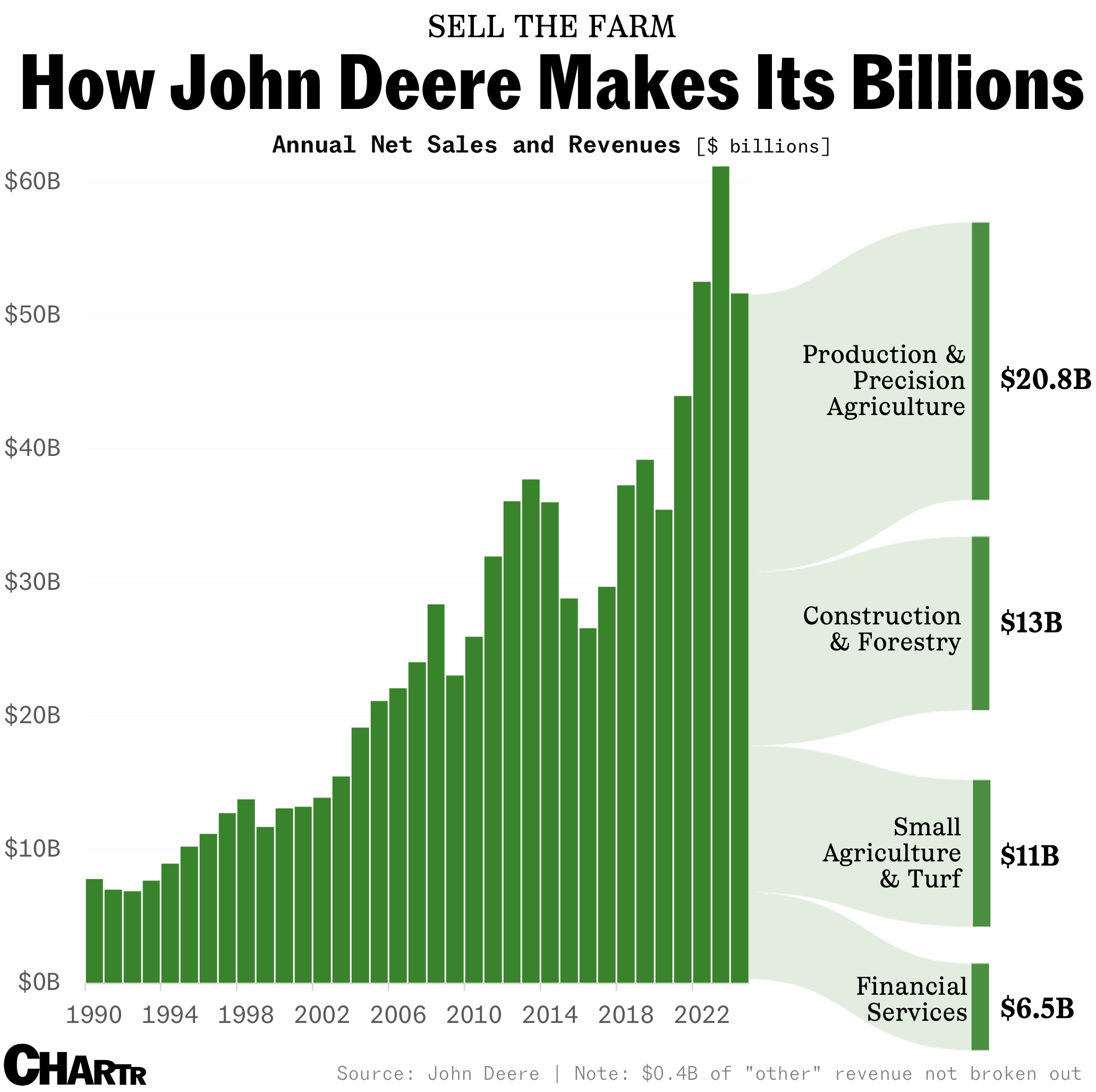
In 2023, John Deere’s total revenues rose to a record $61.3 billion, but sales slumped some 16% in the last fiscal year as farmers tightened their purse strings and invested less into Deere-branded machinery and equipment, which accounts for as much as ~87% of the company’s revenue. Clearly, fewer farmers up and down the country fancied dropping thousands, or indeed millions, of dollars on new machines last year, with the company’s most expensive tractor, the 9RX 830, listing for $1.228 million.

Interestingly, the company aims to make 10% of its annual revenue from software subscriptions by 2030 — quite the shift for a business that’s still almost exclusively known for making things that chop, plow, mow, move, and spray.

More Business

See all Business
business

China’s EV startup trio have all become profitable

China’s EV startup trio, Nio, Li Auto, and XPeng, are now all profitable, following the latter’s Q4 results released Friday.

XPeng reported a quarterly net profit of about $55 million, compared to rival Nio’s Q4 net profit (also its first) of about $40 million. Li Auto posted Q4 net profit of less than $1 million.

All three companies being profitable offers a stark contrast to the EV market in the US, where Rivian quietly delayed its 2027 profitability target in a filing about its Uber robotaxi partnership yesterday. Lucid is likely further away, and last month cut 12% of its US workforce as part of its “path toward profitability.”

Still, it’s not all rosy for China’s EV startups, either. XPeng ADRs were down more than 6% in Friday morning trading as its Q1 sales forecast came in below estimates. As China rolls back subsidies, auto sales are slumping. Chinese retail EV and hybrid sales fell 32% in February from the same month last year.

9.3%

As the war with Iran produces the biggest spike in US gas prices since Hurricane Katrina, car retailer CarMax is continuing to see heightened interest in EVs, hybrids, and plug-in hybrids.

“From Feb 1st - March 1st (inclusive), compared to March 2nd to March 15th (inclusive), we saw a 9.3% lift in page views for these vehicles,” a spokesperson for the company told Sherwood News.

As industry insiders recently told us, EV interest climbs when gas prices rise. That appears to be holding true even without EV tax credits, which the Trump administration ended under its new budget package.

CarMax also saw EV searches spike in 2022, amid Russia’s invasion of Ukraine and the resulting oil price spike.

Walt Disney Chairman And CEO Bob Iger Rings Opening Bell At NY Stock Exchange

It’s the end of Disney’s Iger era (again)

Incoming CEO Josh D’Amaro is replacing Bob Iger on Wednesday, though Iger will remain a senior adviser through the end of the year.

$35.4B

The tariffs imposed by the Trump administration have cost automakers at least $35.4 billion since the start of 2025, according to a new analysis by Automotive News.

That total will continue to climb this year, since the Supreme Court’s February tariff ruling largely leaves the 25% levy on vehicles and auto parts untouched.

Toyota has taken the biggest hit, projecting more than $9 billion in tariff costs in its fiscal year ending this month, while Detroit’s big three automakers — Ford, GM, and Stellantis — were hit with a combined $6.5 billion tariff charge in 2025.

In the fourth quarter, automakers sold about 8% fewer imported vehicles in the US compared to the same period a year ago, per the Automotive News Research & Data Center.

Tariff charges come at a rough time for legacy carmakers, which are also scaling back EV plans following the Trump administration’s elimination of tax credits and fuel standard goals. According to Automotive News, the cost of EV write-downs and restructuring is, so far, nearly $70 billion.

Latest Stories

Sherwood Media, LLC produces fresh and unique perspectives on topical financial news and is a fully owned subsidiary of Robinhood Markets, Inc., and any views expressed here do not necessarily reflect the views of any other Robinhood affiliate, including Robinhood Markets, Inc., Robinhood Financial LLC, Robinhood Securities, LLC, Robinhood Crypto, LLC, Robinhood Derivatives, LLC, or Robinhood Money, LLC. Futures and event contracts are offered through Robinhood Derivatives, LLC.