Millions of Americans are still on AOL, as Apollo mulls $1.5 billion sale
America is online. Very much so, in fact, with the once iconic internet company still putting up web traffic numbers that beat Apple.com, Temu.com, and more.
When industries hit inflection points, pioneers’ fates diverge. Some rocket into behemoths, others hold up without ever reaching those heights, and some capitulate under the change — like the film icon Kodak, the onetime retail titan Sears, or AOL, the internet OG and now obsolete web portal that once defined what it meant to be “online.”
But AOL is not as dead as you might think it is.
According to The Wall Street Journal, private equity giant Apollo is weighing a sale of AOL, after getting “inbound interest” from potential buyers, in a deal that could value it at ~$1.5 billion. That would mark the latest stop in AOL’s long, bumpy ride through a string of owners: Apollo picked it up (alongside Yahoo) from Verizon for $5 billion in 2021, after Verizon itself had bought AOL for $4.4 billion in 2015 — just a fraction of its peak valuation.
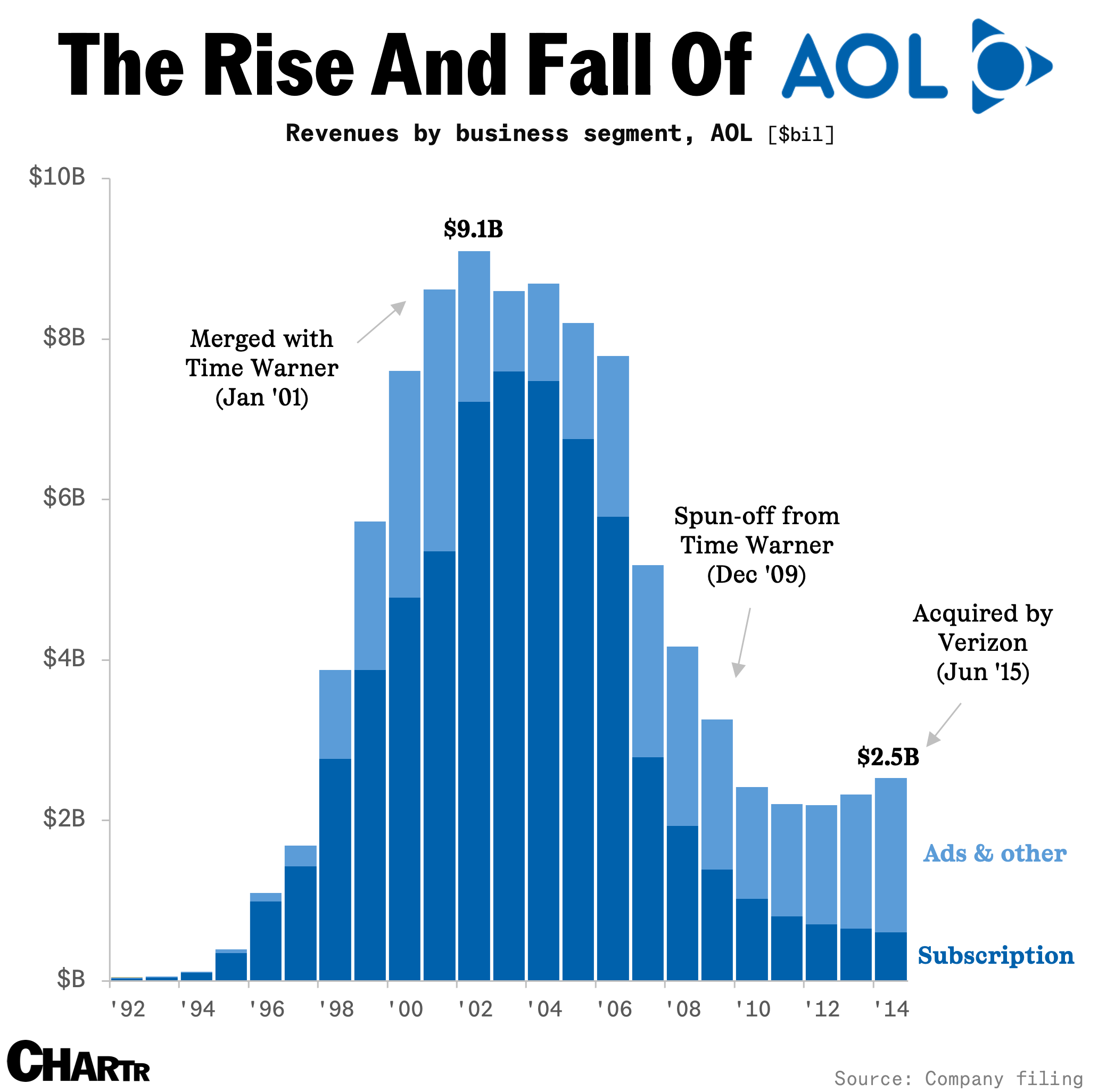
In 2001, AOL merged with Time Warner, one of the biggest corporate tie-ups of all time. Revenue briefly topped $9 billion the following year, but the momentum didn’t last: the dot-com bubble burst, and high-speed broadband quickly ate into AOL’s core dial-up business. The combined company soon posted a record-breaking $99 billion loss, and the business kept shrinking over the following decade.
Per the Journal, the company makes about $400 million in annual EBITDA today — nearly as much as the $406 million it reported in 2014, its final year as a public company. No growth, but also no collapse, which is weirdly impressive for an internet fossil like AOL. So what’s keeping it alive?
Eyeballs matter
In 2014, three-quarters of AOL’s revenue came from ads, with the rest (24%) from subscription — mostly dial-up, often bundled with add-ons like antivirus and tech support.
We don’t know the exact split between ads vs. subscription today, but subscriptions now mean something else, centered on ID protection and security tools, with its dial-up internet service finally being shut down this month. In 2021, CNBC reported that AOL had about 1.5 million monthly customers paying $10 to $15 a month, which could have been worth $180 million to $270 million of revenue a year. Some of that might have come from customers who weren’t necessarily sure what they were paying for, with stories on social media about people finding their grandparents paying AOL every month for services unknown.
Assuming some decline in that subscription business, it’s likely that advertising still does much of the heavy lifting — which makes sense, because AOL’s traffic is still very real.

From June to August, aol.com averaged 239 million monthly visits, per data from Similarweb. That’s more than retailers like Etsy, Target, and Home Depot; tech and streaming platforms like Microsoft, Apple, Hulu, and Spotify; and even big media brands like the New York Post and BBC.
And it’s not just that people show up — they actually stick around.
Users spend an average of 10.2 minutes per visit on AOL, almost on par with Roblox, which draws a similar number of visitors — though their audiences couldn’t be more different, together bookending the internet’s demographics. AOL also beats sites like Indeed, Temu, and Quora on both visits and duration.
We can only guess what people are actually doing there — maybe checking email, skimming headlines... or spending a decent amount of time scrolling through the site’s lifestyle content. Indeed, earlier this year, the company told Sherwood News that it had expanded beyond a site that was “predominantly” news aggregation, adding new sections like fitness, animals, and home & garden to broaden its reach.
Four decades on from its founding, and an uncountable number of existential threats to its business later, AOL is still getting (some) Americans online.