Business
Break the cycle: Peloton is pedaling uphill

Break the cycle: Peloton is pedaling uphill

Uphill struggle

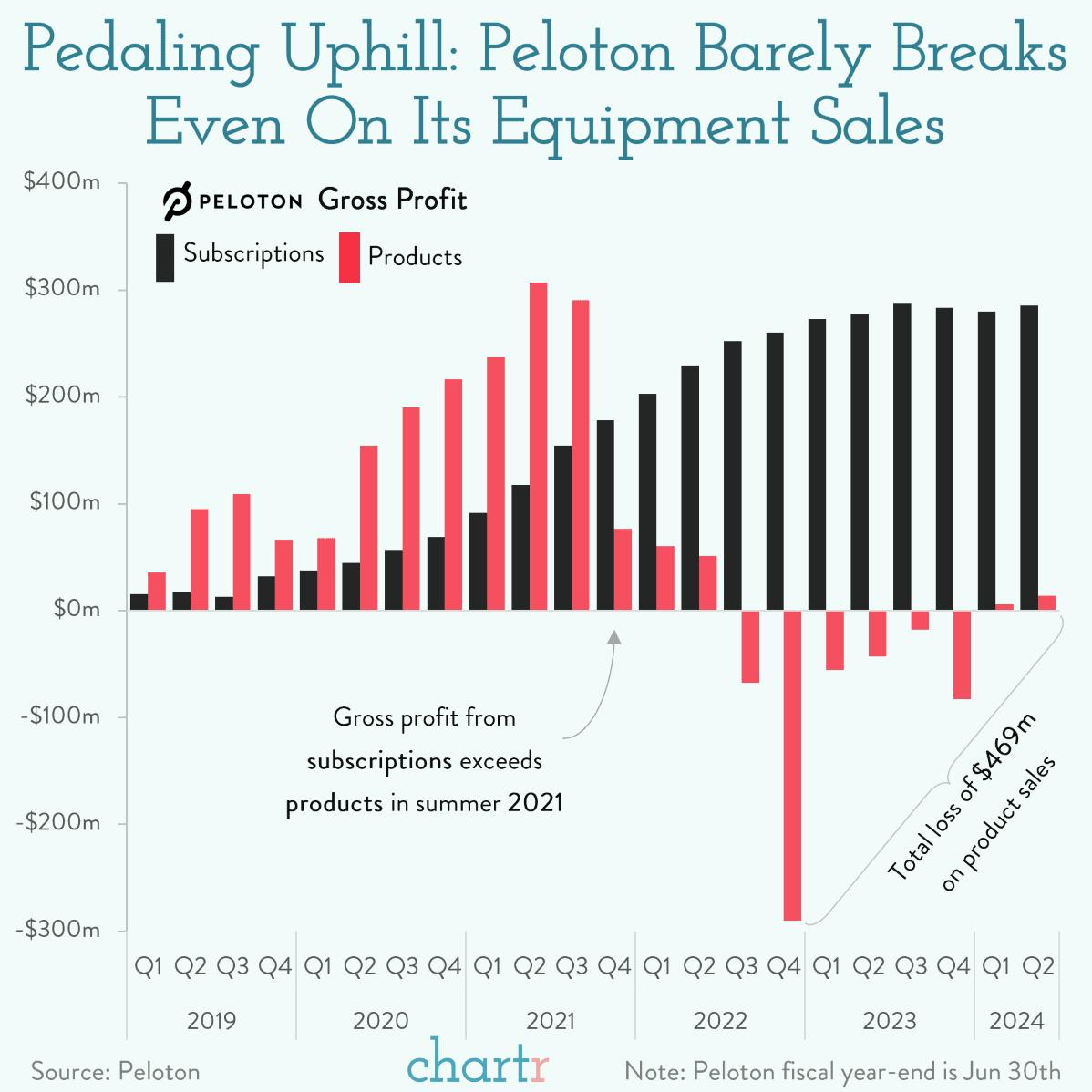
If you’ve ever wanted to buy a Peloton bike, but never wanted to part ways with the ~$2,000 required to get one, you might be able to justify the expense to yourself knowing that the company likely won’t be making any money from your equipment purchase.

Indeed, yesterday Peloton reported another strained set of earnings, slashing its outlook for the coming year and sending its shares down 25%: an all-time low for the company once hailed as the pandemic’s fitness savior. The high-end bike and treadmill maker reported that, in its latest quarter, it made just a sliver of gross profit ($13.8m) on actual product sales — that’s profit only derived from the sale of the item itself. Once sales and marketing expenses, general & administrative expenses, research and development costs, or any other “overheads” were accounted for, Peloton remained deeply in the red.

Shifting gears

Current CEO Barry McCarthy took the reins in February 2022, when gyms were fully reopened and product issues were shaking Peloton. Cutting prices helped stem the losses, but it left the subscription business as Peloton’s financial backbone, relying on the famously energetic live online classes to pedal the company forward. However, despite deals with Lululemon and TikTok — as well as new distribution channels through third-party retailers like Dick’s Sporting Goods and Amazon — Peloton just hasn’t been able to grow subscriptions meaningfully in recent months.

On paper, the business model isn’t inherently flawed: Costco, for example, has a wildly successful subscription-based service, selling a wide array of products for close to cost but profiting enormously on the membership needed to shop there.

More Business

See all Business
business

Sony is reportedly considering pushing the PlayStation 6 to 2028 or 2029 as AI RAM demand squeezes consumer electronics

AI’s ongoing need for more memory chips, which some are referring to as “RAMmageddon,” is reportedly shifting Sony’s plans for its next PlayStation console.

According to reporting by Bloomberg, the company is weighing a delay of the PS6 to 2028 or 2029 — a pivot from the company’s typical six- to seven-year console life cycle.

Memory costs could also result in Nintendo hiking the price of the Switch 2, per the report.

The report is part of a larger trend of AI demand impacting consumer electronics, including gaming equipment. Earlier this month, reports said that Nvidia will not release a new gaming graphics chip this year — a first. Steam owner Valve delayed its forthcoming Steam Machine console, and its popular Steam Deck handheld is currently unavailable for purchase in the US. Per Valve’s website: “Steam Deck OLED may be out-of-stock intermittently in some regions due to memory and storage shortages.”

Amid the AI memory squeeze, gaming stocks have also experienced major recent sell-offs following the release of Google’s AI interactive world-generation tool, Project Genie.

Memory costs could also result in Nintendo hiking the price of the Switch 2, per the report.

The report is part of a larger trend of AI demand impacting consumer electronics, including gaming equipment. Earlier this month, reports said that Nvidia will not release a new gaming graphics chip this year — a first. Steam owner Valve delayed its forthcoming Steam Machine console, and its popular Steam Deck handheld is currently unavailable for purchase in the US. Per Valve’s website: “Steam Deck OLED may be out-of-stock intermittently in some regions due to memory and storage shortages.”

Amid the AI memory squeeze, gaming stocks have also experienced major recent sell-offs following the release of Google’s AI interactive world-generation tool, Project Genie.

Robot illustration

Video game experts say Google’s Project Genie isn’t an industry killer. Investors don’t seem convinced.

Analysts and company execs are trying to dispel fears around AI’s impact on gaming, but Wall Street is still wary.

LA Auto Show

Rivian just had its best day ever on the stock market, after more than 4 years of pain

The EV maker’s software division helped power a strong Q4, as industry giants pump the brakes on their electric ambitions.

Latest Stories

Sherwood Media, LLC produces fresh and unique perspectives on topical financial news and is a fully owned subsidiary of Robinhood Markets, Inc., and any views expressed here do not necessarily reflect the views of any other Robinhood affiliate, including Robinhood Markets, Inc., Robinhood Financial LLC, Robinhood Securities, LLC, Robinhood Crypto, LLC, or Robinhood Money, LLC.