

Business
Headphones
Getty Images
PIVOT TO VIDEO

In the world of podcasts, YouTube is now the elephant in the room — just like in TV

Podcasts are increasingly YouTube ft. everyone else — even tech giants like Amazon are restructuring to favor video-first podcasts led by hosts with big personalities.

Claire Yubin Oh

Earlier this week, Amazon announced it would be restructuring its Wondery podcast business as the landscape increasingly shifts toward host-centric, video-integrated shows. 

About 110 staff will be cut from the move, as first reported by Bloomberg, including the division’s CEO, Jen Sargent. Wondery’s existing narrative-driven studio and series will be moved under Amazon’s Audible banner, while personality-focused shows, like Jason and Travis Kelce’s podcast, “New Heights,” will find a home at Wondery’s new “creator services” team, per a memo shared by Business Insider

The tech giant has largely allowed Wondery to operate independently since its acquisition in 2020, but the latest reorganization signals that Amazon’s $300 million bet into podcasts is getting more focused.

Podcast yourself

Amazon’s decision comes as the podcast industry reinvents itself. In June, Spotify laid off 5% of staff in its podcast division, while radio conglomerate Audacy shut down its audio-centric podcast business Pineapple Street Studios after nine years. 

The elephant in the room of all of this upheaval is YouTube — the silly viral internet video giant that became a TV, music, advertising, and now podcast giant. Per an April survey by Cumulus Media and media research firm Signal Hill Insights, 39% of all weekly podcast consumers use YouTube as their primary platform, more than double the share from late 2019. The video platform estimated that more than a billion people a month are watching podcasts as of February.
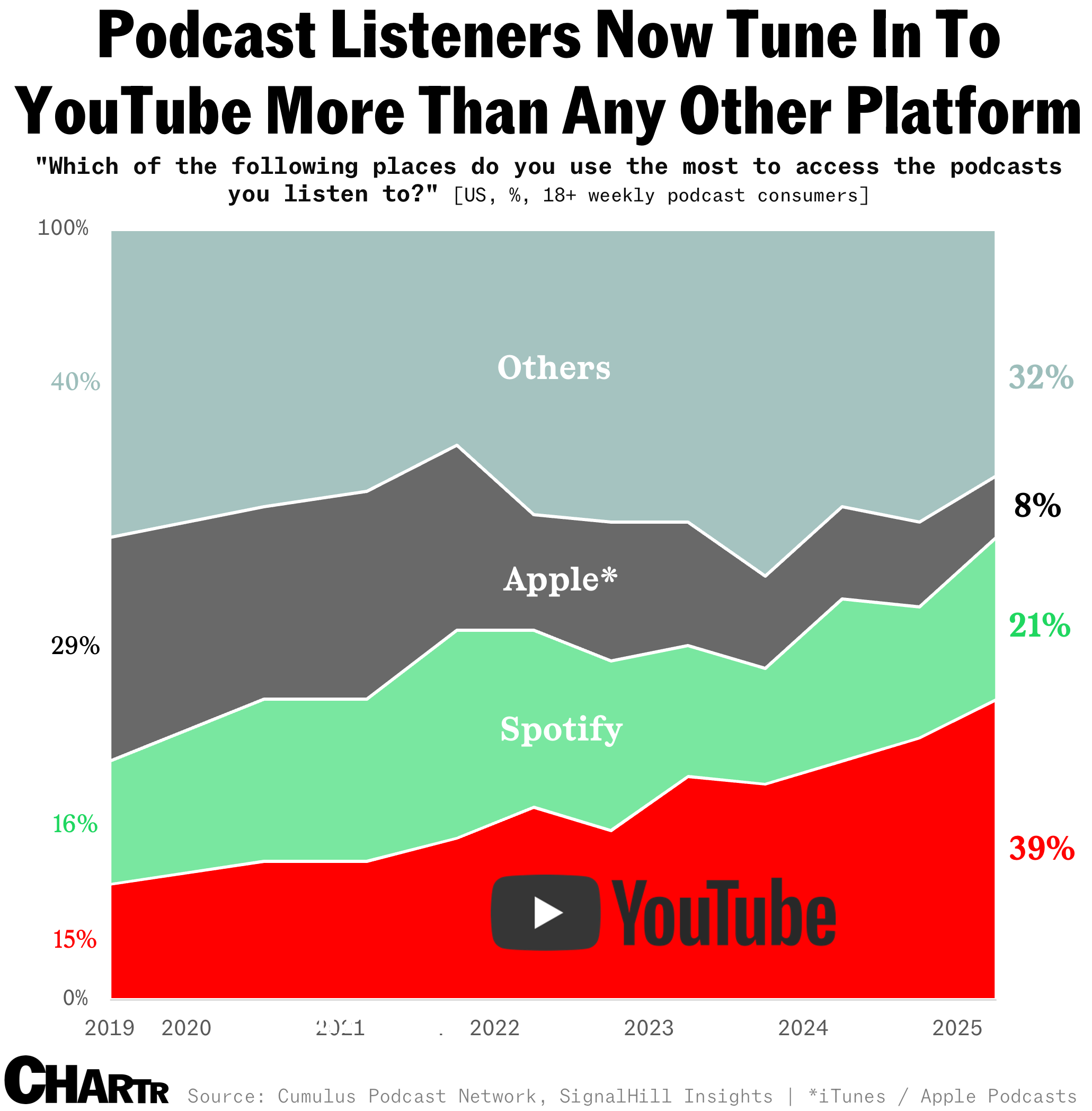
Youtube dominates the podcast sphere
Sherwood News

A large part of that domination comes from how podcast listeners across generations now consume the medium differently — nearly three-quarters of the respondents said they watch podcasts more often than listening to podcasts. That’s quite a stat for an “audio” medium.

YouTube’s domination echoes its success in TV — where it is routinely beating out Disney, Netflix, Paramount, and NBCUniversal.

Main character energy 

At the heart of those video-integrated podcast shows are big personality hosts like Joe Rogan, Mel Robbins, and Amy Poehler, who, with their charisma and consistent jokes, amass legions of highly engaged, targeted listeners (and watchers).

Indeed, since YouTube started to share the most popular podcast shows on the platform in May, host-centric podcasts have been topping the leaderboard consistently in the US, with six out of the top 10 shows revolving around the host’s persona, according to the latest released weekly top 10 (starting July 21).
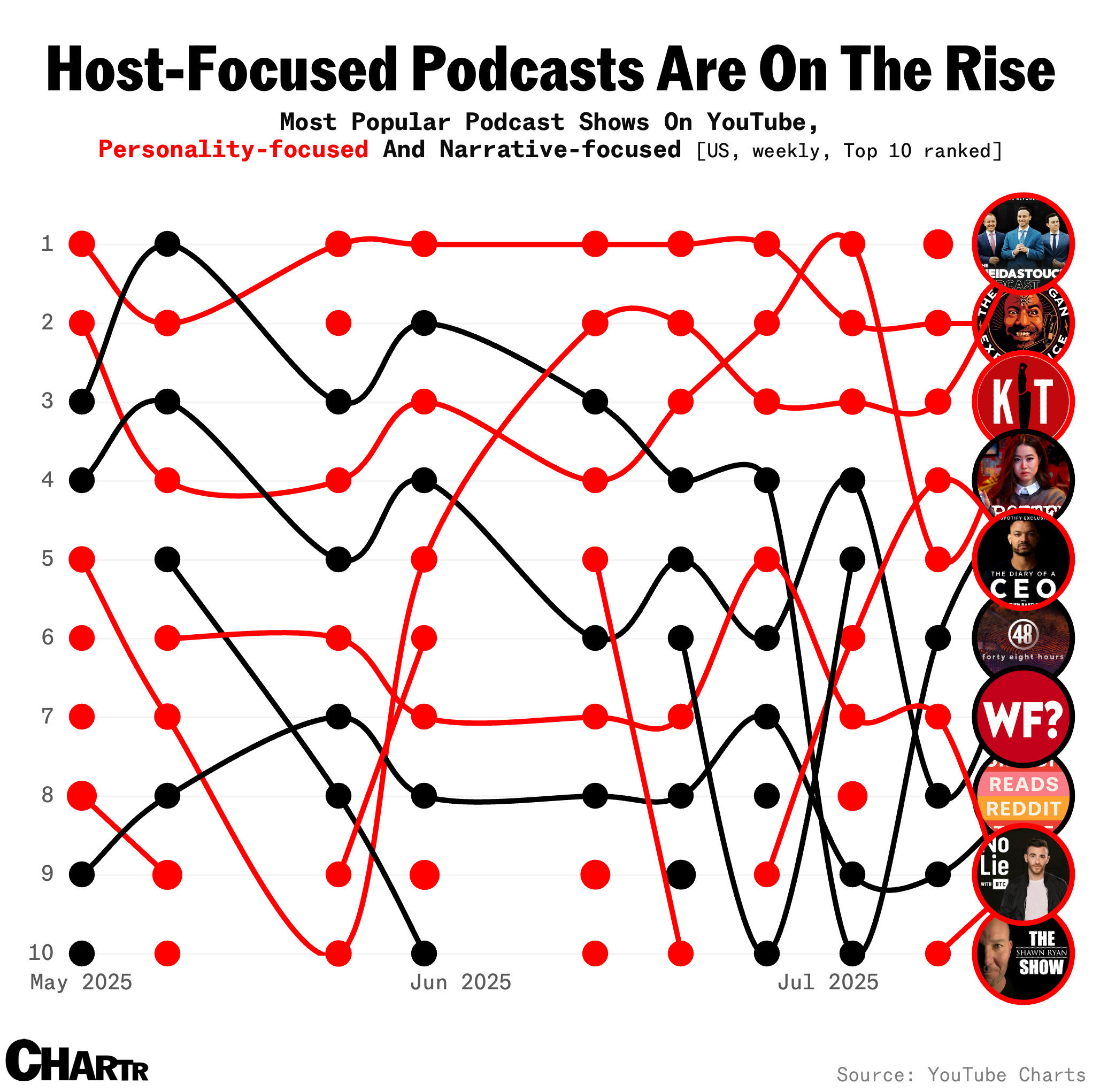
Host-centric podcasts dominate the charts
Sherwood News

To get a sense of how much things have changed, think of the viral podcast appearances of the 2024 presidential campaign, with former Vice President Kamala Harris on “Call Her Daddy” and President Donald Trump on Joe Rogan’s podcast. Video? Tick. Personality hosts? Tick. The biggest podcasts of the day being true crime shows are long gone.

These days, podcasts are things you can watch, listen, or multitask to — a bit like the late-night talk show format that is, ironically, struggling so much on linear TV.

More Business

See all Business
business

China’s EV startup trio have all become profitable

China’s EV startup trio, Nio, Li Auto, and XPeng, are now all profitable, following the latter’s Q4 results released Friday.

XPeng reported a quarterly net profit of about $55 million, compared to rival Nio’s Q4 net profit (also its first) of about $40 million. Li Auto posted Q4 net profit of less than $1 million.

All three companies being profitable offers a stark contrast to the EV market in the US, where Rivian quietly delayed its 2027 profitability target in a filing about its Uber robotaxi partnership yesterday. Lucid is likely further away, and last month cut 12% of its US workforce as part of its “path toward profitability.”

Still, it’s not all rosy for China’s EV startups, either. XPeng ADRs were down more than 6% in Friday morning trading as its Q1 sales forecast came in below estimates. As China rolls back subsidies, auto sales are slumping. Chinese retail EV and hybrid sales fell 32% in February from the same month last year.

9.3%

As the war with Iran produces the biggest spike in US gas prices since Hurricane Katrina, car retailer CarMax is continuing to see heightened interest in EVs, hybrids, and plug-in hybrids.

“From Feb 1st - March 1st (inclusive), compared to March 2nd to March 15th (inclusive), we saw a 9.3% lift in page views for these vehicles,” a spokesperson for the company told Sherwood News.

As industry insiders recently told us, EV interest climbs when gas prices rise. That appears to be holding true even without EV tax credits, which the Trump administration ended under its new budget package.

CarMax also saw EV searches spike in 2022, amid Russia’s invasion of Ukraine and the resulting oil price spike.

Walt Disney Chairman And CEO Bob Iger Rings Opening Bell At NY Stock Exchange

It’s the end of Disney’s Iger era (again)

Incoming CEO Josh D’Amaro is replacing Bob Iger on Wednesday, though Iger will remain a senior adviser through the end of the year.

$35.4B

The tariffs imposed by the Trump administration have cost automakers at least $35.4 billion since the start of 2025, according to a new analysis by Automotive News.

That total will continue to climb this year, since the Supreme Court’s February tariff ruling largely leaves the 25% levy on vehicles and auto parts untouched.

Toyota has taken the biggest hit, projecting more than $9 billion in tariff costs in its fiscal year ending this month, while Detroit’s big three automakers — Ford, GM, and Stellantis — were hit with a combined $6.5 billion tariff charge in 2025.

In the fourth quarter, automakers sold about 8% fewer imported vehicles in the US compared to the same period a year ago, per the Automotive News Research & Data Center.

Tariff charges come at a rough time for legacy carmakers, which are also scaling back EV plans following the Trump administration’s elimination of tax credits and fuel standard goals. According to Automotive News, the cost of EV write-downs and restructuring is, so far, nearly $70 billion.

Latest Stories

Sherwood Media, LLC produces fresh and unique perspectives on topical financial news and is a fully owned subsidiary of Robinhood Markets, Inc., and any views expressed here do not necessarily reflect the views of any other Robinhood affiliate, including Robinhood Markets, Inc., Robinhood Financial LLC, Robinhood Securities, LLC, Robinhood Crypto, LLC, Robinhood Derivatives, LLC, or Robinhood Money, LLC. Futures and event contracts are offered through Robinhood Derivatives, LLC.