The DOJ thinks that Live Nation-Ticketmaster has a monopoly on the live music industry. Could it have a point?
The landmark antitrust trial kicked off on Tuesday, though the ticketing giant maintains that it’s simply spreading joy.
During his opening statement on Tuesday, David Dahlquist, attorney for the US Justice Department, told jurors: “The concert ticket industry is broken, in fact the concert industry itself is broken. It is controlled by a monopolist. It is controlled by Live Nation.”
By contrast, Live Nation’s opening remarks for what could be the most consequential legal battle the modern music industry has seen took a more jovial tone. The Verge reported that the entertainment giant’s counsel pointed mostly to the good times, with slides of popular artists’ concerts underscoring its argument that the company is “all about bringing joy to people’s lives and doing it lawfully.”
The Nation vs. Live Nation
The DOJ first filed the antitrust lawsuit back in 2024, accusing Live Nation — which merged with ticket sales and distribution company Ticketmaster in 2010 — of illegally monopolizing the live music market.
Now, over the next six weeks in a Manhattan courtroom, a jury will decide whether the combined company has wielded its dominance to stifle competition and whether it should be broken up or otherwise penalized.
Incidentally, Live Nation-Ticketmaster also released its full-year earnings for FY2025 around two weeks ago. So, just how big is the music titan today?
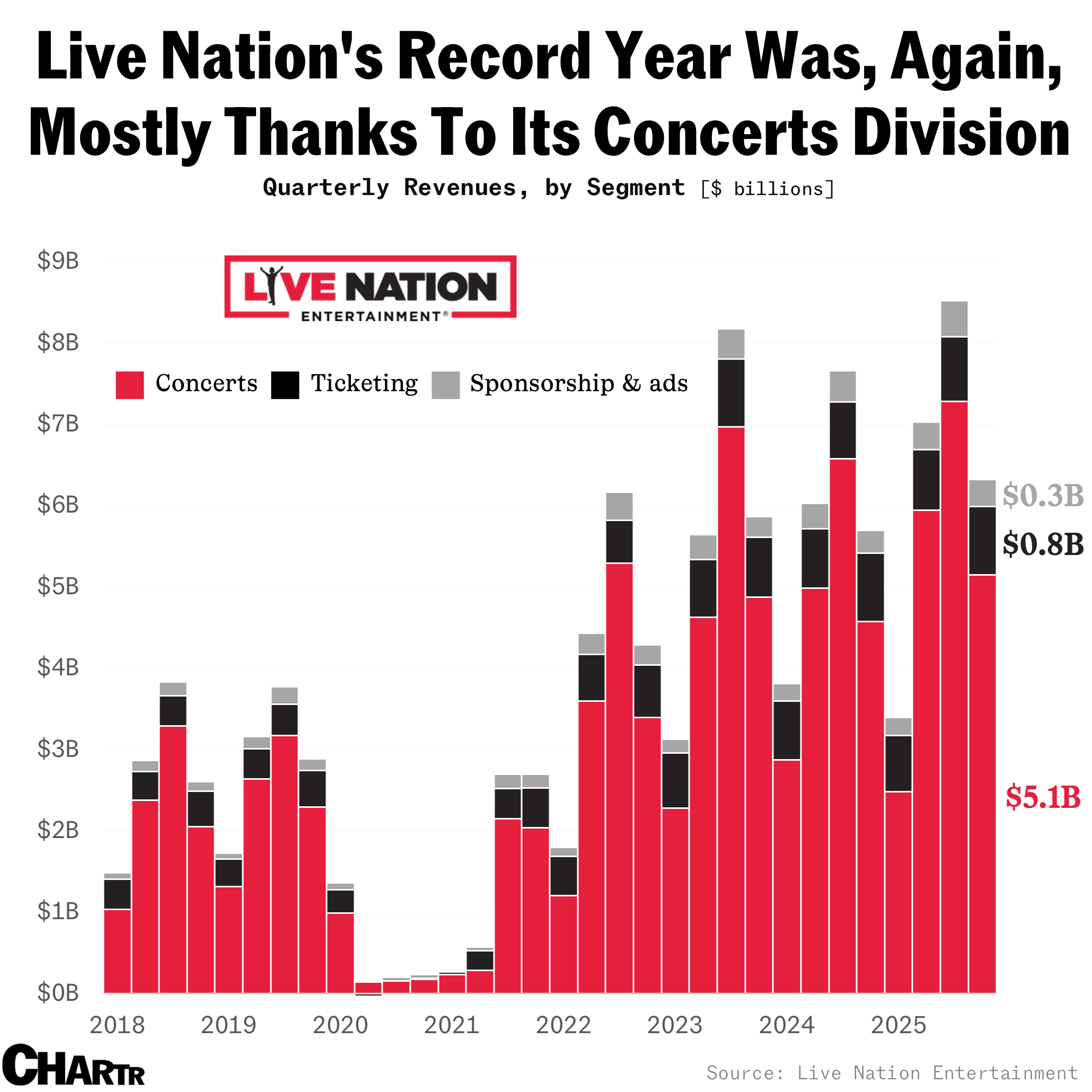
Live Nation posted record-breaking total revenues of $25.2 billion in 2025, up 9% from the year before, with its biggest quarter landing, as it often does, in the summer months of Q3. The company’s concert division posted around $20.9 billion in revenue across 2025 — equivalent to 83% of its year-end total — while its ticketing division accounted for just $3 billion (~12%).
Gig economy
Though concerts have long been the beating heart for revenue in the Live Nation business, its ticketing system is actually the profit center, with a 37% adjusted operating profit margin, netting $1.1 billion over the period — compared with a much smaller 3% margin for concerts (~$687 million). Sponsorships and ads, meanwhile, consistently deliver high margins (64% in FY2025) due to the sector’s relatively low expenses.

While the high expenditure required to operate live events eats into the concert division’s profits, the rising margins in Live Nation’s ticketing system will be a major pressure point in the DOJ’s monopoly case, with the company having drawn particular scrutiny over its pricing model.
A watershed moment came in 2022, when demand for tickets to Taylor Swift’s Eras Tour crashed the Ticketmaster site and saw fans shell out thousands to attend; similar upset occurred in 2024 for those trying to score tickets to the Oasis reunion.
But even with concert ticket prices much higher than before — a 2025 survey from Pollstar found that the average US ticket price for the top 100 tours in the US was $135.92, up 41% from 2019 — more people than ever are going to live events.

Across ~55 million events around the world last year, Live Nation estimated that almost 160 million fans were in attendance in total — a 9% increase from just two years ago.
To an extent, people might just enjoy going to gigs more than they used to. The constant expansion of its already huge portfolio of venues presumably doesn’t hurt the company’s gig attendance figures, though, nor its ticket sales. As reported by Bloomberg, Live Nation controls more than 265 concert venues in North America alone, with the DOJ alleging that it controls 87% of the concert ticketing market through its Ticketmaster subsidiary.
Mob mentality
When people empty their pockets to see their favorite artists perform live, they usually want something to remember the time by, or they’re maybe willing to fork out a little more for an elevated experience... which Live Nation also manages to squeeze significant profit out of.
Indeed, beyond sponsorships and promotions — Live Nation currently manages more than 400 musical artists, giving it more than 65% of the concert promotion market, the DOJ argues — merchandise and premium offerings are bright spots that gild the company’s event business.
Clearly, whatever the outcome of the trial, Live Nation has become a virtuoso in its ability to spread itself across every facet of the modern ticket-buying and concertgoing experience, while keeping its own business in fine tune.