Business
Turning a new leaf: Vegan brands have shed billions since their IPOs

Turning a new leaf: Vegan brands have shed billions since their IPOs

Turning a new leaf

Alternative vegan products — mostly soy, gluten, and plant protein fashioned into cow-less burger patties, pork-free sausages, and milk-that-isn’t-milk — have been leading the charge. Investment in veggie-friendly companies saw sales for plant-based foods grow 44% in the 3 years up to 2022, and some predict that plant-based food could make up to ~8% of the global protein market by 2030.

However, the plant-based “meat” market specifically has cooled. Despite US retail sales for plant-based meat doubling between 2017 and 2020, spearheaded by buzzy companies like Beyond Meat and Impossible Foods, purchases plateaued from 2020 onwards, with dollar sales actually shrinking slightly (-1%) between 2021-2022.

**It's just not the same?**‍

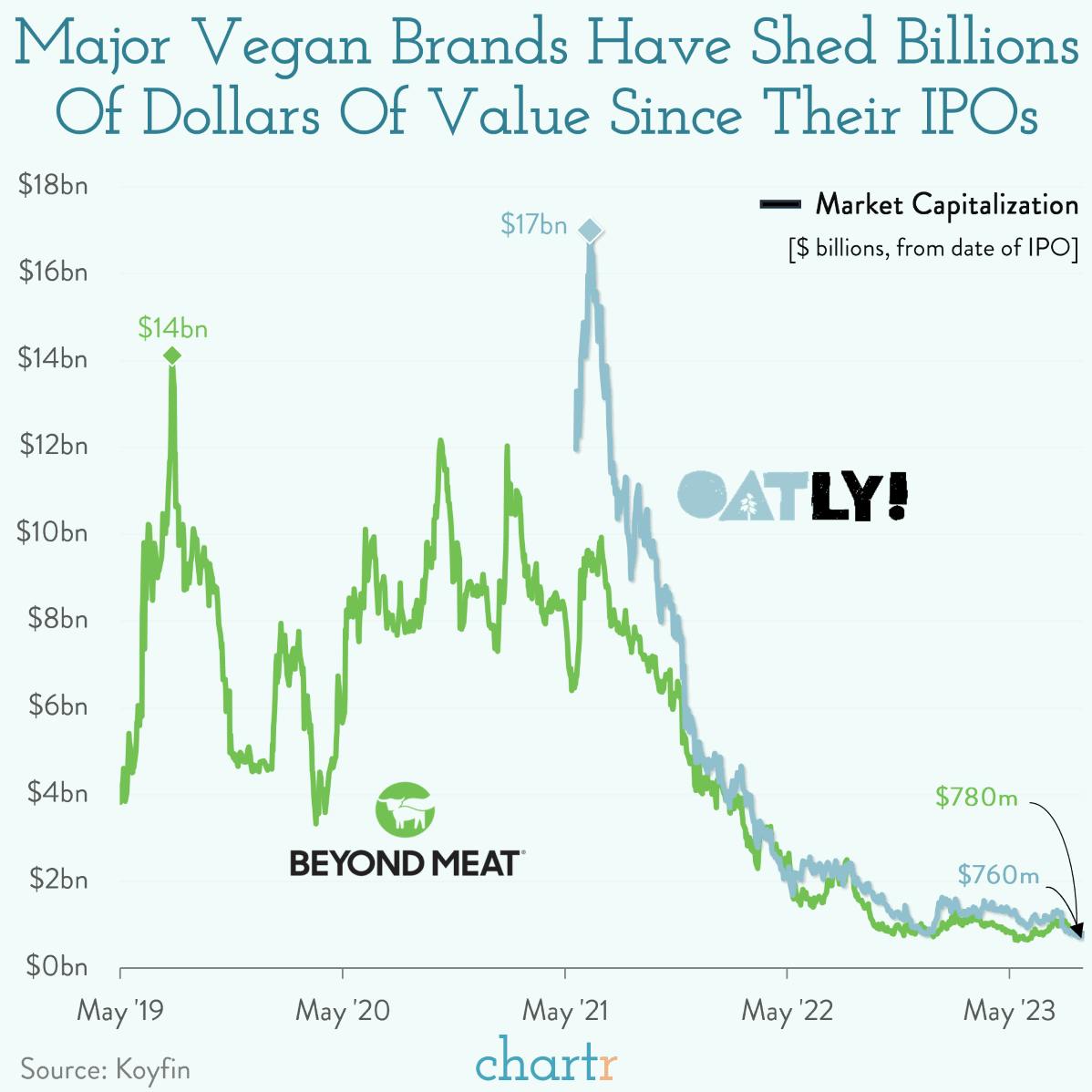
Beyond Meat burst into the field in 2009, having successfully harnessed a technology for realigning protein in plants, before pulling off 2019’s top US IPO — citing Bill Gates and Leonardo DiCaprio amongst its star-studded investors. The company's share price was driven up 163% on its first day of trading, eventually going on to reach a peak market cap of $14bn.

But, per nature, what goes up, must come down: Beyond Meat just couldn't maintain its sizzle, as sales slipped, costs rose and optimism faded. By late last year the company was worth less than $1bn. A similar fate befell the Oprah-backed, oat-derived plant-milk brand Oatly: after the initial excitement of its own IPO, Oatly’s value steadily drained— as we noted later that year — before settling around its current valuation of ~$760m. So far, the next big category-defining vegan-friendly company hasn't hit the mainstream.


More Business

See all Business
business

Paramount sues Warner Bros. for more info on its deal with Netflix, says it plans to nominate new directors

It’s a fresh week and that means a fresh bit of escalation in the ongoing Warner Bros. Discovery merger drama.

At an upcoming meeting, Paramount Skydance plans to “nominate a slate of [WBD] directors who, in accordance with their fiduciary duties, will... enter into a transaction with Paramount,” CEO David Ellison wrote in a letter to WBD shareholders disclosed on Monday.

Ellison also said that Paramount sued WBD in Delaware court in an effort to force the board to disclose “basic information” that will allow shareholders to make an informed decision between Paramount’s offer and one from Netflix. WBD shares dipped about 2% on Monday morning.

The latest update follows Paramount’s move last week to reaffirm — but not raise — its $30-per-share offer for WBD. Some saw that decision as Paramount effectively throwing in the towel on its merger hopes, given that the same deal has been rejected twice by the WBD board and winning over shareholders directly is a difficult process. Monday’s disclosure appears to signal that whether it loses or not, Paramount isn’t going to make Netflix’s acquisition easy.

business

Ford to bring eyes-off driving to its new EV platform by 2028

Ford is wading into the autonomous race against rivals like Tesla and GM.

On Wednesday evening, the Detroit automaker said it plans to introduce “Level 3” eyes-off systems to vehicles being built on its new production platform in Louisville by 2028. The first vehicle planned for the platform is a $30,000 midsize EV truck, planned for 2027.

In an interview with Reuters, Ford Chief EV and Design Officer Doug Field said the tech would not come at the $30,000 price point and would cost extra. Field said the company is still weighing just how much extra, and whether the system should be sold via a subscription model.

According to Ford, the eyes-off and hands-off tech will utilize lidar. Ford shares ticked up slightly in premarket trading on Thursday.

In August, Reuters reported that Ford rival Stellantis had shelved its Level 3 program due to high costs.

Latest Stories

Sherwood Media, LLC produces fresh and unique perspectives on topical financial news and is a fully owned subsidiary of Robinhood Markets, Inc., and any views expressed here do not necessarily reflect the views of any other Robinhood affiliate, including Robinhood Markets, Inc., Robinhood Financial LLC, Robinhood Securities, LLC, Robinhood Crypto, LLC, or Robinhood Money, LLC.