Wall Street likes Southwest’s new bag fee. Passengers hate it. Let’s see how this plays out.
What’s next, Delta’s going to destroy its cookie recipe?
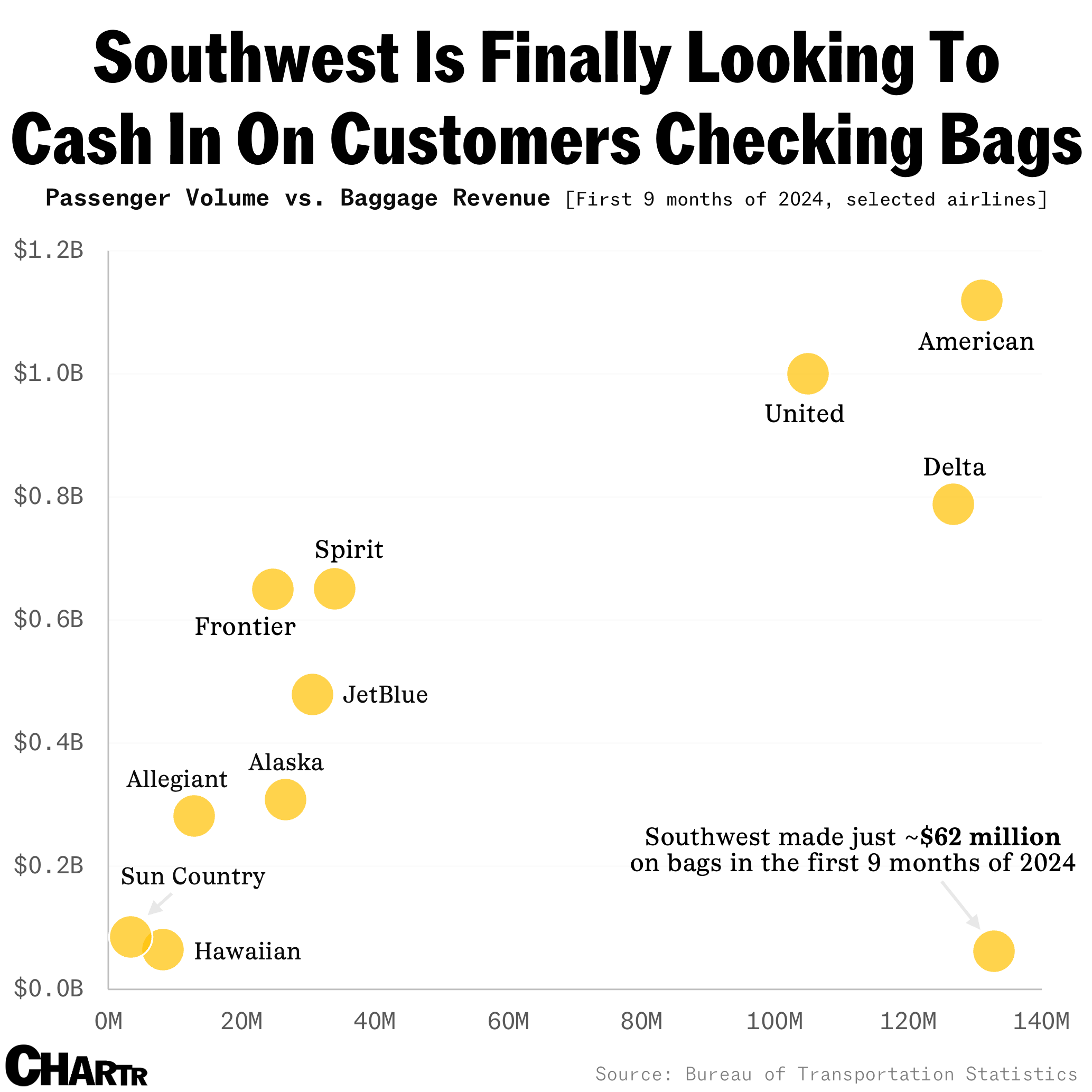
“Bags fly free” has been a defining offering for Southwest Airlines for more than five decades. Now, the airline has decided it would rather have your cash.
Southwest announced a stunning reversal to its “two free checked bags” policy on Tuesday. Any customers who purchase tickets on or after May 28 will have to pay an as yet undefined fee for checked luggage. (Its rivals charge $35.)
Top loyalty members and customers flying “business select” will still get two bags comped, while a few other loyalty groups will receive one free bag. For everyone else: it’s time to pay.
It’s an interesting move, especially considering that in a press release less than six months ago announcing changes to its boarding process, the company wrote:
“Extensive research reinforces Southwest’s bags fly free policy remains the most important feature by far in setting Southwest apart from other airlines. Based on Southwest’s research, the company believes that any change in the current policy that provides every customer two free checked bags would drive down demand and far outweigh any revenue gains created by imposing and collecting bag fees.”
Guess that was just bad math!
The move is easily the most shocking of Southwest’s recent cost-cutting and revenue-boosting maneuvers since it ceded five board seats to activist investor Elliott Management in October. The carrier cut 15% of its corporate workforce last month (its first mass layoff) and previously froze hiring, stopped service to some airports, and cut more than 300 pilot and flight attendant positions in September.
The odds are, if you’re a Southwest investor, you’re probably liking this decision; shares closed up more than 8% Tuesday, despite industry-wide lowered revenue forecasts clouding rivals. If you’re a regular Southwest customer, you’re probably hating it. Everyone else is likely feeling some version of, “I’m confused.”
“When you look at it, Southwest is the airline with the strongest customer loyalty in an industry that is known for a lack of loyalty,” said Bill McGee, author of “Attention All Passengers” and senior fellow for aviation and travel at the nonprofit American Economic Liberties Project. “Now you’re taking away the biggest component of that loyalty. I understand that smart people made this decision. They have supposedly done their due diligence that this is a sensible decision from a dollars and cents perspective. But to me, it just doesn’t seem smart.”
Southwest has, even recently, cited checked bags as its foremost customer draw. Last July, CEO Bob Jordan said the offering was the “number one issue in terms of why customers choose Southwest” after fares and schedules. Another exec at the time claimed that the lost demand from introducing bag fees would eclipse any boost in revenue.
On Tuesday, Jordan changed his tune, stating that the carrier’s prior analysis turned out to be incorrect after looking at fresh customer behavior.
Not everyone’s so convinced.
“If Southwest Airlines had assembled a focus group and asked them ‘what’s the stupidest thing that we could do to ruin our company,’ this is what they would have come up with,” reads a critical post on X with nearly 7,000 likes.
“I don’t usually like to get out the crystal ball,” McGee said. “But in my view, having been around this place a long time, I do think that this is going to severely hurt both the number of people booking [Southwest] and the loyalty of those customers.”
Rival excitement is probably giving the carrier at least some pause, too. Delta Air Lines President Glen Hauenstein’s statement about the change on Tuesday reveals that at least one competitor is viewing the move as an opportunity.
“Clearly, there are some customers who chose them for that and now those customers are up for grabs,” Hauenstein said. “We’ll see how that plays out.”