
Business
CEO Warren Buffett Attending Baseball Game
Warren Buffett, CEO of Berkshire Hathaway, attends an Omaha Royals baseball game (Mark Peterson/Getty Images)
TAKING PITCHES

Warren Buffett’s big cash pile just hit $382 billion — what could Berkshire buy?

Berkshire Hathaway is throwing off more money than ever before — but Buffett and co. are staying patient.

On Friday, we wrote about the actual Buffett Indicator,” a very simple measure of the stock market’s value relative to GDP.

But there’s another Buffett-related signal that investors are focused on: Berkshire Hathaway’s growing cash pile, which hit $382 billion in the third quarter on the back of its growing insurance profit.

While we wouldn’t presume to know what Buffett and his tight-knit investment team are thinking, it’s hard not to speculate on the obvious: that Berkshire’s top brass just don’t see compelling investments right now.

In theory, Berkshire Hathaway has a lot of options — investing in its swath of majority-owned businesses, like railroads and insurance, buying stocks for its portfolio, or even buying back Berkshire’s own shares. In practice, however, $382 billion is such an unfathomably large figure that the list of investments that would make a dent in it is very small. One option would be to make a major acquisition, funded by Berkshire’s cash haul that’s now worth more than a number of iconic American companies.
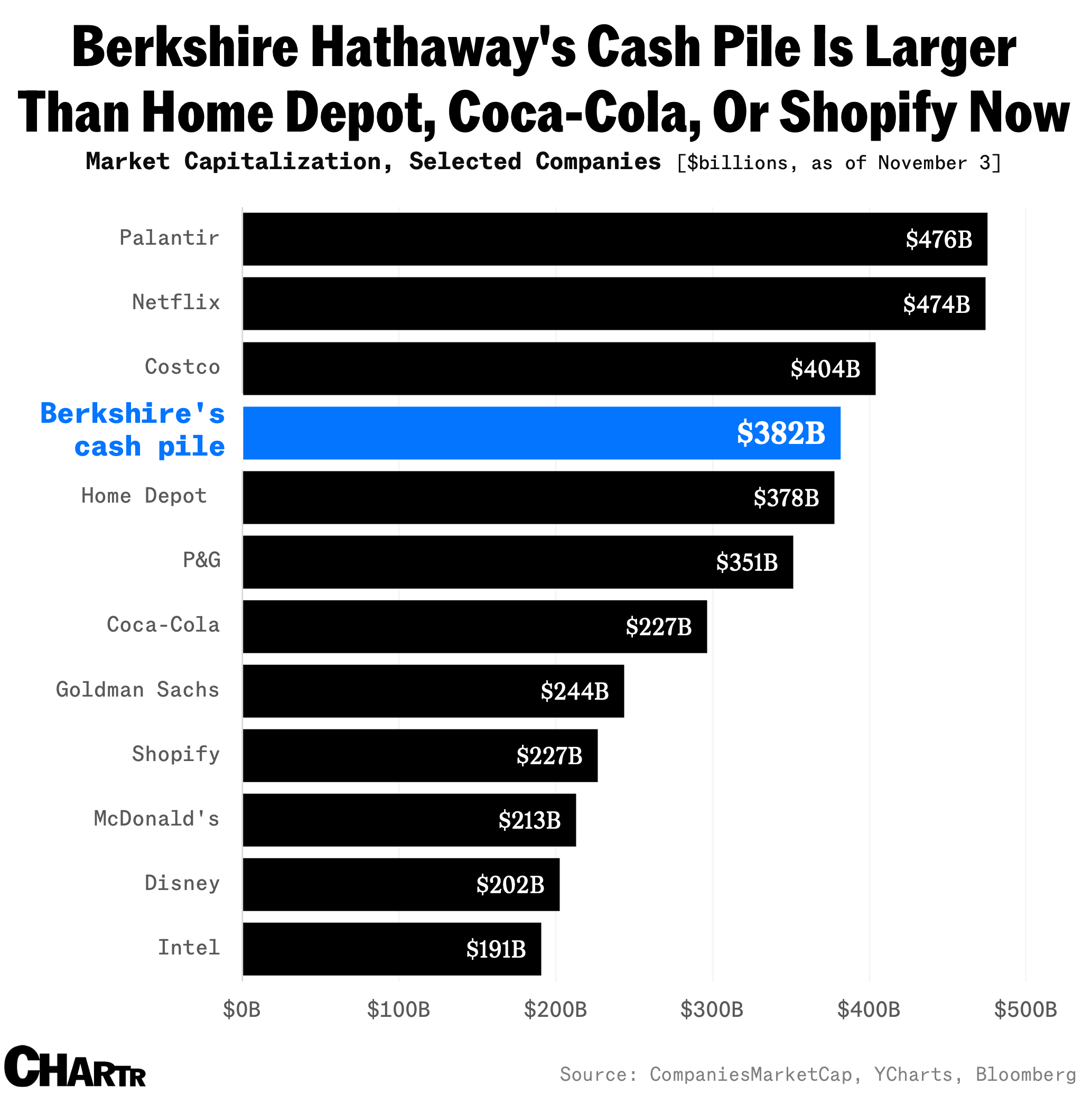
Berkshire’s cash pile is massive
Sherwood News

So, could Berkshire actually buy one these giants? In theory, yes. In practice, almost certainly no.

For starters, Berkshire would likely have to pay a hefty premium, typically 20% to 40%, to convince shareholders to sell — not to mention the fact that any deal would be highly complex and trigger regulatory concerns. Most importantly, however, if Berkshire is struggling to find attractive places to park $5 billion or $10 billion, it seems incredibly unlikely that Buffett, who is 95, will decide to splurge on a megadeal — and even more unlikely that Greg Abel, who will take over as CEO of Berkshire starting January 2026, will decide to take a huge punt as his first act in the boss’s chair.

More Business

See all Business
business

China’s EV startup trio have all become profitable

China’s EV startup trio, Nio, Li Auto, and XPeng, are now all profitable, following the latter’s Q4 results released Friday.

XPeng reported a quarterly net profit of about $55 million, compared to rival Nio’s Q4 net profit (also its first) of about $40 million. Li Auto posted Q4 net profit of less than $1 million.

All three companies being profitable offers a stark contrast to the EV market in the US, where Rivian quietly delayed its 2027 profitability target in a filing about its Uber robotaxi partnership yesterday. Lucid is likely further away, and last month cut 12% of its US workforce as part of its “path toward profitability.”

Still, it’s not all rosy for China’s EV startups, either. XPeng ADRs were down more than 6% in Friday morning trading as its Q1 sales forecast came in below estimates. As China rolls back subsidies, auto sales are slumping. Chinese retail EV and hybrid sales fell 32% in February from the same month last year.

9.3%

As the war with Iran produces the biggest spike in US gas prices since Hurricane Katrina, car retailer CarMax is continuing to see heightened interest in EVs, hybrids, and plug-in hybrids.

“From Feb 1st - March 1st (inclusive), compared to March 2nd to March 15th (inclusive), we saw a 9.3% lift in page views for these vehicles,” a spokesperson for the company told Sherwood News.

As industry insiders recently told us, EV interest climbs when gas prices rise. That appears to be holding true even without EV tax credits, which the Trump administration ended under its new budget package.

CarMax also saw EV searches spike in 2022, amid Russia’s invasion of Ukraine and the resulting oil price spike.

Walt Disney Chairman And CEO Bob Iger Rings Opening Bell At NY Stock Exchange

It’s the end of Disney’s Iger era (again)

Incoming CEO Josh D’Amaro is replacing Bob Iger on Wednesday, though Iger will remain a senior adviser through the end of the year.

$35.4B

The tariffs imposed by the Trump administration have cost automakers at least $35.4 billion since the start of 2025, according to a new analysis by Automotive News.

That total will continue to climb this year, since the Supreme Court’s February tariff ruling largely leaves the 25% levy on vehicles and auto parts untouched.

Toyota has taken the biggest hit, projecting more than $9 billion in tariff costs in its fiscal year ending this month, while Detroit’s big three automakers — Ford, GM, and Stellantis — were hit with a combined $6.5 billion tariff charge in 2025.

In the fourth quarter, automakers sold about 8% fewer imported vehicles in the US compared to the same period a year ago, per the Automotive News Research & Data Center.

Tariff charges come at a rough time for legacy carmakers, which are also scaling back EV plans following the Trump administration’s elimination of tax credits and fuel standard goals. According to Automotive News, the cost of EV write-downs and restructuring is, so far, nearly $70 billion.

Latest Stories

Sherwood Media, LLC produces fresh and unique perspectives on topical financial news and is a fully owned subsidiary of Robinhood Markets, Inc., and any views expressed here do not necessarily reflect the views of any other Robinhood affiliate, including Robinhood Markets, Inc., Robinhood Financial LLC, Robinhood Securities, LLC, Robinhood Crypto, LLC, Robinhood Derivatives, LLC, or Robinhood Money, LLC. Futures and event contracts are offered through Robinhood Derivatives, LLC.