Crypto
US-CRYPTOCURRENCY-CLIMATE-EMPLOYMENT-CHINA
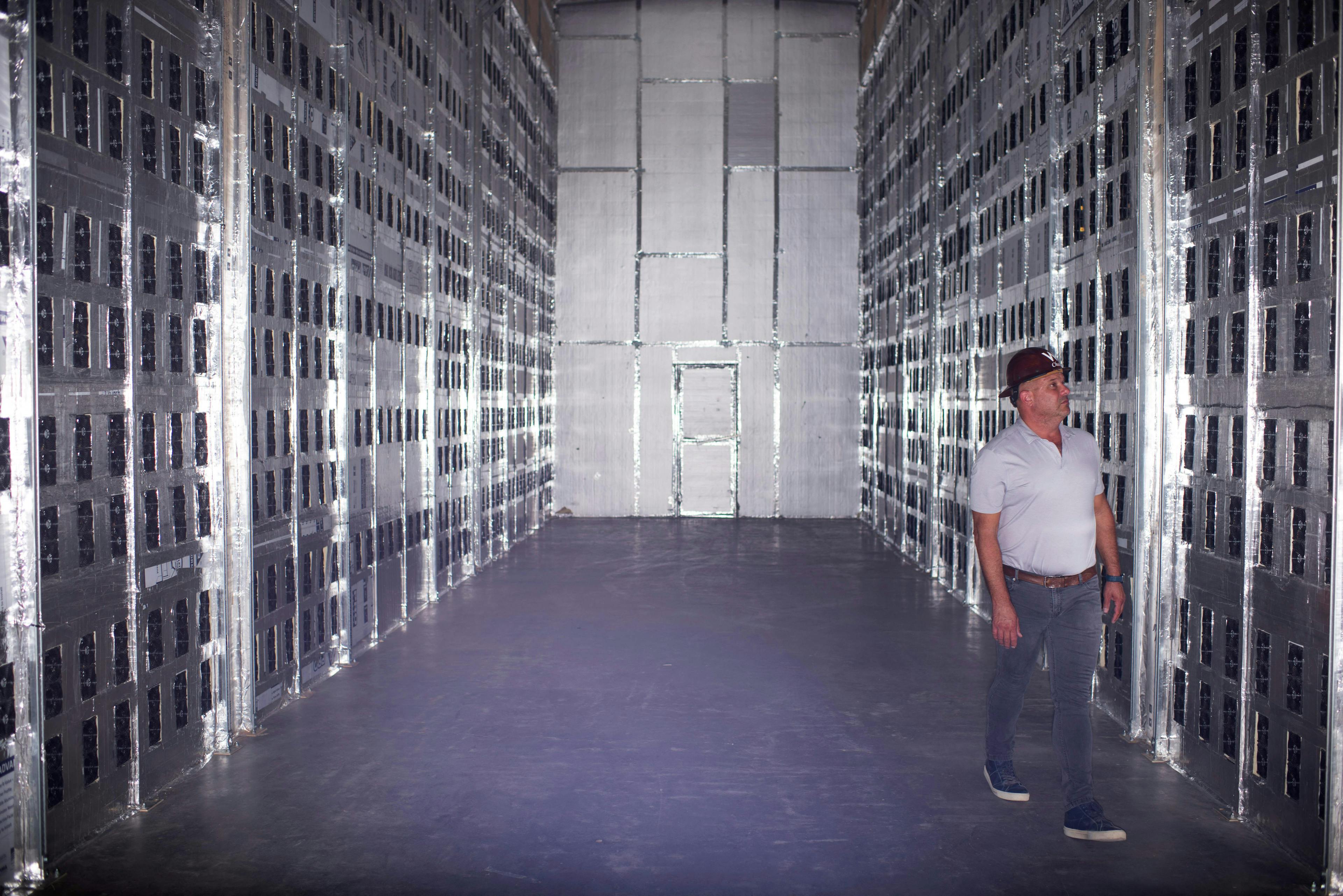
Bitcoin mining machines in Texas (Mark Felix/Getty Images)

As bitcoin mining economics “have gone from bad to worse,” companies pivot and sell to survive

Core Scientific is just the latest miner offloading its bitcoin, as other miners turn their compute power to AI.

Bitcoin is down roughly 50% from its all-time high in October, putting immense pressure on bitcoin mining companies. To survive, the firms are increasingly pivoting to AI and selling their assets, while others are exiting the business entirely.   

On Monday, Core Scientific announced in its earnings call that it sold over 1,900 bitcoin for $175 million in January.

CFO Jim Nygaard said that at this time, the company holds under 1,000 bitcoin and “expects to remain opportunistic going forward” as it shifts focus to AI and colocation growth.

CEO Adam Sullivan added that its mining business is “still essentially in runoff today.”

Core Scientific’s bitcoin sale follows former bitcoin miner Bitdeer’s similar move in late February, when the company announced it had sold all of its bitcoin holdings to fund its pivot to AI.

Haris Basit, chief strategy officer at Bitdeer, told Sherwood News that “unlike many others in the sector, we have mastered the most technically demanding part of bitcoin mining: designing and producing energy-efficient ASICs,” or application-specific integrated circuits.

Basit said that the company is evaluating multiple nonbinding powered land acquisition opportunities, as it is currently prioritizing liquidity to maintain flexibility.

“Going forward, the bitcoin we generate may be monetized or retained on a dynamic basis, depending on capital needs, market conditions, and the relative return on alternative growth initiatives,” Basit said.

Mining is “unprofitable for all but the most efficient operations” now.

Rosenblatt analyst Chris Brendler said in a note that in the two months since the firm’s previous sector update, bitcoin mining economics “have gone from bad to worse.”

“With hashprice now under 3¢, it is down to levels that are unprofitable for all but the most efficient operations, and we do not expect most miners to operate unprofitably for extended periods of time,” Brendler said.

Brendler told Sherwood that bitcoin’s price drop means miners have been squeezed, and the network hash rate hasn’t kept up. “It has happened before and usually takes six months before the market adjusts,” he added.

The most vulnerable miners are the ones with higher cost structures: as the companies went public, they grew operations, and the risks grew bigger too, Brendler said.

The miners in a better position are in places where energy prices are super low, mostly outside the US, he said.

“I don’t think bitcoin mining will be a big industry in the US long term,” Brendler predicted.

He added that as companies exit the mining business, it could create opportunities for others.

Hut 8 spun off its mining business to American Bitcoin (ABTC). They have a low-cost structure and efficient operation so that it can be profitable down here, and with access to capital, they could be an acquirer,” he said, adding that they might not acquire whole companies but rather the locations or machines of firms exiting the space, like Cipher Mining or Terawulf.

Mark Palmer, equity research analyst at Benchmark, said that given the advantage Hut 8 stands to gain from its lower cost of capital after the spin-off, it would be surprising if other bitcoin miners with AI data center exposure did not pursue that option. 

“We have already seen Bitfarms walk away from its bitcoin mining business so it could focus on AI data centers as the rebranded Keel Infrastructure, and it is quite feasible that other miners will do so as well,” he said.

Even MARA Holdings, one of the largest corporate bitcoin miners and stockpilers, recently pivoted to high-performance computing (HPC) with its Starwood deal. Brendler said that while MARA is “late to the game,” the deal makes sense as it outsources HPC development to “an established leader in the data center sector.”

MARA said in a 10K filing that it had revised its digital asset management strategy in 2025 to permit the sale of bitcoin generated from operations, softening its former “HODL” stance.

“We expect to continue to monetize bitcoin opportunistically to enhance our financial flexibility, including to provide liquidity or to fund capital projects and other initiatives that we believe enhance long-term shareholder value,” according to the filing.

“Miners who adapt their business models now... will be the ones who define the industry landscape over the next five years.”

Juliet Ye, head of communications for Chinese miner Cango, which holds 3,645 bitcoin, told Sherwood that bitcoin’s current pullback is accelerating the industry’s evolution.

She said that operators are being pushed to think beyond pure hashrate growth and find how to diversify their infrastructure value — whether through energy optimization, active treasury management, or deploying their energy-secured compute assets toward emerging opportunities like AI inference.

“The miners who adapt their business models now, rather than waiting for the next bull cycle, will be the ones who define the industry landscape over the next five years,” she said.

In February, Cango completed the sale of 4,451 bitcoin on the open market. The move was “executed to strengthen its balance sheet and reduce financial leverage, which provides increased capacity to fund the Company’s strategic expansion into AI compute infrastructure,” a press release said. 

Looking ahead, Alexander S. Blume, founder and CEO of Two Prime, told Sherwood that there is still a core group of miners who remain focused on the space. 

“The hashrate occupied by these pivoting miners will fall into the hands of larger miners or private groups still committed to BTC. At current prices, only a few miners can make money,” Blume said.

Blume said that some groups have added finance desks that can hedge downside exposure and generate income on their holdings.

“I think we will see, ultimately, consolidation of mining hashrate into the hands of fewer players and fewer pools, which is not ideal for the decentralization of bitcoin itself,” he said.

More Crypto

See all Crypto
crypto

Bitcoin jumps to highest level since February, boosted by optimism over reopening of Strait of Hormuz

Bitcoin finally broke out of the tight range it’s been stuck in for weeks, rising to just below the $78,000 mark, a level not reached since early February, as risk-on sentiment floods back into the market.

The jump comes on the heels of Iran and the US announcing the reopening of the Strait of Hormuz on Friday morning, which sent oil prices down and the stock market higher.

The renewed optimism for a deal with Iran and the end of the Middle East conflict also sent crypto stocks jumping, with Strategy, the largest corporate bitcoin holder, up more than 13% late Friday morning.

Wave Digital Assets’ head of international portfolio management, Rajiv Sawhney, told Sherwood News that its all about the Strait of Hormuz. Markets are interpreting it as a win. Its a knee-jerk reaction given positioning and expectations. As such, while bitcoin was able to tick higher, the $80K level will be the real barometer we need to cross for me to feel confident that this relief rally has legs, he said, adding that until then, hes remaining cautiously optimistic that risk assets can close at these levels. 

Nic Puckrin, cofounder of Coin Bureau, told Sherwood that we’re seeing a classic short squeeze as heavy short positions in bitcoin are being liquidated, adding that the next resistance level to watch is $79,000. 

“If we get past that and close the week above this level, $90k becomes a real possibility in the medium term. However, if the rally gets rejected at this level, we could remain stuck in the range between $65k and $75k that held bitcoin hostage for months,” Puckrin added.

Underscoring the cautious comeback, Bloomberg reported that from a derivatives market perspective, “traders remain largely defensive.”

“Funding rates for perpetual futures contracts, a key measure of whether leveraged traders are betting on higher or lower prices, were negative. Hefty premiums are also being paid for put options providing downside protections at $60,000 and $50,000, respectively,” Bloomberg reported.

Bitfinex analysts told Sherwood that the liquidation heat map shows dense shorts leverage stacked between $76,000 and $78,000. 

“Clearing this range opens a substantial air gap in the unspent realized price distribution up to $82,000,” they said, adding that the next level they are watching is $83,000, a “significant wall at the short-term holder realized price.”

crypto

OP token rises after payments card provider Ether.fi finalizes migration to the layer 2 network

OP, the governance token for OP Mainnet, has increased as much as 5% since Tuesday night following news that Ether.fi, a decentralized finance protocol known for providing noncustodial crypto payment cards, completed its migration to the ethereum layer 2 blockchain network. 

Ether.fi’s move resulted in around $220 million in total value locked coming to OP Mainnet, the largest single TVL event in the network’s history, as well as over 70,000 payment cards and more than 300,000 accounts, according to a blog post from Ether.fi

Originally on alternative layer 2 network Scroll, Ether.fi made the switch to OP Mainnet due to lower median transaction fees of $0.00001 and sub-250-millisecond finality times. 

“To ship what comes next, we needed infrastructure that could handle real-time payments at consumer volume,” Ether.fi CEO Mike Silagadze told Sherwood News. “OP Mainnet delivered on every dimension. Three days to migrate $220M with no downtime answered the question. Now we get to build.” 

The migration comes about two months after Coinbase-incubated blockchain Base announced moving away from Optimism’s OP Stack. 

crypto

Ethereum climbs to highest point since end of January

Ethereum has rallied 8% in the last 24 hours to trade just under the $2,390 level, liquidating over $151.7 million worth of ethereum short positions in the period. 

The last time ethereum was at its current level was the last day of January, data from CoinGecko shows.

According to Jim Hwang, COO of investment company Firinne Capital, ETH has been acting as a risk asset: declining in times of heightened uncertainties such as the conflict in Iran, inflation expectations, and diminished rate cut hopes.

“Only in the last 24+ hours when these uncertainties have diminished are we seeing prices lift again. We can feel a bit of optimism but to the extent that this cease fire remains tentative, we should probably view the current ETH price gains with caution,” Hwang told Sherwood News. 

A GlassNode senior analyst, who maintains the pseudonymous X account CryptoVizArt, said on X that ethereum has “reclaimed the one-to-three month holder cost basis at around $2,300. So far, this structure is consistent with a bear market relief rally, comparable to the bounces observed in Q3-Q4 2022, rather than a structural trend reversal.” 

Tom Lee, chairman of ethereum treasury firm BitMine Immersion Technologies, said ethereum’s performance since the start of the Iran conflict demonstrates how the cryptocurrency is a “wartime store of value,” per the firm’s press release on Monday, in which it announced acquired 71,524 additional tokens worth $170.5 million. That brings its total stockpile to nearly 4.9 million tokens, or 4% of the total supply of ethereum. 

That said, the founder of venture capital firm Kenetic, Jehan Chu, told Sherwood, “It’s clear that regaining ATH [all-time high] will take real-world revenue-generation, and not just a Tom Lee narrative.” 

Latest Stories

Sherwood Media, LLC produces fresh and unique perspectives on topical financial news and is a fully owned subsidiary of Robinhood Markets, Inc., and any views expressed here do not necessarily reflect the views of any other Robinhood affiliate, including Robinhood Markets, Inc., Robinhood Financial LLC, Robinhood Securities, LLC, Robinhood Crypto, LLC, Robinhood Derivatives, LLC, or Robinhood Money, LLC. Futures and event contracts are offered through Robinhood Derivatives, LLC.