Bitcoin falls 50% from all-time high and on track for its worst month since June 2022
“The market is priced for catastrophe,” the head of research at Amberdata said.
Bitcoin fell below $63,000 early Tuesday morning, a 50% drop from its October 6 all-time high. The asset is down 19% so far in February, marking its worst month since June 2022, when it was down 37.28%, according to CoinGlass. With a few days to go, bitcoin is about to close February in the red for the fifth consecutive month.
“BTC has developed a downward-shifting structure. The 62K region marked a concentrated long liquidation zone, and a round of leverage flush-out has largely been completed in the short term. Overhead, the 66,000 area remains a dense cluster of short positioning,” said Dean Chen, a Bitunix analyst.
Chen said that if tighter rate expectations persist, the structure is likely to remain characterized by weak consolidation and repeated tests of lower support.
“At this stage, the key variable is not price itself, but whether capital is willing to rebuild risk exposure amid macro uncertainty,” he said.
Another factor to watch is the absence of the “crowded” long positioning we’ve seen in the past, which reduces the risk of cascading liquidations, Bitfinex analysts said.
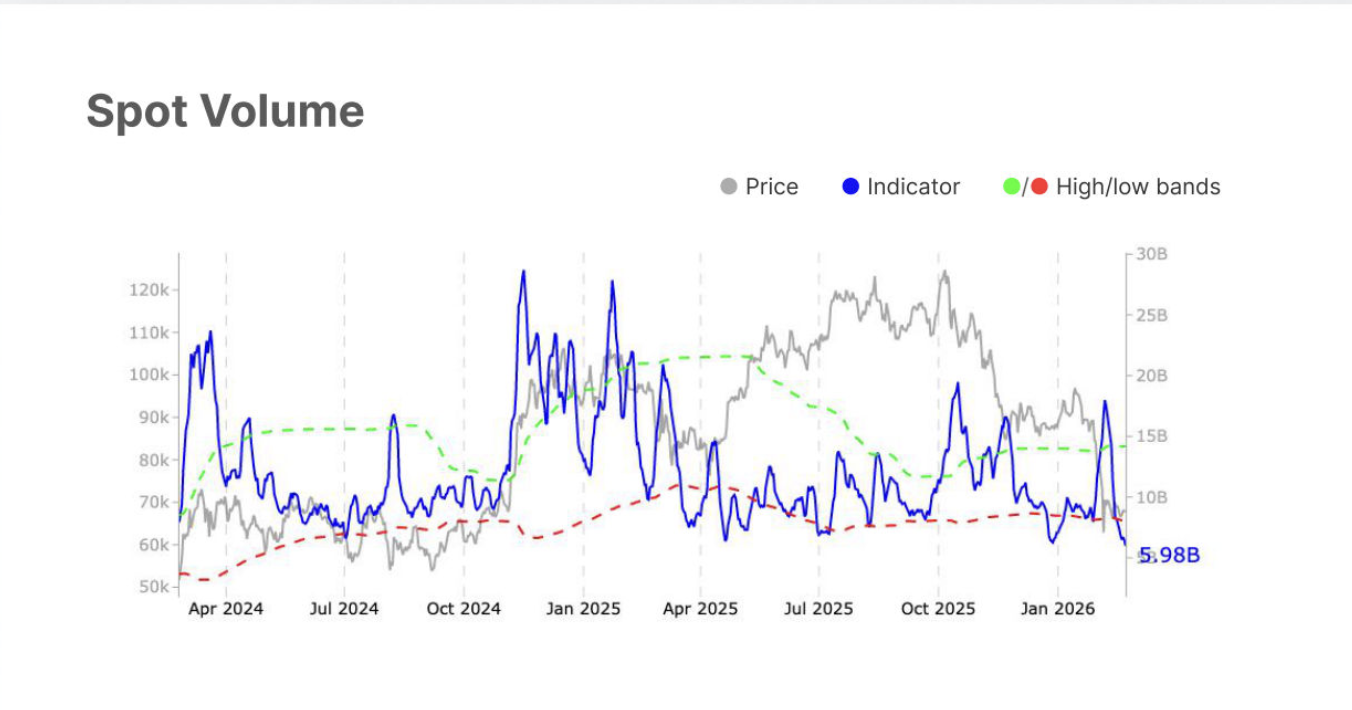
“But there’s a trade-off: upside momentum can no longer rely on the fuel of short-covering alone. For a durable recovery to take hold, we need to see funding stabilize alongside a genuine resurgence in spot demand and not just mechanical squeezes playing out in a leverage-light environment,” they said.
The analysts are watching the $60,000 to $69,000 zone, which is acting as a critical absorption layer where medium-term holders are currently near breakeven and refraining from further distribution.
Meanwhile, bitcoin ETFs crossed the $1 billion mark in outflows for the month, seeing $1.2 billion leave the funds in February, SoSoValue data shows. BlackRock’s iShares Bitcoin Trust, which was on the cusp of reaching $100 billion in assets under management in October, is now down to $48.47 billion in AUM.
Mike Marshall, head of research at Amberdata, told Sherwood News that the Fed holding rates steady until June, the tech and AI sell-off, tariff turmoil, and potential military action against Iran are all funneling through an ETF-era feedback loop where institutional outflows drain liquidity, amplify declines, and trigger more redemptions.
“Derivatives and sentiment indicators are at levels only seen during Covid, Terra/Luna, and FTX — term structure backwardation at 1.30, volatility doubled, funding deeply negative — which doesn’t call a bottom, but tells you the market is priced for catastrophe at a moment when the macro catalyst calendar from Iran to the delayed CPI print is far from resolved,” Marshall said.
Finally, Glassnode analysts said that while sell pressure is easing at the margin and momentum is improving, participation and capital flows remain weak, leaving the market vulnerable to reactive swings.
“A more durable recovery likely requires renewed spot demand and a clearer improvement in on-chain engagement,” they said in a February 23 report.