Bitcoin maintains $71,000 range as new bitcoin ETFs hit market
One of the new funds is designed to capture bitcoin’s profits overnight, a time when bitcoin often sees a significant upside compared to when the US market is open.
Bitcoin got a brief bump on Wednesday, jumping to a three-week high and crossing $72,000 following the announcement of a ceasefire with Iran — but it’s trading sideways on Thursday between the $70,000 and $71,000 levels. Despite bitcoin trading in a tight range for a while now, new bitcoin ETFs keep hitting the market.
On Wednesday, Morgan Stanley launched its Morgan Stanley Bitcoin TRUST fund on NYSE Arca, registering $30.6 million in inflows on day 1, according to Farside Investors, though data from Yahoo! Finance put the figure at $34 million. Bloomberg analyst Eric Balchunas said the inflow represented the “top 1% of ETF launches” in the past year.
In contrast, bitcoin ETFs overall recorded $124.55 million in outflows yesterday, with the only other inflows coming from the market leader iShares Bitcoin Trust.
A major differentiator of the new fund is its 0.14% fee, the lowest rate among bitcoin ETFs. In comparison, BlackRock’s iShares Bitcoin Trust charges a 0.25% fee, while the Grayscale Bitcoin Mini Trust ETF has a 0.15% fee.
Balchunas said that “14bps could entice others to cut, or new entrants to come in even lower. Fee wars are part of life.”
Tyler Rowe, head of video at BitcoinTreasuries.net, called MSBT’s first day “a referendum on distribution,” adding that Morgan Stanley has trillions in client assets and advisers who’ve been fielding bitcoin questions for years without an in-house product to point to.
“The 14 basis point fee just removed the last excuse and is going to fuel an arms race to the bottom for its competitors. Tepid flows into the broader bitcoin ETFs are informed by current asset sentiment, not long-term structural demand. MSBT is tapping a client base that was already asking for the exposure, and the institutional strength of Morgan Stanley releasing this product is going to drive even more eyes to the asset class,” Rowe said.
Speaking of new entrants, Nicholas Wealth launched the Nicholas Bitcoin and Treasuries AfterDark ETF, which provides bitcoin exposure from the US closing bell until the following morning’s market open.
David Nicholas, founder and CEO of XFUNDS, told Sherwood News that the first day of trading “was a perfect example of how NGHT’s ‘AfterDark’ trade can be successful.”
“Bitcoin surged in the overnight hours, but gave back some of the gain during normal trading hours. IBIT closed up 3.35% for the day. NGHT only had exposure during the overnight hours and closed up 5.32% on its first day of trading. NGHT outperformed IBIT by 58%,” Nicholas said.
When asked what prompted the launch, Nicholas said, “It was the historical outperformance of the overnight price of IBIT (+200% since inception) compared to the intraday price (-52% since inception).”
Ishmael Asad, a Bitwise research analyst, told Sherwood that these new launches underscore rising demand for new strategies and ways to gain exposure to crypto markets, as well as the growing direct presence of traditional financial institutions in the space.
“This shift was made possible by the SEC’s approval of generic listing standards for crypto ETPs late last year. Today, there are over 400 crypto ETPs on the market, more than double the amount just two years ago. That change in regulatory stance was just over six months ago — so we’ve only just begun to see its true impact on the crypto ETF landscape,” Asad said.

Bitcoin ETF flows have been somewhat tepid, registering $1.32 billion in inflows in March. This represents the first monthly inflow since October 2025, reflecting renewed institutional interest, but it’s still a far cry from the bombastic multibillion monthly inflows of months past. So far this month, they registered $23 million in inflows, with April 6 seeing $471 million in inflows, the largest daily inflow since February 25.
Bitfinex analysts told Sherwood that the April 6 session marks the strongest single-day institutional bid in over 30 days, which “supports the core thesis: US allocators are actively treating sub-$70,000 prices as an accumulation zone.”
Glassnode echoed the sentiment, saying in a report that ETF flows are starting to improve, “with the 14-day average flipping back into modest net inflows after an extended period of outflows.”
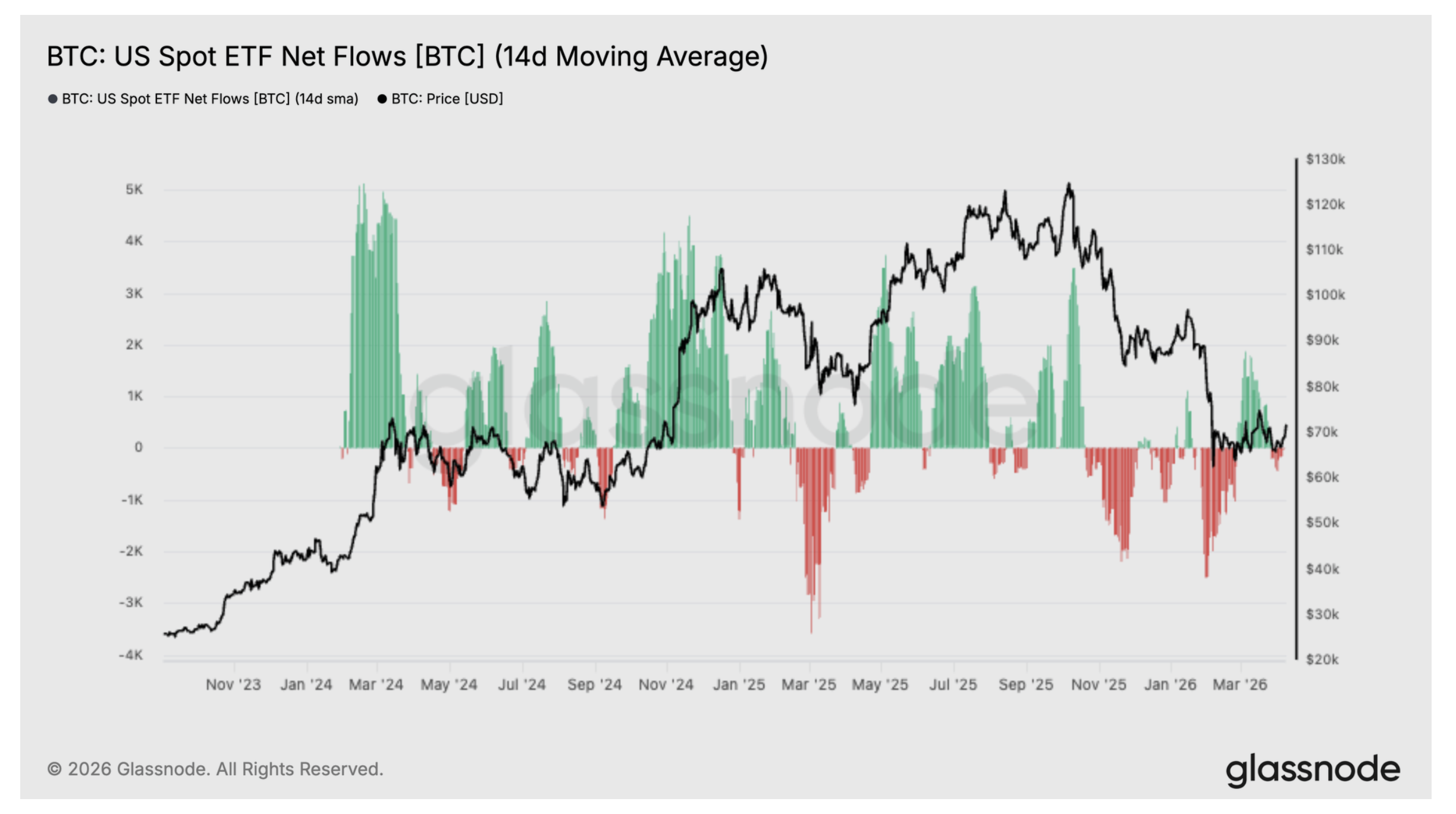
“The shift is still small in magnitude, but directionally important,” Glassnode said, adding that it’s suggesting “early signs of institutional demand returning around current levels.”
Yet, they also noted that “for now, this looks more like early stabilization than a full return of institutional demand.”