


More profitable hardcovers are slowly killing the paperback book
As publishers have tried to avoid printing losses, the number of new adult nonfiction paperback titles has dropped by 42% in the last five years.
It’s a strange time to be an author. Since the pandemic, the average consumer is reading less — one January survey found that almost half (48.5%) of all respondents hadn’t read a single book in over a year — and the acceleration of AI has meant that while established authors face the dilemma of whether to license their work to AI, new authors are contending with an abundance of on-demand literature.
Furthermore, the traditional publishing cycle, which would see a paperback version hit shelves roughly a year after the hardcover’s release, has shifted, as reported by The Wall Street Journal on Monday. Publishers are launching that second round of cheaper prints less frequently, giving authors fewer shots at making sales. Indeed, data from Bowker Books in Print found that the number of new US adult nonfiction paperback titles sunk by 42% in the five years to 2024; the number of equivalent hardcover titles only dropped by 9%.
Meanwhile, per Circana Bookscan, the unit sales of mass-market paperbacks — the soft-covered, pocket-sized titles often spotted on beaches and in airports — fell 19% year over year, compared with modest increases for larger, more durable trade paperbacks, hardcovers, and board books (for children).
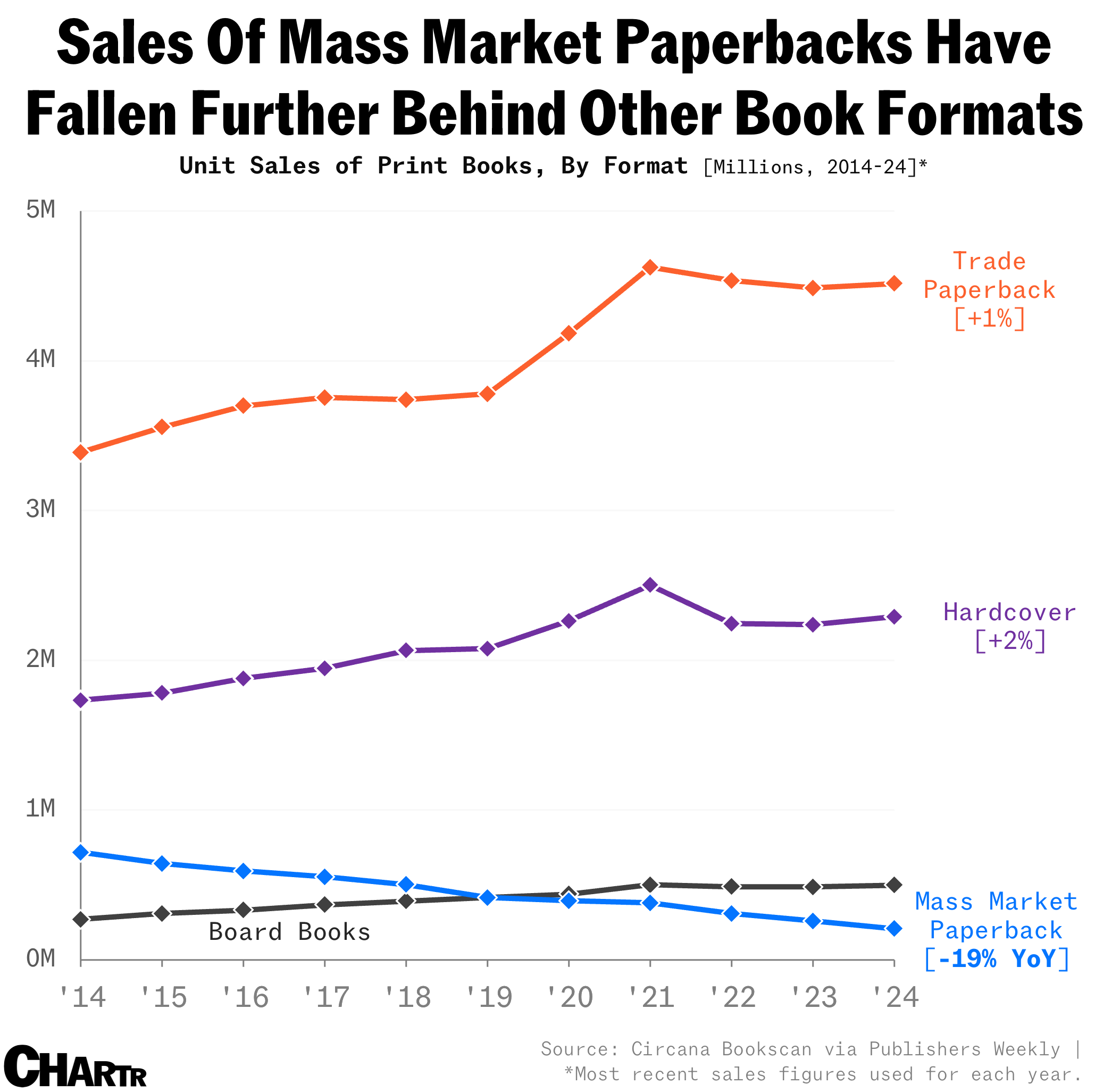
Turning the page
Though hardcovers cost more to produce, publishers, authors, agents, and booksellers all tend to make more money on the higher revenue per title. That allows them to cover the author’s advance, as well as the cost of printing, marketing, and distribution, even when shipping fewer units.
Even so, the market for paperbacks just isn’t what it used to be. Audiobooks and e-books have surged in popularity, attracting midlist writers that might usually aim for a paperback release, and online giants like Amazon sometimes charge less for hardcovers than paperbacks depending on their supplies. Costco has given up on bulky books altogether, closing book sections in hundreds of stores.