


We’re spending more time watching videos on social media
That’s cutting into how much we stream TV and movies
Streaming vs. Social media
For some time, small screens and big screens have been competing for our attention, with many people admitting to “second screening” — when they find themselves flicking through their phone while also absent-mindedly watching something on TV. Now, a new report from Variety suggests that a rise in video consumption on social media is eating into the time we spend streaming on-demand… and TikTok is leading the charge.
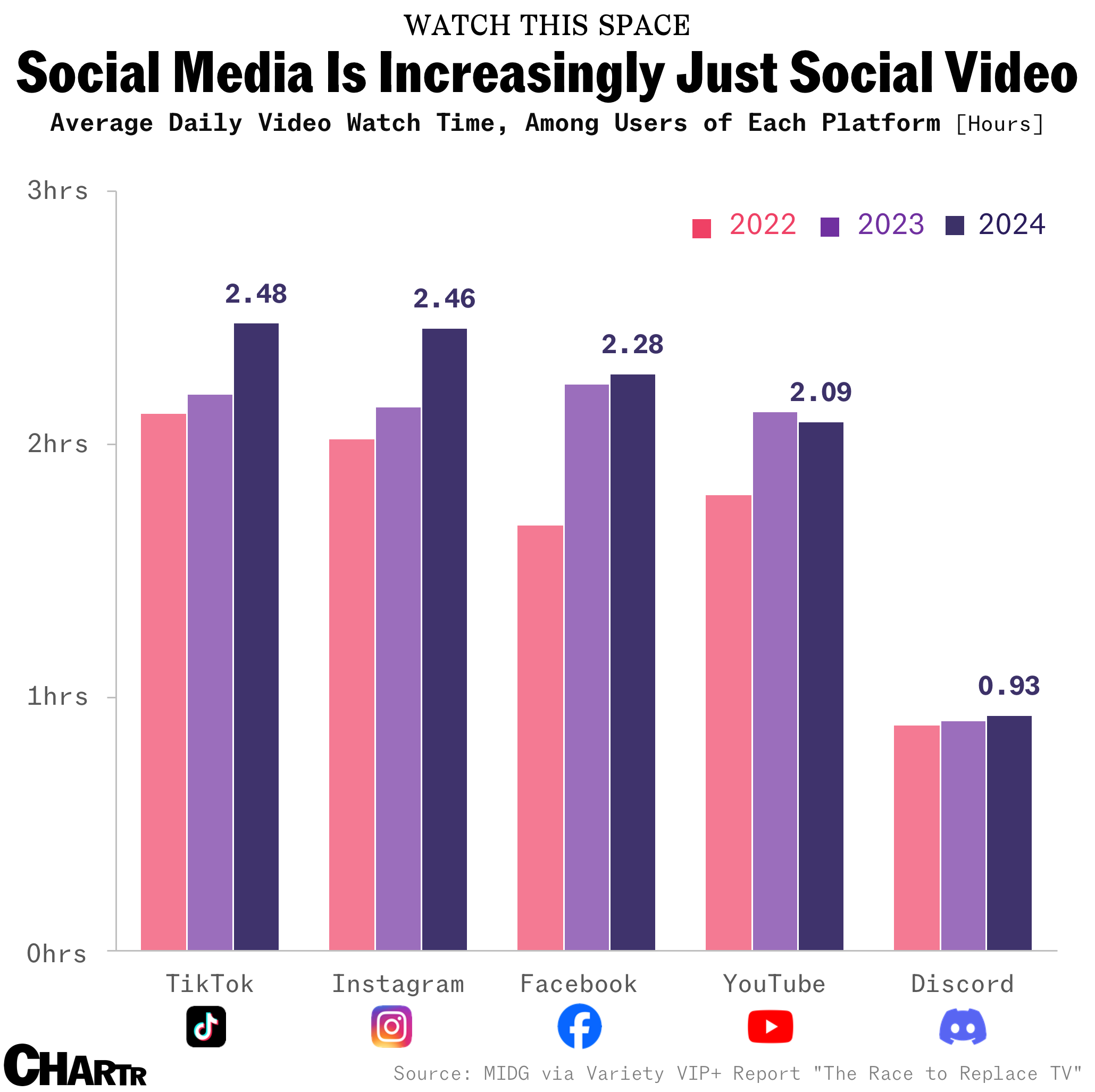
Indeed, the average daily video watch time has increased from 2.12 hours in 2022 to 2.48 hours this year on TikTok, according to data from Media IDentity Graph supplied to Variety. That’s more than any other major social media platform’s watch time, many of which have pivoted to video to compete with TikTok (as with Instagram’s Reels feature).
With audiences spending more time on social video — video now accounts for almost 60% of average time spent on social networks, according to eMarketer — TikTok is now testing a 60-min length limit for uploads, upping the 15-min max established last year, and considerably greater than the 15-second ceiling that it had at launch.
Now, short- and long-form social video is cutting into time spent watching streaming, particularly for younger consumers: per Variety’s report, “Watching TV and movies together accounted for just 32% of media time among 13-24 year-olds, versus 59% for consumers over 35.”
In fact, 58% of respondents aged 13-24 reported that they were spending less time watching “regular” TV because they were watching “non-premium” online videos (i.e., social video). Just as cable TV was quickly swallowed by on-demand streaming at the turn of the century, it was inevitable that an even bigger fish — and, in this case, a smaller screen — would eventually come along.
As Delia Cai aptly put it:
another day of staring at the big screen while scrolling through my little screen so as to reward myself for staring at the medium screen all week
— delia (@delia_cai) November 22, 2020