Markets

LET THERE BE LIGHT

Fiber optic cables
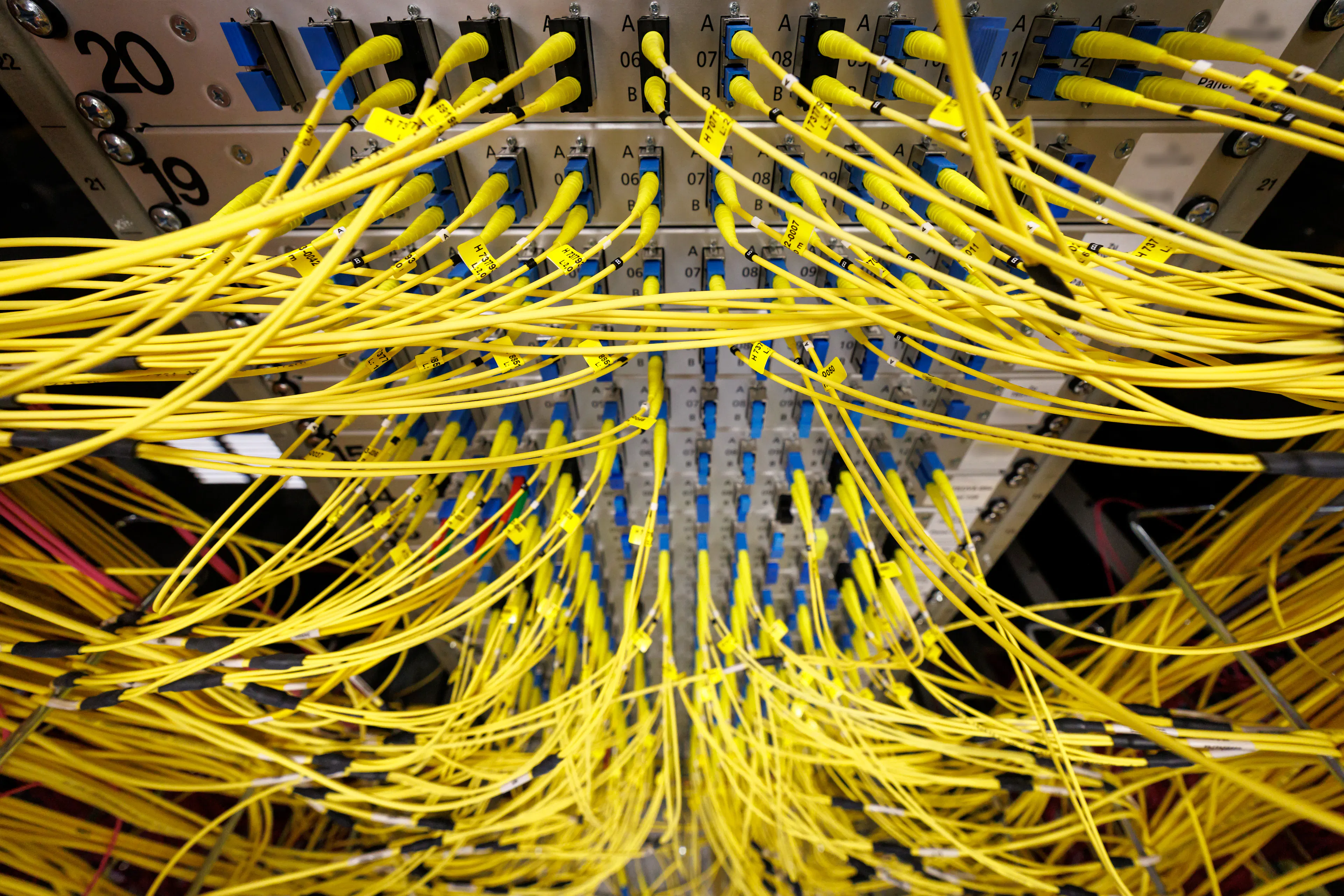
Fiber-optic cables (Daniel Karmann/Getty Images)

After taking a dip when the war started, fiber-optic stocks are running at light speed again

One of the banner names in the space, Lumentum, just hit an all-time high, up 44% off the post-war low that happened just 19 days ago. But are investors starting to price in perfection?

War or no war, the AI boom continues. 

And so does the hunt for companies positioned at choke points in the AI investment frenzy, allowing them to vacuum up a healthy share of the cash pouring into the great AI build-out.

When that wave of capital hits such a bottleneck, it causes product prices to surge, explodes profit margins, and often sends stocks soaring. All three of those things have happened for the companies that produce optical components for AI, and they’ve caught another leg up in recent days after looking wobbly at the start of the Iran war.

These so-called optics companies all handle slightly different aspects of the same undertaking: using light and electrical signals to almost instantly transfer the data that AI technology both consumes and produces. 

And over the past few months, the cluster of optical stocks — Lumentum, Coherent, Ciena Corp., and Corning — has elbowed its way toward the top of the heap of AI-related trades.

The gains accelerated Tuesday when Lumentum — which was only officially added to the S&P 500 at the start of the week — jumped 10% and Corning rose 8.4%, making them the two top gainers in the S&P 500 for the day. Coherent, which also just joined the blue-chip index, rose nearly 7%. Lumentum closed at an all-time high, up a whopping 44% off its post-war low just 19 days prior.

Some of the recent momentum amounts to afterglow from the industry’s big annual conference held last week in Los Angeles. It was followed by a flurry of relatively rosy research reports and price target hikes.

On Monday, for instance, analysts at French bank BNP Paribas jacked up their price target for Lumentum to a Wall Street high of $1,040, a 30% premium to where the stock closed Tuesday. They cited company projections for operating expenses and profit margins presented at the conference that “came in above most bullish expectations.”

There’s been a lot of that going around.

As the scale of AI’s data needs has become clear, investors and analysts — and in some cases, the companies themselves — have rushed to revise their demand and sales forecasts sharply higher.

Late last month, Morgan Stanley analysts kicked up the bank’s estimate of the AI-related optical communications market to around $90 billion by 2028, up from roughly $30 billion in 2025.

BNP Paribas jacked up its price target for Lumentum, saying the company’s expectations for operating expenses and margins “came in above most bullish expectations.”

Likewise, Bank of America this month upped its estimate of the total addressable market for AI optical technology from $14 billion in 2025 to an expected $73 billion in 2030.

At the conference earlier this month, executives from Lumentum told attendees they expected their total addressable market to grow at a 40% annual rate for the next few years, hitting more than $90 billion by 2030. (It was $18 billion in 2025.) 

Where is all this growth coming from? A range of areas. 

For one thing, analysts say the scale of the AI boom — and AI’s requirements for bandwidth, speed, and power — is beyond the capacity of some long-standing networking technologies, such as the copper cables that carry signals using electricity. 

The size of AI data centers and required data speeds further expose the limitations of using copper — which consumes more power and is prone to signal loss over longer distances — compared to fiber-optic cables. 

“Copper is an excellent medium at short reaches (<10 meters),” wrote Bank of America analyst Vivek Arya. “But as hyperscalers build larger compute nodes, interconnect even more nodes, and link geo-dispersed data centers, the role of optics expands.” 

Meanwhile, data centers are also often being built far away from urban centers, meaning they require more long-haul fiber-optic cabling to connect them to end users and sources of data, analysts say.  

“What we’re seeing is that development and construction is expanding toward new and tertiary markets in the United States,” said Gordon Dolven, who heads research on the data center sector for giant commercial real estate brokerage CBRE. “Because of improvements in fiber connectivity, you now can develop — as an example — in Reno, Nevada, instead of having to go to Silicon Valley.” 

But the largest part of the optical technology market related to AI is in so-called transceivers. These devices transform electrical signals into light that can be sent through fiber-optic cables. Transceivers also transform light back into electrical signals that computers can read as data. 

“We have begun to price-in perfection.”

Morgan Stanley analysts estimate the AI-related transceiver market amounts to roughly $50 billion, and is a particular strength for companies like Lumentum and Coherent. The data center build-out has been huge for the sector, as transceivers account for roughly 10% of the cost of a typical data center, according to Morgan Stanley. 

Of course, with growth data like that to point to, it’s no surprise these stocks have been running. The question for investors is whether they’re a good buy at current prices. That’s a tough call.

The stocks certainly aren’t cheap. Ciena is trading about 60x expected earnings over the next 12 months, as is Lumentum. Corning and Coherent are trading at roughly 40x, the highest level in more than 15 years. 

At the same time, these companies keep lifting their guidance and analysts keep raising their forecasts for profits over the coming year. And even with the war in Iran on, there are signs the AI investment boom is slowing. 

“We would fully expect these names to work as long as capex data points are revised higher,” Morgan Stanley analysts wrote. However, they cautioned, “having added ~$180 billion+ of market capitalization over the last year, we have begun to price-in perfection.”

More Markets

See all Markets
markets

Sandisk, Micron dive as Google Research unveils AI algorithm to reduce memory demands

This might be an unfortunately memorable day for the memory trade.

Memory stocks Sandisk, Micron, Seagate Technology Holdings, and Western Digital sank Wednesday after Alphabet’s Google Research group published details of a new algorithm known as TurboQuant.

Per Google’s extremely technical release, TurboQuant is an algorithm that allows for a data technique called “vector quantization to be used while addressing the issue of so-called “memory overhead,” allowing data in AI models to be compressed without reductions in accuracy or requiring retraining, while reducing the memory storage requirements at data centers.

And that outlook seems to be enough for the market to be sending memory stocks down for the day.

Per Google’s extremely technical release, TurboQuant is an algorithm that allows for a data technique called “vector quantization to be used while addressing the issue of so-called “memory overhead,” allowing data in AI models to be compressed without reductions in accuracy or requiring retraining, while reducing the memory storage requirements at data centers.

And that outlook seems to be enough for the market to be sending memory stocks down for the day.

markets

Fundrise’s venture fund extends rally, trading more than 2 dozen times above asset value

Fundrise Innovation Fund, a publicly traded venture fund that owns stakes in private companies like Anthropic, OpenAI, and SpaceX, is continuing to rally as the gap between the value of its stock price and its underlying assets grows.

Shares of the fund, which uses the ticker VCX, closed at $314.99 on Tuesday and rose to $533 by Wednesday morning — a nearly 70% jump for the day and a more than 1,500% increase in the value of its stock since it went public on March 19.

Fundrise’s vertiginous price action underscores just how hungry retail investors are for exposure to high-flying private companies, even at increasingly eye-watering implied valuations.

Shares of the fund, which uses the ticker VCX, closed at $314.99 on Tuesday and rose to $533 by Wednesday morning — a nearly 70% jump for the day and a more than 1,500% increase in the value of its stock since it went public on March 19.

Fundrise’s vertiginous price action underscores just how hungry retail investors are for exposure to high-flying private companies, even at increasingly eye-watering implied valuations.

markets

Chip stocks lifted by Arm’s barn-burner revenue projection hike, Meta deal

Chip stocks rose early after chip design firm Arm Holdings announced a massive upgrade to its long-term forecasts for sales at an investor event Tuesday evening, following earlier news that its partnering with Meta to create a new class of data center chips— the company projected the new chip alone will generate $15 billion in annual revenue by 2031.

Nvidia, Intel, Advanced Micro Devices, ON Semiconductor, Microchip Technology, and NXP Semiconductors all got a bump from Arm’s rosy revisions to its outlook.

Why? Basically, the speech that Arm CEO Rene Haas delivered at its Arm Everywhere event in San Francisco supports the idea that “agentic AI is expanding the TAM for server CPUs which should drive server unit growth upside,” as HSBC semiconductor stock analyst Frank Lee put it in a note Wednesday.

In other words, the rise of AI will equate to a permanent step up in chip demand from AI data center servers — also known as an increase in the total addressable market, or TAM. So, you know, higher chip stock prices.

Nvidia, Intel, Advanced Micro Devices, ON Semiconductor, Microchip Technology, and NXP Semiconductors all got a bump from Arm’s rosy revisions to its outlook.

Why? Basically, the speech that Arm CEO Rene Haas delivered at its Arm Everywhere event in San Francisco supports the idea that “agentic AI is expanding the TAM for server CPUs which should drive server unit growth upside,” as HSBC semiconductor stock analyst Frank Lee put it in a note Wednesday.

In other words, the rise of AI will equate to a permanent step up in chip demand from AI data center servers — also known as an increase in the total addressable market, or TAM. So, you know, higher chip stock prices.

markets

Cipher leaps on signing a 15-year data center campus lease with hyperscaler

Shares of Cipher Digital increased more than 11% on Wednesday morning amid news that the firm signed a new data center lease and secured a $200 million revolving credit facility. 

This is its third data center campus lease, following two deals in November. This 15-year deal is with an “investment-grade Hyperscale tenant” that includes plans to develop a new high-performance computing (HPC) data center at one of its existing sites, according to the press release. 

Cipher Digital also attained a $200 million revolving credit facility with an additional accordion option of up to $50 million, of which the total proceeds will be used to boost liquidity, support working capital, and fund growth initiatives. 

“This transaction marks Cipher’s first syndicated revolving credit facility and represents a major step in the evolution of our capital structure,” CFO Greg Mumford said in a statement. “We believe this facility highlights the continued strength and maturation of our business, as well as the growing confidence in our long-term strategy from premier financial institutions.” 

Last month, the firm rebranded from “Cipher Mining” to “Cipher Digital” to reflect the change of its focus from bitcoin mining to HPC data center development.

Cipher Digital also attained a $200 million revolving credit facility with an additional accordion option of up to $50 million, of which the total proceeds will be used to boost liquidity, support working capital, and fund growth initiatives. 

“This transaction marks Cipher’s first syndicated revolving credit facility and represents a major step in the evolution of our capital structure,” CFO Greg Mumford said in a statement. “We believe this facility highlights the continued strength and maturation of our business, as well as the growing confidence in our long-term strategy from premier financial institutions.” 

Last month, the firm rebranded from “Cipher Mining” to “Cipher Digital” to reflect the change of its focus from bitcoin mining to HPC data center development.

markets

EchoStar jumps on report SpaceX plans IPO filing as early as this week

EchoStar jumped early Wednesday on a fresh report about the supposedly imminent IPO filing from Tesla CEO Elon Musk’s commercial space behemoth, SpaceX.

The satellite stock, which was added to the S&P 500 on Monday, is in line to get a hefty chunk of SpaceX equity in exchange for the valuable spectrum rights it sold to Musk’s company.

EchoStar is set to collect roughly $20 billion on the deal, with as much as $11 billion to be paid in SpaceX stock.

The prospect of EchoStar potentially providing backdoor access to investing in SpaceX has attracted the attention of traders, and helps explain why the shares are up more than 300% over the last 12 months.

But as we’ve mentioned before, EchoStar doesn’t exactly own the shares yet, as the spectrum transactions remain pending. So, while the stock is up and the SpaceX IPO appears on track, as the old saying goes, don’t count your satellite spectrum for pre-public offering equity chickens before they’ve hatched.

EchoStar is set to collect roughly $20 billion on the deal, with as much as $11 billion to be paid in SpaceX stock.

The prospect of EchoStar potentially providing backdoor access to investing in SpaceX has attracted the attention of traders, and helps explain why the shares are up more than 300% over the last 12 months.

But as we’ve mentioned before, EchoStar doesn’t exactly own the shares yet, as the spectrum transactions remain pending. So, while the stock is up and the SpaceX IPO appears on track, as the old saying goes, don’t count your satellite spectrum for pre-public offering equity chickens before they’ve hatched.

Latest Stories

Sherwood Media, LLC produces fresh and unique perspectives on topical financial news and is a fully owned subsidiary of Robinhood Markets, Inc., and any views expressed here do not necessarily reflect the views of any other Robinhood affiliate, including Robinhood Markets, Inc., Robinhood Financial LLC, Robinhood Securities, LLC, Robinhood Crypto, LLC, Robinhood Derivatives, LLC, or Robinhood Money, LLC. Futures and event contracts are offered through Robinhood Derivatives, LLC.