
Markets
Google-Reddit
Friends? Adversaries? Situationship? (Omer Taha Cetin/Getty Images)

Are Google and Reddit becoming frenemies?

Google’s short- and long-term potential headaches may be neatly encapsulated by its evolving relationship with Reddit.

A brief overview of the relationship between Alphabet and Reddit:

Many industries have been blindsided and humbled by algorithm tweaks from the likes of Google and Facebook. Ask any journalist and they’ll tell you, after visibly wincing.

It may be that this change, and its impact on Reddit, was unintentional and proves fleeting.

“We do not believe this was a major change or change targeted at RDDT, but more of the standard algorithmic changes that GOOGL makes multiple times a year (this also coincided with a bug on RDDT’s side that caused RDDT to serve comment pages to GOOGL with comments collapsed, meaning GOOGL couldn’t see the content),” write Morgan Stanley analysts led by Brian Nowak, who deem the sell-off to be a buying opportunity.

However, Reddit’s rise as an ultimate destination in search, at the same time as it’s enhancing its internal search capabilities, threatens to undermine the case for starting your search with Google to begin with. That’s a short-term (and potential long-term) headache.

On the other hand, Google expects to spend $75 billion on capex this year to build out its AI capabilities. Ponying up for Reddit data, along with those billions upon billions in outlays, points to the need for healthy activity on that platform as part of the plan to continue to improve its models, and, in turn, maintain its primacy in search.

As such, there’s seemingly a bit of tension between Google’s short- and longer-term aims (both dominating search, the latter with the aid of AI) that may be revealed in the evolution of its relationship with and actions regarding Reddit.

There are no points for guessing who the big fish and little fish are in this situation: Google still has a decent moat when it comes to search, despite the rise of AI chatbots and even though a decent chunk of those searching end up going immediately to Reddit. Alphabet is a multitrillion-dollar company by market cap; Reddit is not.

It’s a sign of who holds the cards here that Reddit CEO Steve Huffman faced a plethora of questions on Google during the company’s conference call with analysts to discuss its quarterly results, and called the relationship between the two companies “symbiotic.”

Huffman noted that the algo tweak “primarily affects logged-out users in the US” and that the team “adapted nice” and has since seen a recovery in the first quarter.
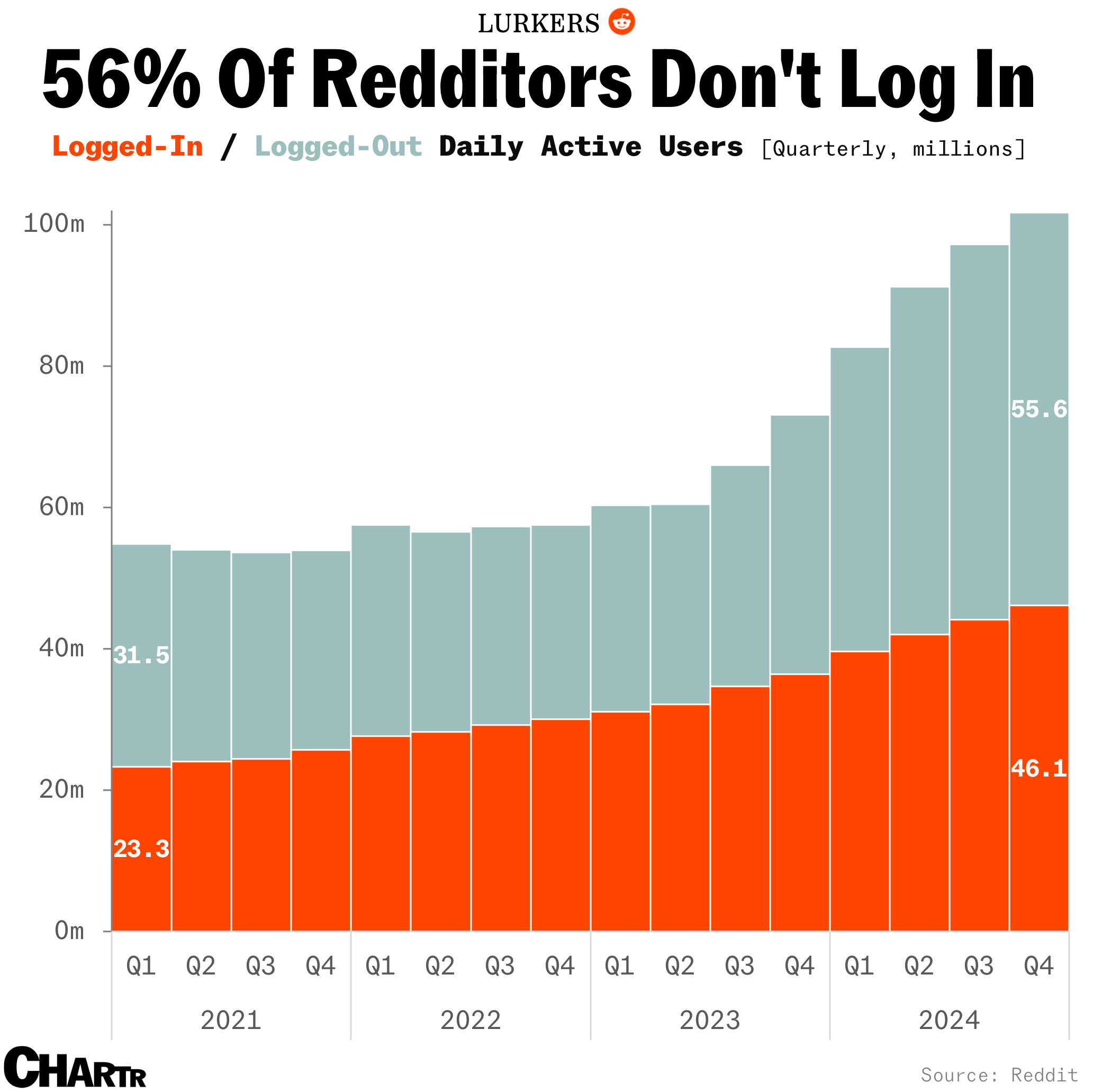
reddit users
Source: Sherwood News

But this line of questioning from LightShed Partners’ Rich Greenfield was the most direct, and the answers not very revealing.

What exactly did Google change in the algorithm? I think theres been a lot of view that sort of Google loves Reddit and was sort of prioritizing Reddit. So what exactly changed? And I guess, Steve, how do you get comfort or confidence that future changes are not going to be more problematic than this one?

Some excerpts from Huffman’s reply:

What did Google change? I have my suspicions, but its not my place to say, but Im not worried about it...

We collaborate in a number of ways, including how they can continue to follow us better. So theres zero concern from us in this department.

Traders clearly don’t share Huffman’s “zero concern,” judging by the post-earnings plunge in shares of Reddit. And this ongoing relationship bears close monitoring as a flashpoint for how Google may be attempting to balance the competing concerns of dominating search now and ensuring that this dominance endures well into the future.

More Markets

See all Markets
markets

Whirlpool tumbles on Q1 earnings, says war is causing “recession-level” decline in US appliance demand

Shares of home-appliance giant Whirlpool Corp. are tumbling on Thursday following its Q1 earnings and stark warning about consumer confidence.

According to Whirlpool, the war with Iran “resulted in recession-level industry decline in the US as consumer confidence collapsed in late February and March.”

The company’s Q1 sales were down about 10% year over year. In April, Whirlpool issued its “largest price increase in more than a decade,” with costs for consumers rising 10%. US appliance demand dropped 7.4% in Q1, Whirlpool said, including a 10% drop in March.

“This level of industry decline is similar to what we have observed during the global financial crisis and even higher than during other recessionary periods,” CEO Marc Bitzer said on the company’s earnings call.

Whirlpool shares were down more than 20% in premarket trading, but pared some of those losses in early trading. It remains on pace for one of its worst trading days in company history.

markets

Krispy Kreme jumps on narrower Q1 loss and “significant progress on turnaround”

Krispy Kreme’s shares are climbing this morning, with the stock ticking up around 5% as the market opened after the company reported narrowing losses and highlighted the success of its turnaround efforts before the bell.

For the quarter ended March 29, 2026, Krispy Kreme trimmed its net loss to $22.8 million, down from $33.3 million a year earlier, though still wider than the $10.8 million loss analysts had penciled in (compiled by Bloomberg). Adjusted EBITDA for Q1 came in at $33.1 million, a little more than the $30.6 million that analysts had been expecting.

CEO Josh Charlesworth struck an optimistic note around the earnings, commenting that Q1 “highlighted significant progress across every pillar of our turnaround plan” and that management expects “this momentum to continue through 2026, driven by profitable growth in the U.S. with key strategic partners, higher digital sales, and international expansion.”

The donut chain is tightening its belt quicker than previously anticipated and expects a net leverage ratio of less than 5.5x in 2026, where they’d expected the level to remain at or below 5.5x last quarter. DNUT also expects more than $15 million in cash flow by the end of the fiscal year as it tightens its debt reduction target.

The company’s newly introduced FY2026 net revenue outlook, forecast to be between $1.25 billion and $1.35 billion, fell below Wall Street’s $1.46 billion estimates — a discrepancy that Krispy Kreme addressed by saying that analyst expectations don’t yet reflect recent asset sales.

markets

Datadog surges after boosting 2026 sales forecast, pulling software stocks higher

Shares of Datadog are surging after the cloud-monitoring platform announced Q1 results that beat Wall Street forecasts on the top and bottom lines while hiking its full year sales guidance.

Key numbers:

  • Revenue of $1.01 billion (up 32% year over year and above analyst estimates of $957.8 million).

  • Adjusted EPS of $0.60 (estimate: $0.52).

Full-year revenue guidance was lifted to $4.3 billion to $4.34 billion from the earlier range of $4.06 billion to $4.1 billion. Management also raised the company’s full-year guidance, now giving an adjusted EPS outlook of $2.36 to $2.44.

The boost to the sales outlook isn’t just helping Datadog, but also the beaten-down semiconductor industry at large. The iShares Expanded Tech Software ETF is up about 4% as of 10:46 a.m. ET, with the likes of Palo Alto Networks, GitLab, Palantir, Atlassian, and CrowdStrike outperforming.

“Overall, we view this as a transformational print/guide for DDOG as the company continues to demonstrate that AI is a powerful demand catalyst rather than a disruptive threat with mission-critical positioning across cloud migration, digital transformation, and now AI training/inference workloads creating a multi-year runway for accelerating growth and continued share gains,” wrote Wedbush analyst Dan Ives in the wake of this report, boosting his price target to $220 from $190.

The rally comes as Datadog announced that it has received FedRAMP High certification, meeting federal government cloud security and compliance standards for handling sensitive unclassified information. The certification is designed to protect controlled unclassified information in cloud environments through strict security controls.

“This milestone reinforces Datadog’s leadership in cloud security and compliance, and sets a new standard for observability platforms in regulated sectors,” said Emilio Escobar, CISO at Datadog.

Going into the report, Datadog had gained over 47% year to date.

markets

Vistra rises after reporting better-than-expected Q1 numbers

Power provider Vistra, a key AI energy trade, reported better-than-expected results early Thursday, sending shares up in premarket trading.

The Texas-based company, which supplies nuclear energy, natural gas, and coal-fueled power to wholesale and retail markets, reported:

  • Net income of $1.029 billion (including a massive $723 million unrealized gain from hedges expected to settle in future years) vs. Wall Street expectations for $434.2 million.

  • Adjusted EBITDA of $1.49 billion vs. expectations for $1.44 billion, per FactSet.

  • Revenue of $5.6 billion vs. an estimated $5.1 billion, per Bloomberg.

Vistra reaffirmed its 2026 Ongoing Operations Adjusted EBITDA guidance range of $6.8 billion to $7.6 billion and Ongoing Operations Adjusted Free Cash Flow before Growth range of $3.925 billion to $4.725 billion.

The companys shares soared 258% in 2024 amid a flurry of excitement over the AI energy boom. Last year was more muted, with the stock rising 17%. So far in 2026, shares were down roughly 4% through yesterday’s close.

markets

Peloton jumps on surprisingly strong Q3 cash flow generation, boost to outlook

Peloton shares are jumping in premarket trading after the company reported a modest Q3 sales beat while generating surprisingly strong cash flows.

The key numbers:

  • Revenue of $630.9 million (compared to analyst estimates of $617.6 million).

  • Adjusted EBITDA of $126.2 million (estimate: $128.7 million).

  • Free cash flow of $150.5 million (estimate: $54.2 million).

For full-year 2026, Peloton nudged up its revenue guidance to a range of $2.42 billion to $2.44 billion, and also boosted its adjusted EBITDA and free cash flow outlooks.

Peloton has spent the last few years working through the aftermath of its pandemic-era hardware boom. The company announced a series of product updates last year in October featuring updated cross-training bikes and treadmills that include AI-powered form tracking and stronger processors.

Under CEO Peter Stern, the company is pivoting toward new growth levers by renewing efforts to expand content distribution and reach commercial markets. This includes the launch of the Peloton Commercial Series for high-use environments, which helped drive a 14% year-over-year increase in commercial business revenue.

A pillar of this strategy is its global partnership with Spotify. By integrating over 1,400 on-demand Peloton fitness classes into a new Fitness hub for Spotify Premium members, the company aims to reach new audiences outside its own hardware ecosystem.

Latest Stories

Sherwood Media, LLC produces fresh and unique perspectives on topical financial news and is a fully owned subsidiary of Robinhood Markets, Inc., and any views expressed here do not necessarily reflect the views of any other Robinhood affiliate, including Robinhood Markets, Inc., Robinhood Financial LLC, Robinhood Securities, LLC, Robinhood Crypto, LLC, Robinhood Derivatives, LLC, or Robinhood Money, LLC. Futures and event contracts are offered through Robinhood Derivatives, LLC.

