
Markets
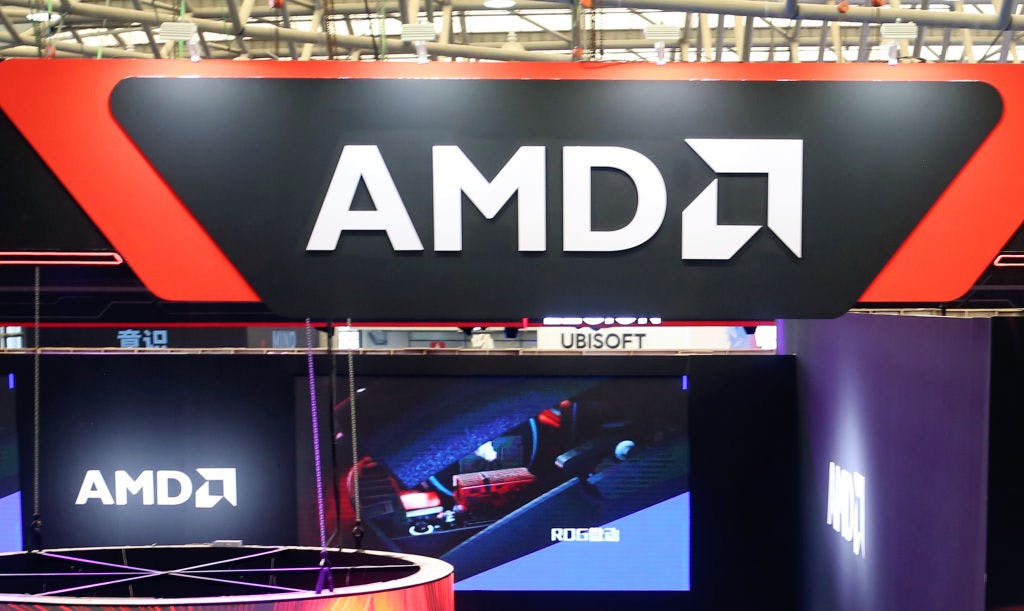
AMD booth
(Xing Yun/Getty Images)

AMD slumps on no new big customer wins, with unexpected China sales driving AI revenue beat

Sometimes stocks just go down after reporting good results. Especially if they’d been going up a lot before that.

Luke Kawa

Is Advanced Micro Devices a software stock? Because even after reporting Q4 sales and earnings beats and a Q1 sales outlook ahead of Wall Street’s expectations, shares of the No. 2 name in GPUs are sliding.

A handful of potential reasons why:

  • Data center sales were merely in line with expectations after accounting for sales to China. This division posted sales of $5.38 billion versus a consensus estimate of $4.97 billion. But $390 million came from sales of MI308 chips to China. After Nvidia CFO Colette Kress said H20 demand from China “never materialized” after export restrictions were lifted, investors weren’t expecting AMD’s functional equivalent of that processor to be the swing factor in delivering better-than-anticipated results from this key segment.

  • No big customer wins. We’re living in a world where press releases touting new major customers and partnership as well as flashy reveals on conference calls are par for the course. AMD CEO Dr. Lisa Su and CFO Jean Hu offered none of the above, with Barclays analyst Tom O’Malley flagging that “management is signaling they won’t announce all new customers.” Well, yes, but you can bet if AMD had a major win to share, they’d share it! They’d almost be obligated to. And a big cause of the plethora of price target hikes that AMD received in the wake of its megadeal with OpenAI was the presumption that this pact would beget more major buyers to choose its AI processors.

  • The company isn’t doing a fantastic job of expense control. Better-than-expected adjusted gross margins “was more than offset by operating expense that was ~$200MM higher than guidance (a ~200 bps OpM headwind), marking several quarters of AMD overshooting expenses,” JPMorgan analyst Harlan Sur wrote. “So, though Mar-Qtr guidance was also better than expected, the extent to which AMD is able to generate operating leverage remains in question and likely represents an overhang on the stock until this can be satisfactorily demonstrated (most likely 2H26), especially in light of risk to gross margins with the upcoming ramp of MI450/Helios later this year.”

If all this sounds narratively unsatisfying when presented against the surface-level reality of results and guidance coming in ahead of expectations, well, that’s because it is.

“We were surprised at aftermarket weakness, as all the numbers were quite good and AMD said the right stuff about the new products,” wrote Morgan Stanley analyst Joseph Moore.

Sometimes stocks just fall after reporting better-than-expected quarterly figures and outlooks. Again, ask basically any software company that’s released results recently.

But unlike those tech companies that are in free fall, AMD had been performing very well year to date heading into this report. The stock matched its longest winning streak since 2005 en route to a 13% gain, besting the VanEck Semiconductor ETF by about 2.5 percentage point and trouncing Nvidia, which is down 3.3% in 2026.

These results reaffirm that this relative performance has come despite AMD being significantly smaller and still posting substantially slower top-line growth than its GPU overlord.

More Markets

See all Markets
markets

DoorDash jumps on better-than-expected Q1 earnings, Q2 order outlook

DoorDash is up more than 10% in premarket trading Thursday after the delivery company beat Q1 earnings estimates and gave a stronger-than-expected Q2 gross order value outlook.

While revenue in the first quarter jumped 33% year on year to $4.04 billion, falling short of analysts estimates of $4.14 billion, earnings per share came in at $0.42 to top the $0.36 estimate. Gross order value — the total dollar value of all orders completed on the platform — rose 37% to $31.6 billion, also above the $31.5 billion expected.

DoorDash said order growth was driven mainly by more its consumer base growing, plus a boost from its acquisition of the British delivery app Deliveroo, which is “seeing the highest growth rates it has in the past four years,” CEO Tony Xu said on yesterday’s earnings call.

The second quarter is “off to a good start” with strong demand, CFO Ravi Inukonda said, and DoorDash now forecasts gross order value of $32.4 billion to $33.4 billion, ahead of analyst estimates of $32.43 billion at the midpoint. The company also expects $770 million - $870 million in adjusted EBITDA, with the midpoint falling short of the $830 million expected. DoorDash cited more than $50 million in expected costs from its driver gas-relief program amid the Iran war-driven surge in oil and gas prices, though it plans to offset at least some of that by “adjusting investment in other areas,” per the statement.

Doordash continues to invest heavily in AI tools and newer categories like electronics, apparel and auto parts, as well as restaurant reservation features through SevenRooms, which it acquired last year.

markets

Snap ends Perplexity deal, says advertising business took a hit from “geopolitical headwinds” in Q1

Snapis down some 10% in premarket trading after its first quarter earnings results hit estimates but pointed to cracks in its advertising business and said it ended an AI deal.

Snap reported reported $1.26 billion in advertising revenue for the first quarter, which was a hair under the $1.27 billion analysts polled by FactSet were penciling in, and included a “$20 to $25 million impact from the geopolitical headwinds in the Middle East experienced during March.”

It reported $1.53 billion in total revenue for the first quarter, which was in line with estimates, and $0.10 adjusted earnings per share — broadly in-line with expectations. Subscriptions, while still a relatively small chunk of revenue, are fueling the company’s sales growth as its advertising business stagnates.

The company told investors it expects revenue in the second quarter to land between $1.52 billion and $1.55 billion, also line with analysts’ estimates, but warned “large advertisers in North America remained a headwind.” That guidance also assumes no contribution from its $400 million deal with Perplexity, which it announced in November and said has now ended “amicably.”

markets

Arm Holdings surges after reporting a doubling of demand for its AI CPUs since late March

Arm Holdings is jumping in postmarket trading despite posting a relatively ho-hum set of fiscal Q4 2026 results and Q1 2027 guidance.

The reason: a deluge of demand for its data center CPUs, which were launched in late March.

“We now have more than $2 billion of customer demand across fiscal 2027 and fiscal 2028, more than double what we stated at launch,” according to the press release. “Soon the data center will be Arm’s largest business.”

The company says it already has 50% market share for CPU compute among top hyperscalers.

AMD’s results showed just how central CPUs are to the AI boom, and Arm’s comments are underlining that message in bold.

markets

FanDuel parent Flutter rises after reporting better-than-expected Q1 sales and earnings

Flutter Entertainment rose in aftermarket trading Wednesday after reporting better-than-expected Q1 earnings and revenue. The rally recouped losses during regular trading hours that followed a CNBC report on the departure of Amy Howe, the CEO of Flutter’s FanDuel sports betting unit.

Flutter reported:

  • Q1 revenue of $4.30 billion vs. Wall Street expectations for $4.24 billion.

  • Adjusted earnings per share of $1.22 vs. the $1.09 forecast, per FactSet.

  • Adjusted EBITDA of $631 million vs. expectations for $610.9 million.

  • Full-year sales guidance of $18.31 billion at the midpoint vs. its previous estimate of $18.40 billion and analyst expectations for $18.35 billion.

  • Full-year adjusted EBITDA guidance of $2.865 billion vs. its previous midpoint estimate of $2.97 billion.

While FanDuel is the leader in the US online sports betting market, it’s considered something of a laggard in prediction markets, an area of fast growth for the industry, in part because it’s exposed to relatively lighter regulation.

(For instance, in most states, gaming commissions limit sports betting to those 21 and older, whereas sports-based events contracts typically have lower age restrictions, thus expanding their potential universe of customers.)

Flutter’s inability to come up with a prediction markets product that investors find convincing has contributed to its falling share price, which is down roughly 50% since the start of the year. Rival DraftKings is down a relatively better 30% over that period.

markets

Axon beats Q1 revenue expectations, raises guidance

It might be a great time to be a surveillance company. Axon, a maker of police body cameras, Tasers, and AI intelligence tools, is ticking lower postmarket after the company reported revenue exceeding expectations in its Q1 earnings report and upbeat guidance for the year. 

Here are the numbers:

  • Revenue of $807.3 million (compared to analyst estimates of $779.2 million).

  • Adjusted EBITDA of $202 million (estimate: $183.8 million).

For the full year, Axon boosted its target for revenue growth to a range of 30% to 32%, up from a quarter ago, when it forecast 27% to 30% growth.

Previously, the stock had been sliding despite increasing revenue. It was trading down more than 32% since the beginning of the year, suffering the same fate as many software-as-a-service stocks thanks to AI-related anxieties. 

But for the year ahead, Axon says the company entered the year with “strong momentum, delivering record quarterly revenue,” marking its ninth consecutive quarter of more than 30% growth thanks to its suite of technologies, including artificial intelligence and counter-drone offensive products.

Axon told investors its targeting $6 billion in annual revenue by 2028, which would be more than double 2025’s results. The company plans to get there by growing globally (Axon says it’s currently “deployed” in 85 countries) and continuing to partner with federal agencies including the Department of Homeland Security, as well as reaching out to the business community.

The company also noted that the federal governments Safer Skies Act, passed in Decembers National Defense Authorization Act, earmarks $250 million in federal grants for local agencies to further “track and mitigate drone threats.” Again, more good news for Axon, which grew that segment of its business 300% year over year.

Latest Stories

Sherwood Media, LLC produces fresh and unique perspectives on topical financial news and is a fully owned subsidiary of Robinhood Markets, Inc., and any views expressed here do not necessarily reflect the views of any other Robinhood affiliate, including Robinhood Markets, Inc., Robinhood Financial LLC, Robinhood Securities, LLC, Robinhood Crypto, LLC, Robinhood Derivatives, LLC, or Robinhood Money, LLC. Futures and event contracts are offered through Robinhood Derivatives, LLC.

