

Markets
Illustration of man balancing crowd of people on seesaw
(Getty Images)

America’s top 1% now holds nearly a third of household wealth

Stock market rallies have added trillions to the fortunes of the wealthiest people in the US.

The wealth of America’s top 1% surged to a record $52 trillion in the second quarter, according to new Federal Reserve data.

Every wealth group saw gains over the past year, but the biggest boost went to those at the upper end. While the bottom half’s wealth rose 6.3% from a year earlier, the top 1% saw their fortunes climb some 8.5%, now commanding nearly a third of the nation’s total wealth.
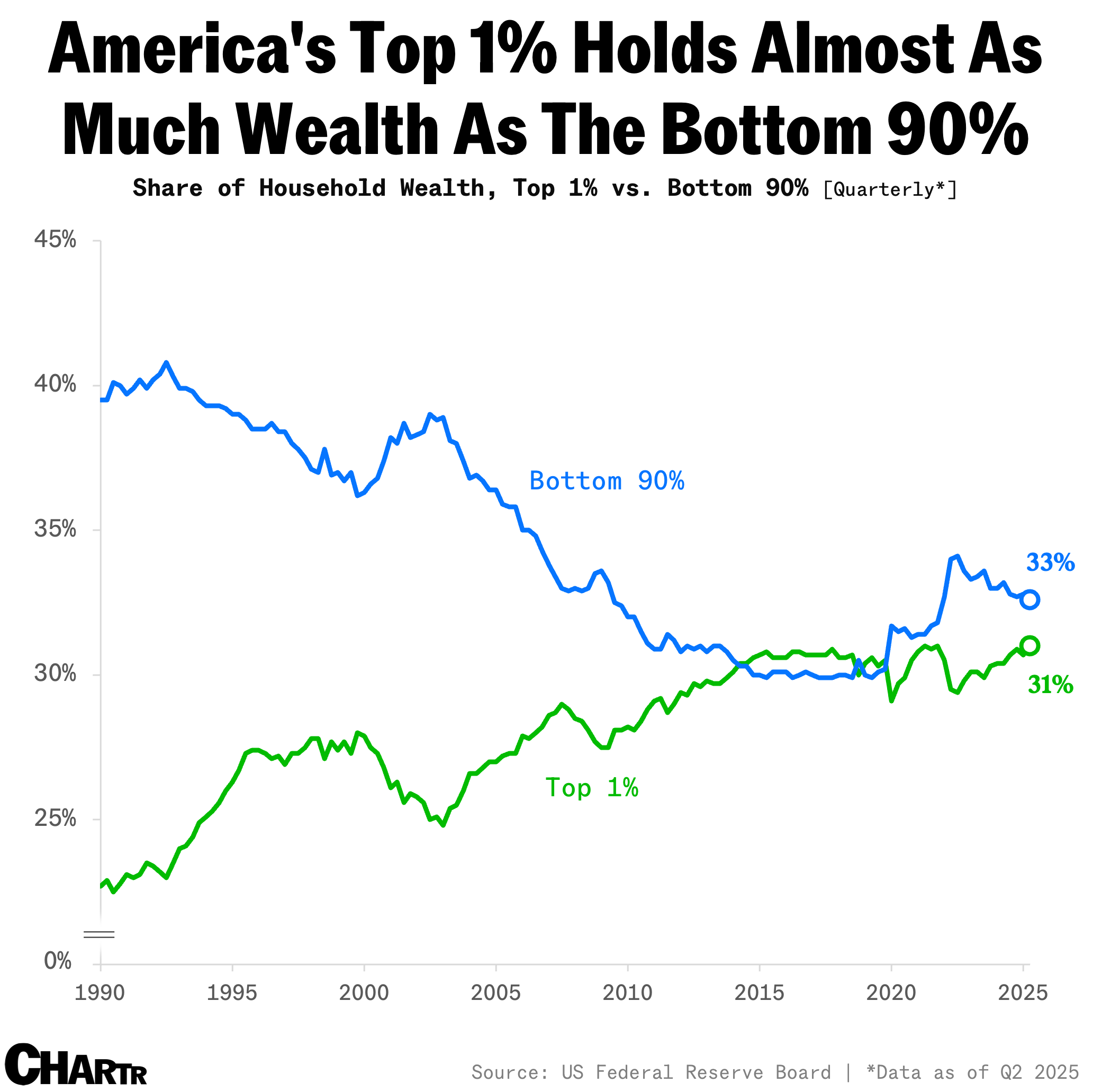
US 1% household wealth chart
Sherwood News

Indeed, that share has climbed steadily over the past 35 years, fueled largely by stock market gains. The top 1% now owns roughly half of all corporate equities and mutual fund shares, up from 42% in 1990. In contrast, just 12.8% of those assets are held by the bottom 90%, whose portfolios rely more heavily on real estate, a sector that lagged stocks through much of the last decade’s bull run — and again into 2025, per a note from Goldman Sachs’ Global Investment Research division last week.

Meanwhile, uneven wage growth is also driving the so called “K-shaped economy.” According to the Bank of America Institute, after-tax wages for low-income households grew just 0.9% year over year in August, the slowest pace since 2016. For higher earners, wage growth hit 3.6%, the fastest since late 2021.

Spreading (some of) the wealth

From a macro view, though, the picture isn’t entirely grim. With the top 40% of earners driving more than 60% of total US spending, Goldman Sachs estimates that “positive wealth effects” from rising asset prices have lifted annualized consumption growth by 0.3 percentage points in Q3, reversing a drag earlier this year. If asset prices keep pace with nominal GDP, that spending engine could keep humming into 2026.

Still, Goldman warns that a market pullback could quickly turn that boost into a slowdown. Moody’s chief economist, Mark Zandi, also told CNBC that an economy “powered in big part by the spending of the extraordinarily well-to-do” could face a “serious threat” if their portfolios start flashing more red than green.

More Markets

See all Markets
markets

With their recent surge, Intel shares just hit their highest level since the dot-com era

Intel’s surge of nearly 60% this month has the iconic American chipmaker’s stock price approaching levels last seen during the dot-com era. Bloomberg noted that shares just touched their highest intraday level since the turn of the century:

The stock rose as much as 1.5% to $69.55, topping a peak it hit on Jan. 24, 2020. The shares are up 90% this year, after soaring 84% in 2025. Intel is now roughly 8% from its all-time closing high of $74.88, established on Aug. 31, 2000.

That’s just the most recent late-’90s-era throwback we’ve been seeing in tech shares lately. Oracle is currently pacing for its best week since late 1999.

What’s even more remarkable, however, is that Intel’s forward price-to-earnings ratio today dwarfs the premiums the market was putting on the stock during the nuttiness of the dot-com mania.

That reflects the fact that the recent run-up in Intel shares is, essentially, giving the chip giant credit for a massive turnaround that hasn’t actually happened yet.

One also might wonder if the fact that Intel is partially owned by the US government means it’s more attractive — and therefore worth a higher premium — than other chipmakers without the state imprimatur.

Still, kind of startling.

markets

Eli Lilly’s GLP-1 pill hit nearly 1,400 prescriptions in first week

Eli Lilly rose after preliminary numbers cited by Wall Street analysts showed strong uptake of its new weight-loss pill.

The FDA approved Foundayo on April 1 and shipments began on April 9. In its first week, roughly 1,400 US prescriptions were written for the drug, according to IQVIA data cited by Deustche Bank analysts in a Friday note.

Novo Nordisk, Lilly’s rival in the GLP-1 market, released its GLP-1 pill earlier this year, and early signs show that it’s expanding the market, inviting patients who were turned off by weekly injections. Novo’s pill had a stronger first week than Lilly’s, with its Wegovy pill hitting 3,071 US prescriptions in the first four days after its launch on January 5.

Lilly’s pill has an advantage over Novo’s, which is that it can be taken at any time of day, with or without food. Lilly disclosed in a February regulatory filing that it had $1.5 billion worth of prelaunch inventory ready ahead of the FDA approval — which is about as much as analysts polled by FactSet expect it to sell this year.

Novo Nordisk, Lilly’s rival in the GLP-1 market, released its GLP-1 pill earlier this year, and early signs show that it’s expanding the market, inviting patients who were turned off by weekly injections. Novo’s pill had a stronger first week than Lilly’s, with its Wegovy pill hitting 3,071 US prescriptions in the first four days after its launch on January 5.

Lilly’s pill has an advantage over Novo’s, which is that it can be taken at any time of day, with or without food. Lilly disclosed in a February regulatory filing that it had $1.5 billion worth of prelaunch inventory ready ahead of the FDA approval — which is about as much as analysts polled by FactSet expect it to sell this year.

markets

Critical Metals jumps after Greenland’s government approves CRML to take majority control of the Tanbreez mining project

Critical Metals is up more than 25% in premarket trading on Friday after the critical mining company announced that it now owns 92.5% of the Tanbreez rare earth deposit following an approval from the government of Greenland.

With that latest government support, Critical Minerals added an additional 50.5% stake to its ownership, reportedly acquired from Rimbal Pty Ltd, per Bloomberg News. With access to eight heavy rare earth elements often used in consumer electronics and defense, the site is one of the world’s largest undeveloped rare earth deposits and a key source of rare earth supply outside of China, according to the company.

In Critical Metals’ press release, Chairman Tony Sage commented that the approval “removes the most significant structural overhang on the project and provides the clarity to advance Tanbreez to production with confidence,” especially as Tanbreez’s location offers a significant logistical advantage through its year-round direct shipping access, compared to rival projects.

With 92.5% of the project now vested in Critical Metals Corp., and the remainder owned by European Lithium Ltd., CRML now has full control of the project and is seeking to accelerate development there, with plans for a new international airport and a 150-tonne bulk sample program, which is slated for June 2026.

Latest Stories

Sherwood Media, LLC produces fresh and unique perspectives on topical financial news and is a fully owned subsidiary of Robinhood Markets, Inc., and any views expressed here do not necessarily reflect the views of any other Robinhood affiliate, including Robinhood Markets, Inc., Robinhood Financial LLC, Robinhood Securities, LLC, Robinhood Crypto, LLC, Robinhood Derivatives, LLC, or Robinhood Money, LLC. Futures and event contracts are offered through Robinhood Derivatives, LLC.

