

Markets
markets
Luke Kawa

The K-shaped economy, in one chart

The idea of a “K-shaped recovery” — relatively affluent Americans doing well, while those lower on the income spectrum struggle mightily — was in vogue as the US economy emerged from its Covid-induced recession in 2020.

A few years of better wage growth for lower earners helped put a dent in this trend, but now, the “K-shaped economy” is back in a big way:
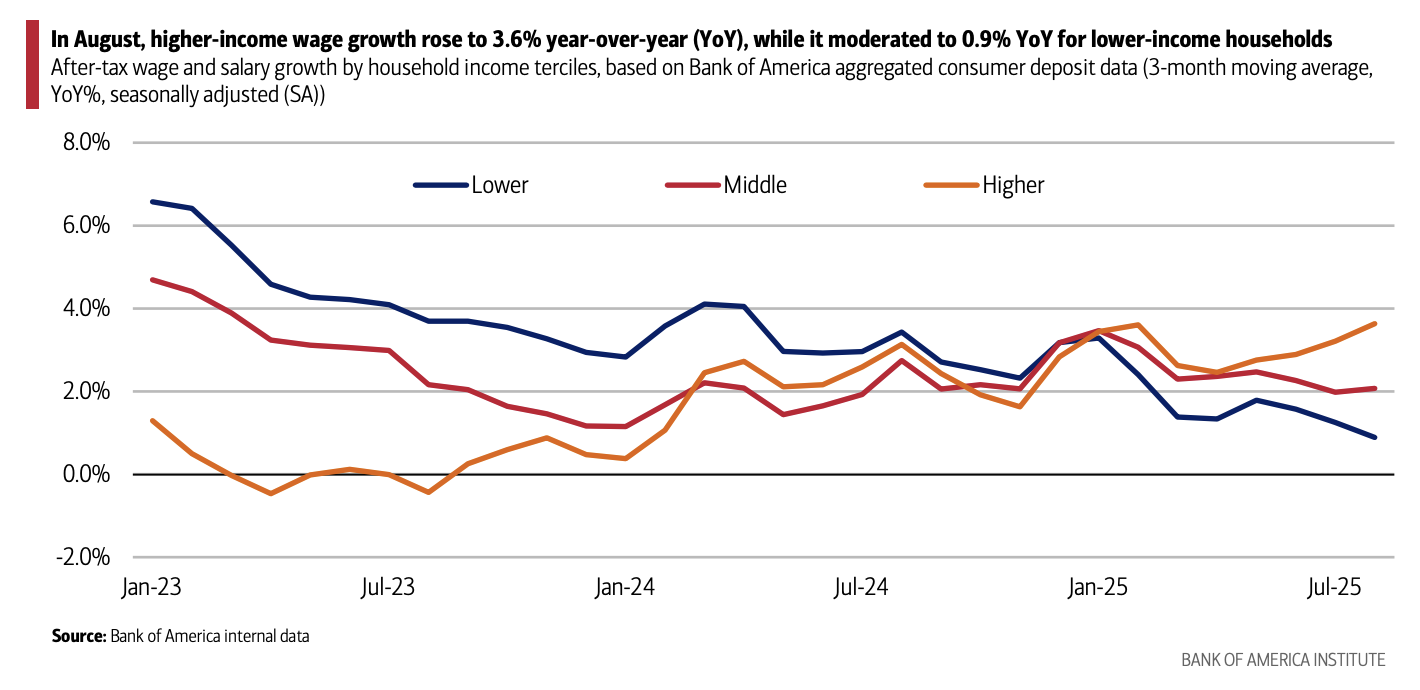
BofA Institute chart on income growth

Liz Everett Krisberg, head of the Bank of America Institute, and senior economist David Michael Tinsley wrote in a new report (emphasis ours):

The labor market slowdown appears to be impacting lower-income households, in particular. According to Bank of America deposit data, after-tax wage and salary growth slipped to just 0.9% year-over-year (YoY) for lower-income households in August — the smallest gain since the start of the series in 2016. Wage growth for higher-income households, on the other hand, rose to 3.6% YoY, the highest growth rate since November 2021. This growing divergence between income cohorts is also reflected in spending trends, with credit and debit card spending growth easing for lower-income households but accelerating for higher-income ones.

Deteriorating labor market outcomes for lower-income and traditionally marginalized groups sucks. Full stop.

From a macroeconomic perspective, however, remember that the top 40% of earners drives over 60% of US consumer spending. That means any easing of nominal consumption growth at the lower end of the income scale can be more than offset by a similar-sized pickup in spending growth at the upper end.

More Markets

See all Markets

US airlines pop on report Spirit preparing to shut down as government rescue deal fails to gain support

US airlines are spiking on Friday following a Wall Street Journal report that low-budget carrier Spirit Airlines is preparing to shut down. According to CBS News, the airline could cease operations as early as Saturday, barring an intervention.

In late April, President Trump said he would “love somebody to buy Spirit.” The administration weighed a $500 million rescue package, though it received significant blowback from members of Congress and ultimately didn’t receive support from Spirit’s creditors.

On Friday, Trump told reporters that the administration has given Spirit a “final proposal.”

Shares of Spirit’s rivals surged on the report, with budget carriers like Frontier Airlines and JetBlue climbing by double digits. The big four — Delta Air Lines, United Airlines, American Airlines, and Southwest Airlines — rose by low single digits. Alaska Air and Allegiant also saw a bump.

markets

Estée Lauder gets a glow-up after earnings beat, guidance hike

Estée Lauder shares are soaring after the beauty giant released Q3 earnings results that topped expectations and raised its full-year outlook, while also expanding its restructuring plan.

The key numbers:

  • Revenue of $3.71 billion (compared to analysts’ estimate of $3.69 billion).

  • Adjusted earnings per share of $0.91 (estimate: $0.65).

Estée Lauder also lifted its full-year earnings outlook to a range of $2.35 to $2.45 per share, up from $2.05 to $2.25 previously.

The bottom line is getting flattered by job cuts, with management increasing that target to as many as 10,000 roles, up from a prior range of 5,800 to 7,000, as part of a broader effort to streamline operations and shift toward faster-growing sales channels.

The rally comes after a tough stretch for the stock, which is down more than 20% year to date, with the results inspiring hope that its turnaround efforts will bear fruit.

CEO Stéphane de La Faverie said fiscal 2026 is “promising to be the pivotal year we intended,” with the company expecting to restore organic sales growth and expand margins for the first time in four years.

Amid these positive signals, Estée Lauder flagged risks from tariffs, geopolitical tensions, and potential disruptions tied to the Middle East.

markets

Moderna beats Q1 estimates and reaffirms full-year guidance

Moderna rose in premarket trading after it reported earnings results that beat Wall Street expectations and reaffirmed its full-year guidance.

For the first three months of 2026, the company reported:

  • An adjusted loss per share of $3.40, less than the $4.45 loss per share analysts polled by FactSet had expected.

  • Revenue of $352 million, more than the $236 million the Street was anticipating. About 80% of that came from outside the US, the company said.

For the full year in 2026, the company still expects:

  • Revenue to grow 10%. Currently, analysts are penciling in $2 billion in 2026 sales, which is about a 5% increase.

Moderna was tapped by the US government to quickly develop a vaccine for COVID-19 in 2020, a product that has seen its sales plummet, but remains the company’s main source of revenue.

Now, the company sees growth on the horizon this year, after the European Commission approved its combination vaccine for the flu and COVID-19 for adults ‌50 years and older. Indeed, Moderna said a growing share of its revenue is coming from international markets.

The company has had a harder time getting approval from the US Food and Drug Administration, though the agency said in February that it would reconsider its stand-alone flu vaccine.

Latest Stories

Sherwood Media, LLC produces fresh and unique perspectives on topical financial news and is a fully owned subsidiary of Robinhood Markets, Inc., and any views expressed here do not necessarily reflect the views of any other Robinhood affiliate, including Robinhood Markets, Inc., Robinhood Financial LLC, Robinhood Securities, LLC, Robinhood Crypto, LLC, Robinhood Derivatives, LLC, or Robinhood Money, LLC. Futures and event contracts are offered through Robinhood Derivatives, LLC.
