
Markets
Impossible staircase, 1950s.
The first model of the “impossible staircase” (SSPL/Getty Images)

An explosion of speculative call option buying signals the return of retail traders’ favorite weapon

We’re seeing activity that looks an awful lot like gamma squeezes in some of the most speculative stocks.

Luke Kawa

A funny thing happened after the S&P 500 set an all-time high in late June, officially shaking off the tariff-induced tumble.

The benchmark US stock index became pretty boring while an explosion of risk appetite happened below the surface, propelling nonprofitable tech companies, former SPACs fallen from grace, crypto-linked stocks, heavily shorted companies, and other retail favorites sharply higher.

Most of these indexes have reached multiyear, if not record, highs in the process:

Some companies within these baskets have seen their stock prices surge thanks to a clear catalyst, whether that’s Nvidia starting to do business with them or a pivot to holding crypto treasury assets. Some booms, like Opendoor Technologies, have come out of nearly thin air. But what many of them have in common is an underlying market dynamic that’s reinforcing their gains: the gamma squeeze is back

The sequence goes a little something like this: traders buy a ton of call options, and they have to buy them from someone (market makers and/or dealers). These players don’t want to make money by taking the other side of this bet, though. They want to make money through extracting value from every little bit of buying and selling activity that occurs. So when a market maker sells a call — which would leave them exposed to losses if shares of the underlying company rally a ton — they will simultaneously offset that risk by buying a given amount of shares of that company.

When lots of traders are buying options, they are effectively forcing a lot of buying of the underlying stock at the same time! This buying can put upward pressure on the share price, which forces even more buying from these entities that have no view whatsoever on the stock, but are merely trying to cover their butts.

Let’s tie in the Greeks: delta is a term that describes how an option’s price is expected to change based on a $1 shift in the price of the underlying asset. Delta will tend to go up as the stock price goes up. When market makers are buying stock after they’ve sold a call (and buying more if the stock rises after that!), they’re delta-hedging. Gamma is the second derivative of delta; it describes how much the delta is poised to change based on a $1 change in the price action. Gamma is at its highest at the point when the option is at the money. This makes some intuitive sense: whether an option is in the money or out of the money will, at expiration, loosely determine whether or not it has any value.

To sum/to some: the natural response of market makers in an environment where increasing out-of-the-money call option buying propels a stock price higher, pushing that strike in the money and pushing the stock even closer to a higher strike price where another formerly out-of-the-money call option threatens to be money-good, and so on and so forth. It starts to look an awful lot like a perpetual motion money-making machine.

A “gamma squeeze” is the technical explanation for how and why these parabolic moves occur. Market makers are rapidly picking up more deltas, which they need to hedge their exposure because gamma keeps accelerating at different, higher points in the options chain. It’s much easier to see this dynamic play a starring role in smaller stocks and/or ones with constrained float.

This is something that, while very well known by professional options traders, was “discovered” and popularized in the r/WallStreetBets community in early 2020 thanks to… me (whoops). Similar market dynamics played a significant role in the next year’s mania that took shares of GameStop to record highs.
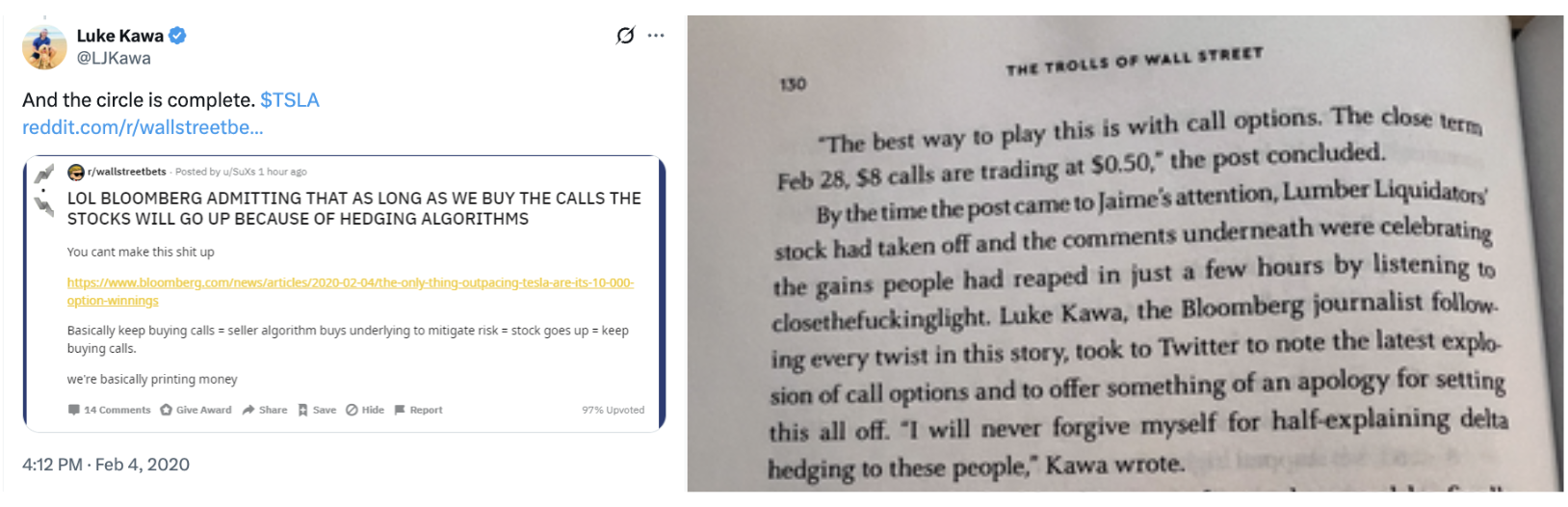
Kawa Post
Source: X, The Trolls of Wall Street

Benjamin Graham, the famous value investor who trained the likes of Warren Buffett, famously quipped, “In the short run, the market is a voting machine but in the long run it is a weighing machine.” 

Well, the gamma squeezes we’re seeing are the market equivalent of stuffing the ballot box in third-world countries.

More Markets

See all Markets
markets

Reddit rises after reporting strong Q1 numbers and guidance

Social media platform Reddit climbed late Thursday after guiding for stronger sales in the current quarter and posting Q1 numbers that were better than analysts had expected. Reddit reported:

  • Q1 earnings per share of $1.01 vs. analysts’ expectations of $0.57.

  • Revenue of $663.4 million vs. expectations for $607.7 million.

  • 126.8 million “daily active uniques” vs. the 125.9 million expected.

  • Sales guidance for Q2 2026 of between $715 million and $725 million (midpoint $720 million) vs. analysts’ estimates of $710.9 million.

After surging 40% last year, Reddit has struggled since last September, when it hit a record closing high of $270.71. The stock closed Thursday roughly 45% below that level.

The drop is not so much because the outlook for sales and earnings at the company have weakened dramatically. (In fact, Wall Street analysts have lifted their sales estimates for the next 12 months by about 30% since then, and raised earnings estimates by about 70%.)

It’s that the price-to-earnings multiple on the stock has plunged from over 90x expected earnings over the next 12 months to about 32x, suggesting that sentiment around the stock — which had been something of a favorite for retail traders last year — has ebbed significantly.

markets

Roblox craters after Q1 daily active users miss estimates while management slashes full-year guidance

The bottom is falling out of Roblox in postmarket trading after the video game company’s Q1 daily active users fell short of estimates and management cut full-year guidance.

For the period ended March 31, the company reported: 

  • Net revenue of $1.44 billion (compared to analyst estimates for $1.42 billion).

  • Daily active users of 132 million (estimate: 143.8 million).

The real pain, though, comes from the reduced full-year outlook, with management lowering their view for sales to between $5.87 billion and $6.14 billion, down from a range of $6.02 billion to $6.29 billion. In other words, the old base case for sales is now their best-case scenario.

The firm also cut its outlook for 2026 bookings (money spent on in-game currency known as Robux) to a range of $7.33 billion to $7.6 billion (previously $8.28 billion to $8.55 billion).

Analysts were way off-side, having expected full-year revenue of $6.6 billion and bookings of $8.4 billion.

The stock hit its lowest level since October 2024 in the after-hours session. It’s been languishing near its 52-week low after halving over the past six months, with analysts wondering whether the kid-focused company has a plan to stay out of legal trouble, monetize, and “age up” in the years ahead. 

Roughly one-third of the video game company’s users are under 13. This month, Roblox announced expanded controls for parents and the rollout of Roblox Kids (for ages 5 to 8) and Roblox Select (for ages 9 to 15) this June. These launches are one part of its multitiered safety plan, which includes third-party biometric scans — something kids have been expertly outsmarting. 

Roblox’s decision to cut its guidance for 2026 was “largely safely-related,” Roblox’s C-suite said on Thursday’s earnings call. As Roblox started age-gating, CFO Naveen Chopra explained, many users lost access to intercommunications on the platform — resulting in a lack of engagement and daily active users, as well as negative App Store reviews (which management also blamed on running annoying ads).

David Baszucki, Roblox CEO:

We have seen a reduction in App Store rating, and we believe this may be contributing to a reduction in organic sign ups that typically flow from app stores.

Naveen Chopra, Roblox CFO:

We do know that the fact that we had more sign up headwinds over the last few months is going to put pressure on bookings over the remainder of the year.

Over the past month, the company has also importantly settled with several states over lawsuits that allege the company failed to implement proper security to protect children from adults on the site, which showed up in the company’s quarterly bill.

The platform paid out $1.5 billion to creators in 2025, and the company overall remains in the red.

markets

Western Digital slips despite posting strong quarterly results

AI memory play Western Digital posted stronger-than-expected quarterly earnings and sales figures.

Shares of the company, which have run up 131% so far this year, were down 3.6% as the beats weren’t able to satiate investors, a similar situation that played out with its peer Sandisk, which also reported earnings on Thursday afternoon.

Here’s how the results looked:

  • Fiscal Q3 revenue of $3.34 billion vs. the $3.25 billion consensus analyst expectation, per FactSet.

  • Adjusted earnings per share of $2.72 vs. the $2.39 analysts had predicted.

  • Fiscal Q4 guidance for adjusted EPS of $3.10 to $3.40 ($3.25 midpoint) vs. analyst estimates of $2.75.

  • Sales guidance for Q4, which ends in June, of $3.55 billion to $3.75 billion ($3.65 billion midpoint) vs. estimates of $3.46 billion.

A maker of hard disk drives that are suddenly in high demand due to the AI data center build-out, Western Digital — along with Seagate Technology Holdings, Sandisk, and Micron — is a cornerstone of the AI memory trade, which has delivered massive gains over the last year. Western Digital alone is up more than 1,000% over the last 12 months and is one of the top-performing names in the S&P 500 in 2026.

markets

Sandisk crushes expectations for quarterly EPS and sales, but stock drops anyway

Data storage company Sandisk dropped late Thursday despite reporting much better-than-expected quarterly numbers. The massive beneficiary of the data center boom — the stock topped the S&P 500 last year and is leading it again in 2026 with an astounding year-to-date gain of about 360% — reported:

  • Non-GAAP diluted earnings per share of $23.41 vs. the $14.62 forecast from Wall Street analysts polled by FactSet.

  • Revenue of $5.95 billion vs. a $4.72 billion consensus forecast from FactSet.

  • Non-GAAP EPS guidance for the current quarter, which ends in June, of $30 to $33 vs. Wall Street’s $23.38 expectation.

  • Current-quarter revenue guidance of $7.75 billion to $8.25 billion ($8 billion midpoint) vs. the $6.62 billion analyst forecast.

Shares fell 6% after-hours.

Sandisk was spun off from Western Digital in February 2025, and since then, its AI-driven stock price run-up has been nothing short of spectacular. The stock has risen more than 3,300% over the last 12 months, creating more than $150 billion in market value. When it emerged as a stand-alone company, it was valued at about $5 billion.

Can such a run-up continue? The law of large numbers would suggest not.

Sandisk executives have been adamant that demand for products — to store the massive amounts of data required for and produced by AI — shows no sign of slowing. But the sell-off after the numbers suggests investors who have ridden the shares up are nervous.

markets

Rivian delivers better-than-expected Q1 earnings and revenue

US EV maker Rivian reported its first-quarter results after markets closed on Thursday. The company’s shares whipsawed in after-hours trading.

For Q1, Rivian reported:

  • An adjusted net loss of $0.54 per share, compared to the $0.60 loss per share expected by Wall Street analysts polled by FactSet.

  • $1.38 billion in sales, compared to $1.37 billion expected.

Looking ahead, Rivian maintained its forecast for a full-year adjusted loss in the range of $1.8 billion to $2.1 billion. Wall Street expects a $1.99 billion loss.

Rivian’s primary focus this year will be the commercial launch of its new, smaller R2 SUV.

Earlier this month, Rivian reaffirmed its full-year delivery guidance of 62,000 to 67,000 vehicles. Analysts polled by FactSet expect 17,200 of those to be R2s, while Rivian has implied annual R2 deliveries of between 20,000 and 25,000 units. In March, Rivian announced that the R2 price would start at $59,485 at launch. The company reportedly began deliveries of the first R2s to employees this month.

Rivian also announced a robotaxi partnership with Uber in the first quarter. Uber will invest up to $1.25 billion in the EV maker in a deal for 50,000 robotaxis.

This week, a regulatory filing revealed that Rivian CEO RJ Scaringe earned $402.6 million in 2025 — more than 7x the combined pay for GM CEO Mary Barra and Ford CEO Jim Farley.

Latest Stories

Sherwood Media, LLC produces fresh and unique perspectives on topical financial news and is a fully owned subsidiary of Robinhood Markets, Inc., and any views expressed here do not necessarily reflect the views of any other Robinhood affiliate, including Robinhood Markets, Inc., Robinhood Financial LLC, Robinhood Securities, LLC, Robinhood Crypto, LLC, Robinhood Derivatives, LLC, or Robinhood Money, LLC. Futures and event contracts are offered through Robinhood Derivatives, LLC.

