

Markets
2024 Los Angeles Comic-Con
Cosplayers dressed as Jason Voorhees and Freddy Krueger (Angela Papuga/FilmMagic)

Be on guard for S&P 500 earnings estimates to finally come under the knife

Even as the benchmark US stock index tumbled, 12-month forward earnings estimates kept rising.

Luke Kawa

A curious thing happened on the S&P 500’s road to a 10% correction: earnings estimates went up.

From the benchmark US stock index’s February 19 record close through today, 12-month forward earnings estimates have ground about 0.7% higher while stocks swooned. Unlike the S&P 500, forecasts for where earnings per share will be in a year’s time are still at records.

Now, is this even more evidence that the stock market’s downdraft is primarily a momentum-driven phenomenon? Not really. Or at least, not yet. That’s because analysts are notoriously slow to revise earnings estimates to the downside. There’s typically a decent lag between how quickly the stock market incorporates negative fundamental news (immediately) compared to Wall Street’s bean counters (slowly, after double-counting all the beans and hoping things changed for the better in the interim).

That being said, when you get a stock market downdraft of this magnitude, you’d usually expect earnings estimates to come under some pressure soon. (That’s because, despite what anyone else might tell you, the stock market is the economy. Or at the very least, it’s not not the economy.)

In a past life, I flagged how every recent US pullback of note didn’t end until earnings estimates started to get cut. (That was to make the case for why it was unlikely that stocks had truly bottomed in June 2022; indeed, the trough came in October of that year.)
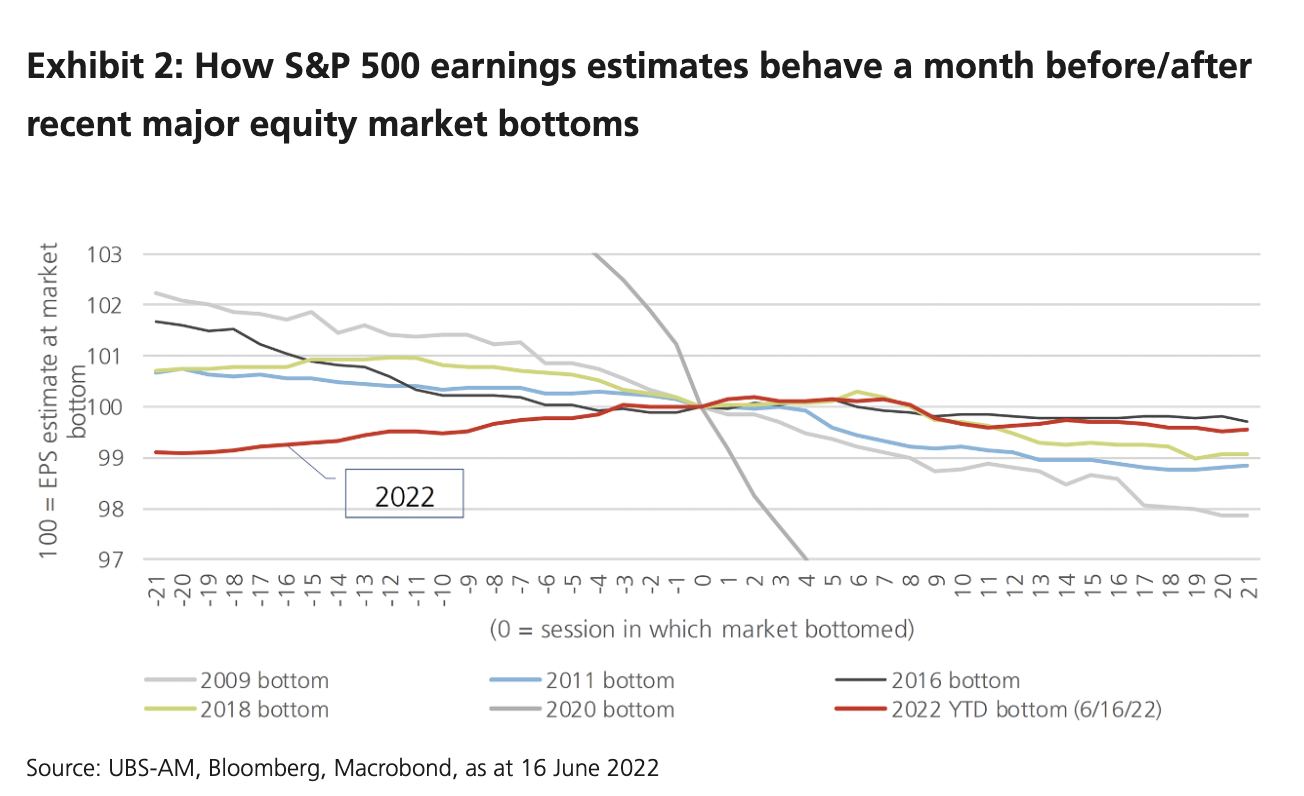
Earnings estimates and S&P 500
Source: UBS AM

The US economy has been cooling for a long time, and profit growth attributable to the AI boom (while still rapid) is decelerating. The size and scope of tariffs that may be pursued by the Trump administration is still a known unknown. But for this stock market episode to morph into a true growth scare and for tariffs to metastasize from a hit to confidence to a hit to earnings, we’re probably going to need to see that show up in profit forecasts before too long. We know retail guidance was brutal, for instance, and some in the space didn’t even include tariffs in their forward outlook.

The coming month will bring us squarely into the heart of the Q1 earnings season, prime time to be reevaluating the near-term outlook for Corporate America.

More Markets

See all Markets
markets

SpaceX gets a wave of bullish ratings from Wall Street analysts

SpaceX received more than a dozen positive analyst calls on Tuesday — including from major Wall Street banks — as they initiate coverage on Elon Musk’s space and AI company.

SpaceX went public on June 12 at a $2.2 trillion valuation, the largest debut in history. While the company hasn’t yet posted a profit, it seems to have convinced Wall Street that it will get there and grow its valuation on the way.

Of the at least 17 analysts that gave a rating on Tuesday, all but one gave it a “buy” or “outperform” rating. MoffettNathanson was "neutral."

The ratings come as SpaceX joined the Nasdaq 100 index, a benchmark tech-heavy basket of companies that underpins millions of portfolios. The inclusion adds built-in demand for the stock from index funds and ETFs.

Still, SpaceX fell more than 5% on Tuesday amid a broader sell-off, and is currently effectively flat from its opening price of $150 a share.

markets

Nike sinks to lowest level since 2014 after warning of “challenged” sales environment in Q4 report

Did Nike do it?

Investors had a mixed reaction after the global sports apparel company reported its fourth quarter earnings on Tuesday after the bell. Shares initially rose 5% as Nike beat out Wall Street expectations amid a hefty tariff refund bonus. However, the stock then sank to its lowest level since August 2014 in postmarket trading.

Here are the Q4 numbers:

  • Revenue of $11.0 billion (estimate: $10.8 billion).

  • Adjusted earnings per share of $0.20 (estimate: $0.12).

Ahead of this report, Nike warned that results would be flattered by a one-time tariff refund (now estimated at roughly $0.52 per share for the bottom line). That gave the company an extra cushion in snapping its streak of seven quarters of year-over-year profit declines.

Over the past year, the company had been punished by tariffs on imported goods, stagnant consumer spending, and increasing competition from other footwear brands like New Balance, Adidas, and Hoka.

Outgoing CFO Matthew Friend deemed it an “increasingly challenging operating environment, where sell-through remains challenged.”

Latest Stories

Sherwood Media, LLC and Chartr Limited produce fresh and unique perspectives on topical financial news and are fully owned subsidiaries of Robinhood Markets, Inc., and any views expressed here do not necessarily reflect the views of any other Robinhood affiliate, including Robinhood Markets, Inc., Robinhood Financial LLC, Robinhood Securities, LLC, Robinhood Crypto, LLC, Robinhood Money, LLC, Robinhood U.K. Ltd, Robinhood Derivatives, LLC, Robinhood Gold, LLC, Robinhood Asset Management, LLC, Robinhood Credit, Inc., Robinhood Ventures DE, LLC and, where applicable, its managed investment vehicles.

