
Markets
Allen & Company Annual Conference Draws Media And Tech Leaders To Sun Valley
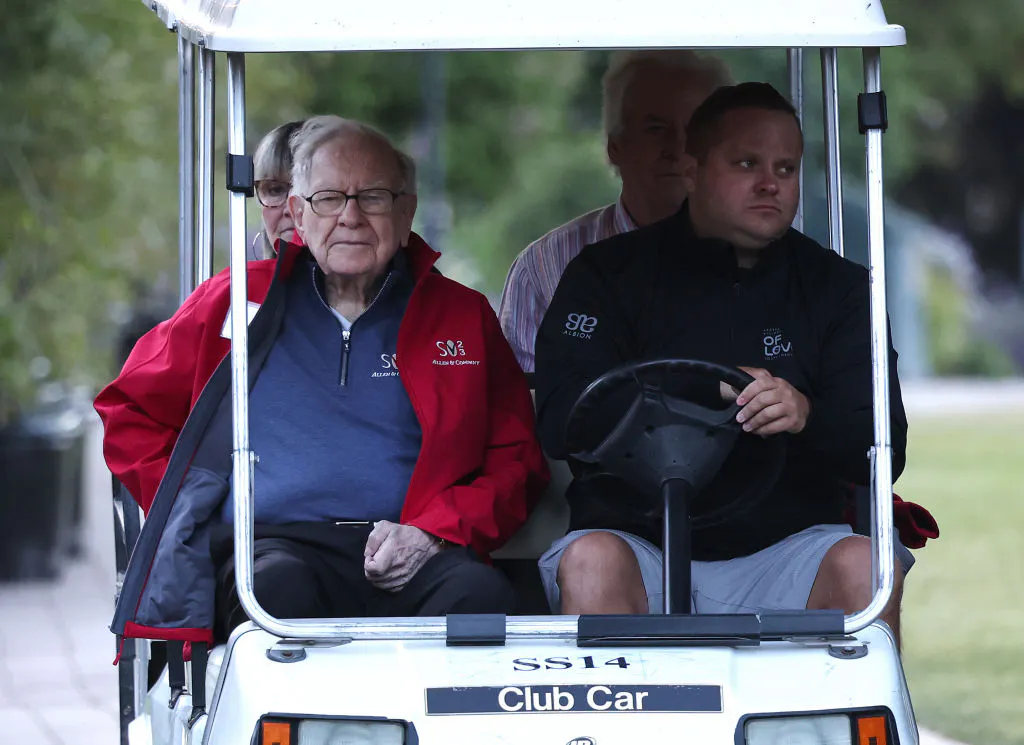
Buffett was giving retirement vibes before he officially retired (Getty Images)

Berkshire Hathaway is the ultimate anti-AI stock

Berkshire is a rare breed in today’s market: a megacap US stock that doesn’t really have a big footprint in AI.

Luke Kawa

Shares of Berkshire Hathaway are up more than 1% in early trading on Monday after the company reported that its Q1 operating profit rose 18% year on year.

The up day is helping the conglomerate, which just hosted its annual meeting/weekend camp for capitalists, reverse a touch of its worst period of underperformance compared to the S&P 500 since at least 1985, per Bespoke Investment Group.

No wonder management repurchased shares in Q1 for the first time since Q2 2024!

Berkshire Hathaway intermeeting performance
(Bespoke Investment Group)

One could point to the imminent exodus of the Oracle of Omaha as a catalyst for its reversal of fortunes. And there would certainly be an element of truth to that.

Warren Buffett announced he’d be stepping down as CEO last May, with Greg Abel taking his place.

“On the Friday before Berkshire’s 60th annual meeting, the stock closed at an all-time high, and three months later, it was down around 15%,” per Bespoke. “In the nine months since then, they haven’t recovered any ground.”

On the one hand, it seems like Berkshire should be one of those “heavy assets, low obsolescence” stocks that should avoid being battered by the AI boom, thanks to having such a heavy industrial footprint (including trains, energy, and aerospace manufacturing) in addition to well-known consumer brands. No matter how powerful AI gets, I’ll still be eating Dairy Queen in my Fruit of the Loom undies. Perhaps even more so, if/when the computers take my job.

On the other hand, Berkshire’s bread and butter is insurance: premiums paid provide powder for investment in other businesses and publicly traded companies. Insurance is an industry often mentioned as being at risk of AI disruption, and Q1 2026 was noteworthy for how much investors were willing to punish perceived AI losers, not just reward its winners. (On that note, Progressive Corp. surpassing Berkshire’s Geico in auto insurance market share has been attributed to, among other things, its superior investment in technology.)

But a close inspection of the fundamentals probably isn’t as useful as a characterization of what this company is, at a more basic level, and how it trades.

Berkshire is a) a very large stock, and b) not an AI stock. For many portfolio managers, being overweight a large-cap AI stock in the Magnificent 7 will effectively mean you have to be underweight one of its peers or another large-cap stock that doesn’t have high exposure to the theme. Oh, and Berkshire’s largest public holding is Apple, a company that is sitting out the AI capex boom!

Among S&P 100 companies, the weekly change in Berkshire’s share price has been the most negatively correlated with Oracle and Advanced Micro Devices over the past quarter. To invert the “cleanest dirty shirt” phrase, that publicly traded hyperscaler and AI chip designer are (with respect) considered to be the worst-tailored tuxedos at their respective balls.

To that end, Berkshire has also been negatively correlated with Goldman Sachs’ long-short high-beta momentum pair. That is, if volatile stocks that usually go up are beating risky stocks that have been trending down, it probably means that Berkshire’s a loser that day as well.

Or, as is the case this morning, the formerly Buffett-led gets to go up while the high-beta momentum trade takes a dip.


More Markets

See all Markets
markets

SpaceX gets a wave of bullish ratings from Wall Street analysts

SpaceX received more than a dozen positive analyst calls on Tuesday — including from major Wall Street banks — as they initiate coverage on Elon Musk’s space and AI company.

SpaceX went public on June 12 at a $2.2 trillion valuation, the largest debut in history. While the company hasn’t yet posted a profit, it seems to have convinced Wall Street that it will get there and grow its valuation on the way.

Of the at least 17 analysts that gave a rating on Tuesday, all but one gave it a “buy” or “outperform” rating. MoffettNathanson was "neutral."

The ratings come as SpaceX joined the Nasdaq 100 index, a benchmark tech-heavy basket of companies that underpins millions of portfolios. The inclusion adds built-in demand for the stock from index funds and ETFs.

Still, SpaceX fell more than 5% on Tuesday amid a broader sell-off, and is currently effectively flat from its opening price of $150 a share.

markets

Nike sinks to lowest level since 2014 after warning of “challenged” sales environment in Q4 report

Did Nike do it?

Investors had a mixed reaction after the global sports apparel company reported its fourth quarter earnings on Tuesday after the bell. Shares initially rose 5% as Nike beat out Wall Street expectations amid a hefty tariff refund bonus. However, the stock then sank to its lowest level since August 2014 in postmarket trading.

Here are the Q4 numbers:

  • Revenue of $11.0 billion (estimate: $10.8 billion).

  • Adjusted earnings per share of $0.20 (estimate: $0.12).

Ahead of this report, Nike warned that results would be flattered by a one-time tariff refund (now estimated at roughly $0.52 per share for the bottom line). That gave the company an extra cushion in snapping its streak of seven quarters of year-over-year profit declines.

Over the past year, the company had been punished by tariffs on imported goods, stagnant consumer spending, and increasing competition from other footwear brands like New Balance, Adidas, and Hoka.

Outgoing CFO Matthew Friend deemed it an “increasingly challenging operating environment, where sell-through remains challenged.”

markets

Rocket Lab deal lifts space stocks

Shares of Rocket Lab are surging after announcing an $8 billion acquisition of satellite communications operator Iridium Communications, helping lift a broader basket of space-related stocks as investors piled back into the sector.

Planet Labs, AST SpaceMobile and Redwire all traded higher alongside Rocket Lab, extending gains in an industry that has drawn enhanced investor attention in recent months in light of the strategic importance that governments place on space and satellite communications infrastructure.

In a presentation, Rocket Lab’s management called the purchase “a shortcut” for its satellite communications business.

Under the terms of the agreement, Iridium shareholders will receive $27 in cash and Rocket Lab stock, valuing Iridium at $54 per share. Backed by a $3.6 billion bridge loan committed by Deutsche Bank and Wells Fargo, Rocket Lab absorbs Iridium’s globally licensed spectrum and an active base of 2.5 million subscribers.

Rocket Lab has also remained one of the most active launch providers in the sector. The company completed its 12th launch of the year last week, maintaining one of the highest launch cadences among commercial space companies.

Today's rally helps offset a brutal stretch for the group. Rocket Lab shares had fallen over 35% over the prior month, while Planet Labs stock was down more than 40% and AST SpaceMobile stock was down around 30% over the same window.

Latest Stories

Sherwood Media, LLC and Chartr Limited produce fresh and unique perspectives on topical financial news and are fully owned subsidiaries of Robinhood Markets, Inc., and any views expressed here do not necessarily reflect the views of any other Robinhood affiliate, including Robinhood Markets, Inc., Robinhood Financial LLC, Robinhood Securities, LLC, Robinhood Crypto, LLC, Robinhood Money, LLC, Robinhood U.K. Ltd, Robinhood Derivatives, LLC, Robinhood Gold, LLC, Robinhood Asset Management, LLC, Robinhood Credit, Inc., Robinhood Ventures DE, LLC and, where applicable, its managed investment vehicles.