
Markets
Casual Dining Chain Chili's
(Justin Sullivan/Getty Images)

Brinker shares slide after earnings, but Chili’s is still bringing the heat as Gen Z’s dining-out darling

All hail the Triple Dipper.

Brinker International shares slid about 8% in premarket trading Monday, even as the parent of Chili’s and Maggiano’s Little Italy served up top- and bottom-line results that exceeded estimates and boosted its sales guidance.

The slump in the stock may signal overinflated expectations for a company that had been performing very well year to date, up 21% heading into today’s session versus a 6% decline in the S&P 500.

The fast-casual giant posted Q3 earnings of $2.66 per share, beating analyst estimates of $2.56, while revenue rose 27% year over year to $1.425 billion, also ahead of Wall Street’s target. Chili’s, Brinker’s undisputed MVP, drove most of the gains: comparable sales at the chain soared 28%, and franchisees pulled in $237.4 million, up from $216.2 million a year ago.

Brinker also sweetened its full-year outlook, raising revenue guidance to between $5.33 billion and $5.35 billion — a jump from the $5.15 billion to $5.25 billion range it offered back in January. 

“Chili’s sales growth this quarter was driven primarily by continued increases in traffic, supported by advertising that highlights our industry-leading value and encourages guest trial,” the company said in a statement.

The continued strength in Chili’s is thanks in no small part to a social media sensation: the Triple Dipper.
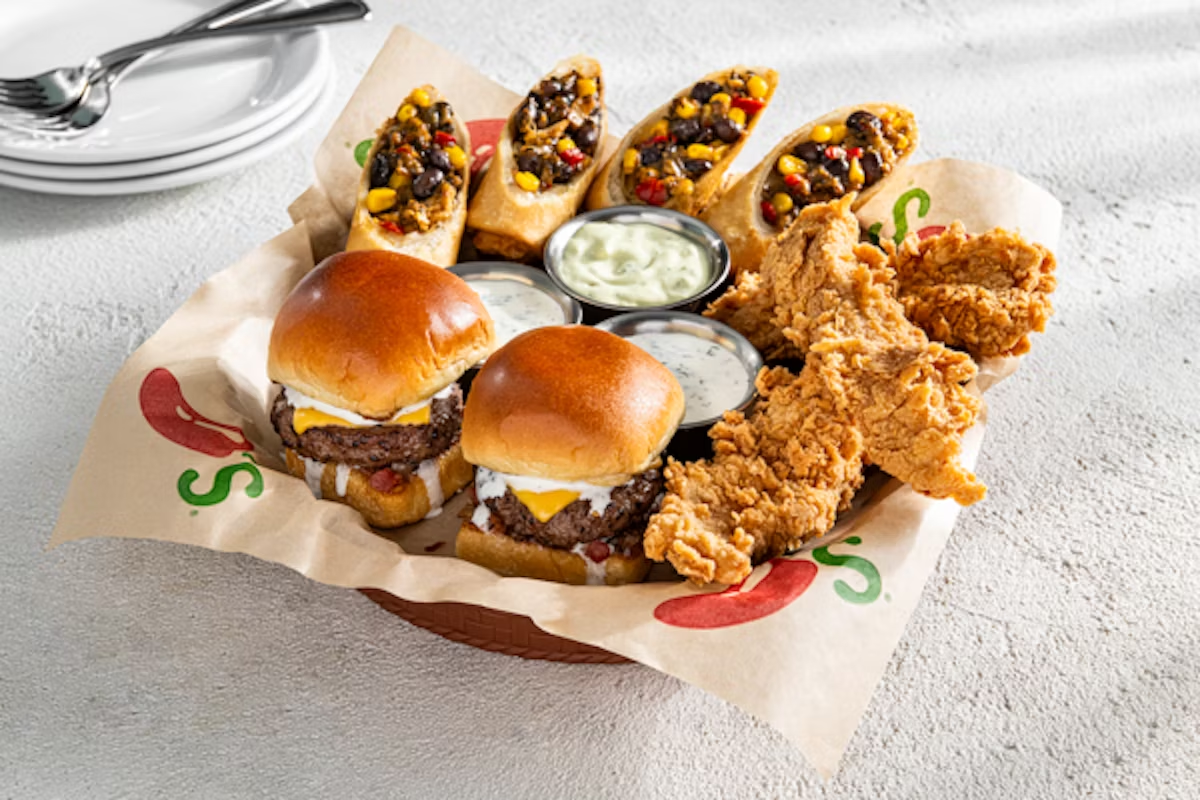
Triple Dipper
Photo: Brinker International

TikTok made me do it

Chili’s has long been a staple of the American dining scene, first opening in Dallas in 1975 with a Southwestern-style menu aimed at bridging casual food and a bar-forward atmosphere. But most recently, the chain’s Triple Dipper — a choose-three combo of appetizers like Southwestern egg rolls, chicken crispers, sliders, and mozzarella sticks — has put the 50-year-old brand back on the map, becoming a near-instant viral hit.

According to trend analytics firm Spate, online interest in the Triple Dipper has surged by 118.5% over the past year, with TikTok engagement spiking 375.5%. Google searches, meanwhile, climbed nearly 30%. Much of that momentum can be traced back to content creators like Celine Chung, a California-based food and lifestyle influencer who saw her first Triple Dipper video explode with over 6.6 million views (and counting).

“I did the whole flash shot of the Triple Dipper spread — it just looked so visually appealing,” Chung told Sherwood News. “It started picking up fast. I checked back like 30 minutes later and it already had hundreds of thousands of views.”

Chung, who began creating food content in 2018 and pivoted to TikTok during the pandemic, says Chili’s content has proven unusually sticky. “In my first Chili’s one, I did like the whole flash with the spread of the Triple Dipper, and it just was so visually appealing. I think maybe I added a cheese pull in the beginning, too. I found that it really gravitates with an audience.” 

A Kitchen Revamped

Brinker is betting big on that kind of heat. In the previous quarter, Chili’s began streamlining kitchen operations by removing its wing station, making room for high-performing items like the Triple Dipper and chicken crispers. It’s been paying off: the Triple Dipper accounted for 14% of total restaurant sales in Q2. Executives say the menu revamp is not only attracting a younger demographic, but also increasing average check sizes and driving repeat visits.

Even as restaurant spending grew 2% in 2024 — marking a fourth straight year of gains — Brinker has left the broader category in the dust. The company has tacked on more than $4 billion in market cap over the past year. Even with the Tuesday sell-off, Brinker’s stock has blown past rivals like Dine Brands (Applebee’s, IHOP), Cheesecake Factory, and Bloomin' Brands (Outback Steakhouse, Carrabba’s), and is up more than 203% over the past year.

More Markets

See all Markets
markets

Nike craters after issuing weak revenue guidance

Sportswear kingpin Nike is tumbling on Wednesday morning after saying it doesn’t expect to grow sales this year.

On its fiscal Q3 earnings call, management said that revenue is expected to drop 2% to 4% in the current quarter, and that overall they “expect revenues to be down low-single-digits versus the prior year, with gains in North America offset by declines in Greater China.” That's a disappointment to analysts, who were anticipating 2% growth in Q4, and even more in the latter stages of the year, per Bloomberg.

Nike’s Q3 sales in China — where the company earns about 15% of its revenue — fell 7% to $1.62 billion. The company had issued weak guidance for this quarter considering continued softness in the region. That’s its seventh straight quarter of sales declines in the market. While this quarter’s was decline was less than feared, management warned that more pain is in the offing.

Nike’s turnaround effort “is complex work, and parts of it are taking longer than I'd like,” said CEO Elliott Hill.

Nike’s fiscal Q3 results (the three months ended February) were solid at the headline level:

  • Earnings of $0.35 per share, comfortably above the Wall Street consensus of $0.29 per share compiled by FactSet.

  • $11.28 billion in total revenue, roughly in line with the $11.26 billion estimate.

But the gloomy sales outlook has Wall Street analysts souring on the stock:

  • JPMorgan downgraded the shares to “neutral” from “overweight” and cut its price target to $52 from $86.

  • Citi reduced its target price to $53 from $65,

  • Stifel lowered its price target to $56 from $65,

  • Truist reduced its price target to $57 from $69, and

  • Barclays cut its target price to $67 from $73.

Nike shares are trading near decade lows this month, as tariffs continue to weigh on profits and shipping costs rise amid the war with Iran. As of Tuesday’s close, the stock was down 17% year to date.

Oil-sensitive travel stocks pop following Iran state media reporting on potential war resolution

Travel stocks are surging on Tuesday as oil prices fall following reports from Iranian state media that President Masoud Pezeshkian said the country has the necessary will to end this war, but would only do so with guarantees that prevent the recurrence of aggression.

The war has sent oil prices and refining margins surging this month, causing airlines and cruise lines to cut profit forecasts despite reported high demand.

Following Tuesday’s update, shares of the big four US airlines (Delta Air Lines, United Airlines, American Airlines, and Southwest Airlines) all climbed, along with smaller rivals including JetBlue. US airlines have stopped fuel hedging in recent years, increasing their exposure to upward swings in oil prices.

Cruise stocks also rallied, with Carnival and Norwegian up more than 6% and Royal Caribbean up about 5%.

markets

The FDA is expected to lift restrictions on certain peptides, the NYT reports

The Food and Drug Administration is expected to lift restrictions on certain peptides, allowing the experimental, often injectable substances to be sold by compounding pharmacies, The New York Times reported Tuesday.

The potential move was previously reported by The Wall Street Journal, and teased by Health Secretary Robert F. Kennedy Jr. on the “Joe Rogan Experience” podcast in late February.

Peptides have boomed in popularity recently, with search interest for “peptides” surpassing “ozempic” this month. Many of them are currently understudied and not approved for human use, a rule consumers are able to bypass by purchasing them from suppliers that sell them for, ostensibly, research purposes only.

As reports of the FDA changing its stance of peptides mount, consumer health companies like Hims & Hers and Superpower have been getting ready to roll out their peptide offerings as soon as they get the FDA's blessing.

Peptides have boomed in popularity recently, with search interest for “peptides” surpassing “ozempic” this month. Many of them are currently understudied and not approved for human use, a rule consumers are able to bypass by purchasing them from suppliers that sell them for, ostensibly, research purposes only.

As reports of the FDA changing its stance of peptides mount, consumer health companies like Hims & Hers and Superpower have been getting ready to roll out their peptide offerings as soon as they get the FDA's blessing.

Latest Stories

Sherwood Media, LLC produces fresh and unique perspectives on topical financial news and is a fully owned subsidiary of Robinhood Markets, Inc., and any views expressed here do not necessarily reflect the views of any other Robinhood affiliate, including Robinhood Markets, Inc., Robinhood Financial LLC, Robinhood Securities, LLC, Robinhood Crypto, LLC, Robinhood Derivatives, LLC, or Robinhood Money, LLC. Futures and event contracts are offered through Robinhood Derivatives, LLC.

