

Markets
markets

Carvana’s stock is sometimes up, sometimes down, always volatile

Shares in online car seller Carvana surged some 34% yesterday, continuing their recent resurgence. That rebound has made the father-son duo behind the company some $11B since late 2022 — a period when the stock was dropping as much as 40% in a single day, and was teetering on the verge of insolvency as creditors explored options to restructure its debt.

Since then the company, famous for its “car vending machines”, has seen its fortunes reverse, as the used-car market has stabilized and sales have returned to growth (up 17% in Q1 2024). Most importantly, however, Carvana seems to have gotten a handle on its massive $5B+ debt load — which was a major factor in why the equity in the company was so volatile — after swinging into profitable territory in Q1.

Yesterday’s move leaves the stock up more than 16x in the last 12 months.
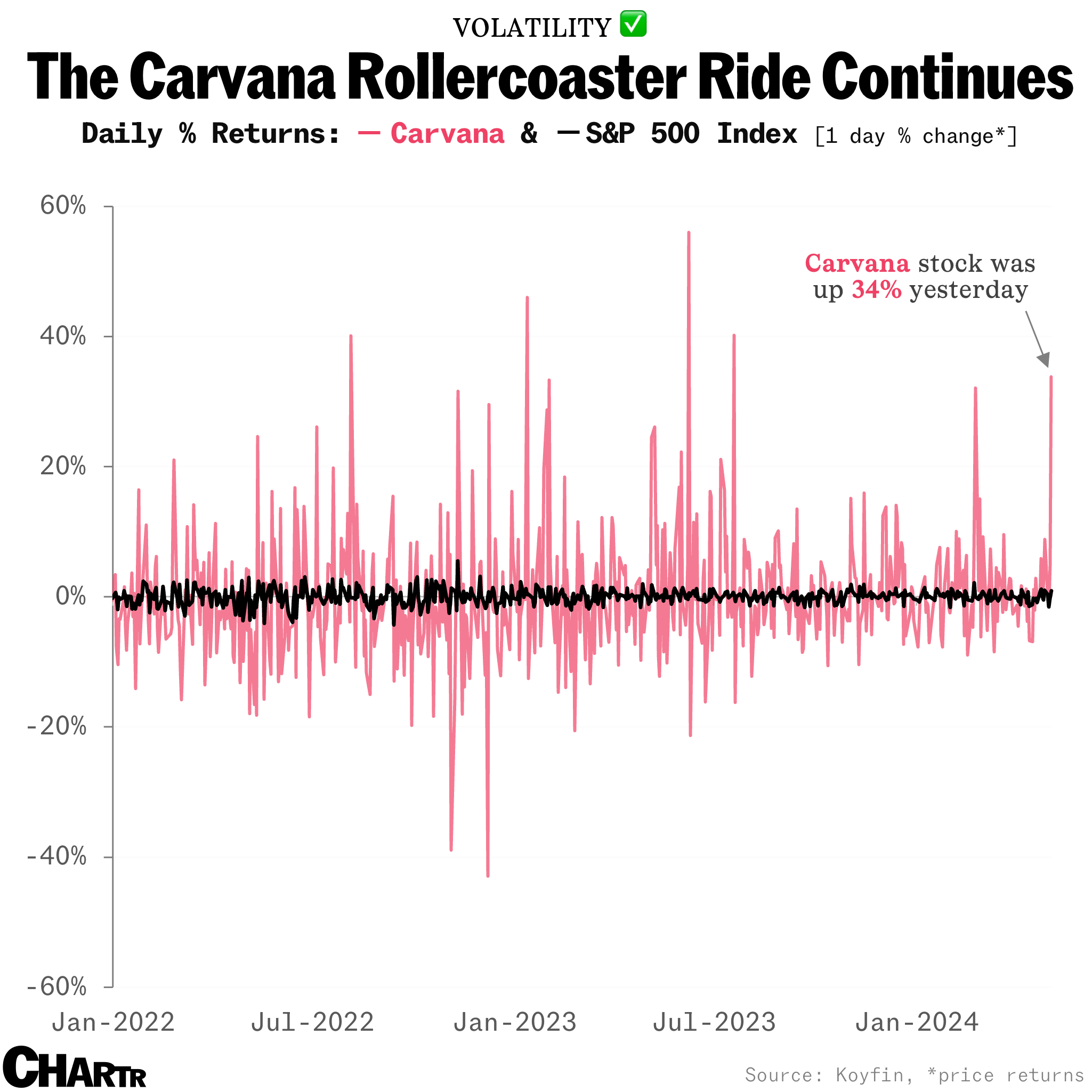
Carvana stock volatility

Since then the company, famous for its “car vending machines”, has seen its fortunes reverse, as the used-car market has stabilized and sales have returned to growth (up 17% in Q1 2024). Most importantly, however, Carvana seems to have gotten a handle on its massive $5B+ debt load — which was a major factor in why the equity in the company was so volatile — after swinging into profitable territory in Q1.

Yesterday’s move leaves the stock up more than 16x in the last 12 months.
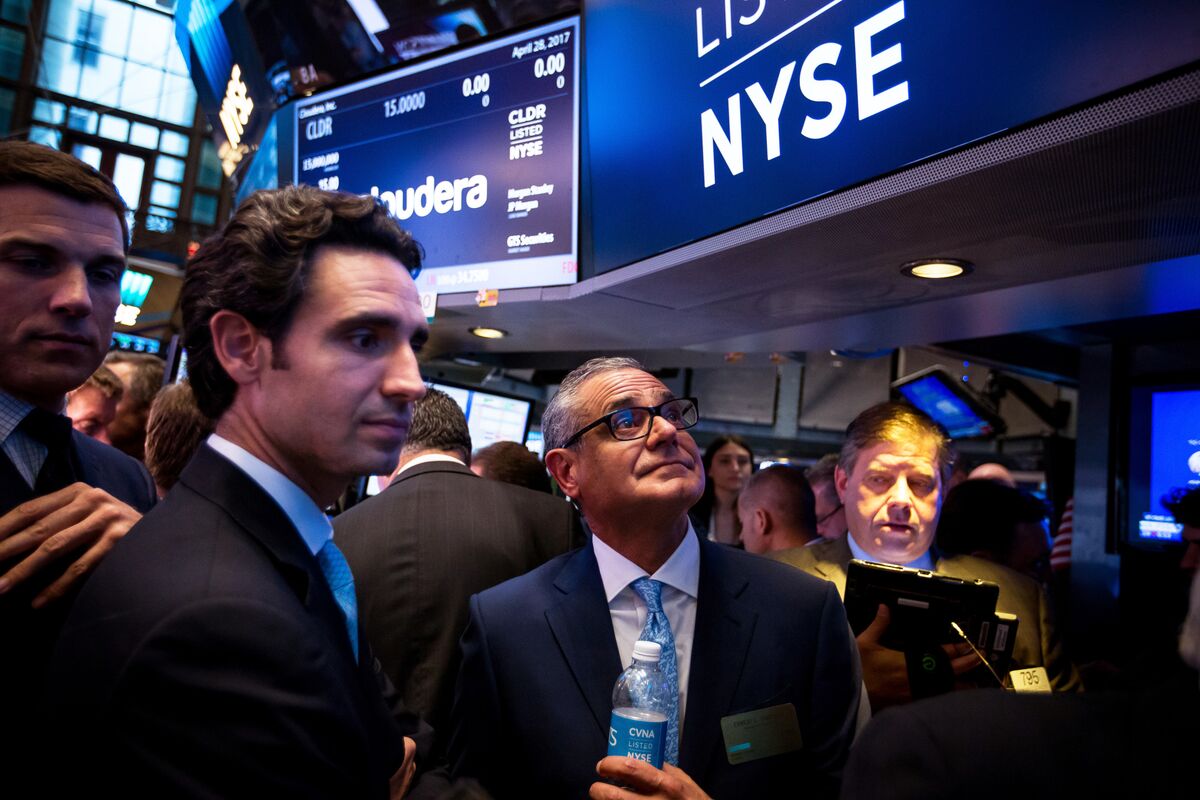
Carvana stock volatility

More Markets

See all Markets
markets

AppLovin craters after report from CapitalWatch alleges it’s a money-laundering operation for “transnational criminal kingpins”

AppLovin is tumbling in premarket trading on Tuesday after financial research agency CapitalWatch published a report on Monday calling the company “the ultimate monument to 21st-century new-type transnational financial crime.”

“AppLovin serves as the ultimate exit for asset laundering/diversion by transnational criminal kingpins,” the authors wrote, claiming that the growth of its advertising business comes in part from illicit cryptocurrency funds routed through its platform.

AppLovin did not immediately respond to a request for comment from Sherwood News.

This is far from the first report to question AppLovin’s business practices.

Fuzzy Panda Research and Culper Research announced short positions in the adtech firm last February in research reports alleging that AppLovin’s operating performance was a function of “systematic exploitation of app permissions” as well as taking data and gaming the ad platforms of other tech giants, particularly Meta. In October, reports surfaced that the SEC was investigating AppLovin’s data collection practices, as were a number of state regulators.

The allegations raised by CapitalWatch are a whole different kettle of illegal fish.

Anything is possible. But if I were hypothetically trying to launder a bunch of money, I likely would not try to do so through a publicly-traded entity domiciled in the United States that’s subject to much more regulatory oversight and scrutiny than the average global firm.

markets

Ives: Greenland tariff talk pushing markets into the red is “an opportunity to own the tech winners for 2026 and beyond”

When markets are reacting to negative news, sometimes traders just sell the things that have gone up the most — whether or not this new catalyst disproportionately hurts those companies or not.

That’s something we saw in the run-up to last year’s tariff announcements, and Wedbush’s global head of tech research Dan Ives reckons we’re in for more of the same as US President Donald Trump threatens escalating tariffs on a host of European countries unless they agree to let America purchase Greenland.

“Being here at Davos this week on the ground... the tariff scuffle is clearly an overhang on the conference as Trump gets here tomorrow to speak to tech leaders and various world leaders,” Ives wrote. “Our view is just like over the last year the bark will be worse than the bite on this issue and tariff threats as negotiations take place and tensions ultimately calm down between Trump and EU leaders.”

Every member of the Dan IVES Wedbush AI Revolution ETF, a fund that holds the analyst’s favorite AI stocks, is trading to the downside as of 7:35 a.m. ET. Ives highlighted Nvidia, Microsoft, Palantir, CrowdStrike, Nebius, Palo Alto Networks, Google, and Tesla as names to buy on weakness.

“Tech stocks will be hit as the ‘risk off dynamic’ hits AI names front and center but ultimately we view this as an opportunity to own the tech winners for 2026 and beyond,” he concluded.

Buying the dip in general (and buying the dip in megacap AI stocks in particular) were massive contributors to retail traders’ success in 2025.

markets

Micron announces deal to buy fabrication plant for $1.8 billion as AI demand drives memory chip supply crunch

Micron is preparing to benefit from the supply crunch in memory chips for years to come.

On Saturday, the company announced that it had signed a letter of intent to buy a fabrication plan from Powerchip Semiconductor Manufacturing Corporation in Taiwan for $1.8 billion.

This acquisition “will enable Micron to increase production and better serve our customers in a market where demand continues to outpace supply,” said executive vice president of global operations Manish Bhatia. Management expects this purchase to begin to add to DRAM output in the second half of 2027.

Micron’s spectacular quarterly earnings and guidance released in mid-December catalyzed a fresh wave of buying for memory chip and storage stocks, reinforcing the fact that near-term demand is running far hotter than analysts anticipated. The memory chip specialist and its rivals have been scrambling to boost production as the AI boom leaves supplies short and propels prices higher.

“Without considering conventional DRAM supply-demand, we believe the DRAM industry is in net deficit of 180k wafer starts per month in 2027E to resolve the standalone high-bandwidth memory part of the industry S-D shortage,” write JPMorgan analysts led by Jay Kwon. “MU’s P5 fab (50k wspm or annualized 35k equivalent volume), if 100% is dedicated to HBM, would only resolve 20% of the shortage, by our calculation.”

TOPSHOT-GREENLAND-DENMARK-US-DEMONSTRATION

Stocks slide further as President Trump doubles down on Greenland ambitions despite European pushback

With US exchanges shut yesterday, traders are finally getting the chance to react to the president’s tariff threats and escalation over Greenland. The only winners so far are precious metals like gold and silver.

markets

Stock futures slide on Trump's 25% European tariff threat over Greenland, as gold and silver push higher

With US exchanges closed for MLK Day, European and Asian stock markets have been the main release valve for reaction to President Trump’s fresh tariff threats to Europe, which followed sharp pushback from European allies around America’s ongoing Greenland pursuit.

In a Truth Social post on Saturday, Trump warned that the US would impose tariffs on several European countries — Denmark, Norway, Sweden, France, Germany, the UK, the Netherlands, and Finland — unless a deal is reached for the “Complete and Total purchase of Greenland.” A 10% tariffs on “any and all goods” shipped to the US from the eight countries would take effect February 1, rising to 25% by the start of June if an agreement isn’t reached.

European stock markets opened lower, with the broad STOXX Europe 600 down 1.2%. France's CAC 40 index, Germany's DAX, and the UK's FTSE 100 fell 1.5%, 1.3%, and 0.5%, respectively, as of 5:12 a.m. ET. Asian markets also closed lower on global trade fears, with Tokyo's Nikkei 225 down 0.6%.

Although liquidity is thin, US risk assets weren’t entirely shielded, with S&P 500 Futures (Mar ‘26 E-Mini contract) down a little over 1% as of 5:45 a.m. ET. Bitcoin also dropped sharply, down ~2.5% from its undisturbed price.

Meanwhile, precious metals (again) hit all-time highs, with spot gold up more than 2% to a record $4,690 per ounce and silver hitting a record $94.08 per ounce, extending its rally this year.

TACO vs. TART?

A popular market narrative over the last year has been that President Trump often employs tariffs as threat, using them as a bargaining tool for other goals. But the “Trump Always Chickens Out” argument isn’t really borne out by the data. As Luke Kawa pointed out last year, the reality is that the US has raised its levies rate on both occasions that Trump has been in the White House, suggesting that the more accurate acronym is really: “Trump Always Raises Tariffs.” For now, this latest reactive threat to America’s allies looks more like a bargaining tool than a high-priority bit of trade policy.

Latest Stories

Sherwood Media, LLC produces fresh and unique perspectives on topical financial news and is a fully owned subsidiary of Robinhood Markets, Inc., and any views expressed here do not necessarily reflect the views of any other Robinhood affiliate, including Robinhood Markets, Inc., Robinhood Financial LLC, Robinhood Securities, LLC, Robinhood Crypto, LLC, or Robinhood Money, LLC.