
Markets
CHINA-GANSU-LANZHOU-XI JINPING-INSPECTION (CN)
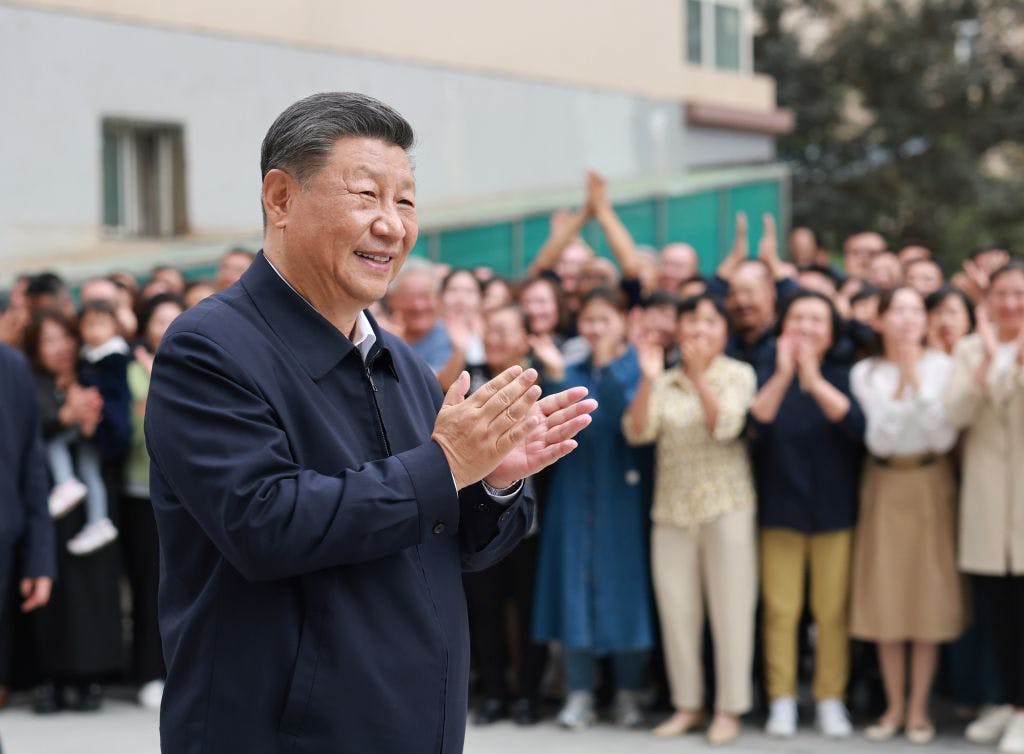
Chinese President Xi Jinping claps (Wang Ye/Xinhua via Getty Images)
Mainland, painland

Chinese stocks are going wild on new stimulus measures. How long will it last?

Some Chinese equity indexes could really use the help. Others were already primed for a move higher.

Luke Kawa

Chinese policymakers have finally reached their breaking point.

Authorities in Beijing unveiled a slew of monetary and quasi-fiscal stimulus measures overnight intended to deliver a shot in the arm — if not engineer a genuine turnaround — for the nation’s sagging economy and Mainland stocks.

Here’s a non-exhaustive smattering of the policies:

  • Cutting mortgage rates on outstanding borrowing (by roughly 50 basis points)

  • Lowering the minimum downpayment on second homes from 25% to 15%

  • Reducing the reserve requirement ratio 

  • Trimming its 7-day reverse repurchase rate by 20 basis points to 1.5%

  • 800 billion yuan in “liquidity support” for the stock market

Is this suite of policies sufficient to improve an economy, and in particular, a housing market, in which the supply of credit to would-be homebuyers is a much smaller problem than the fact that around 50 million homes that have already been sold have not been completed (due to financial strains faced by many developers)?

In my mind, this is a rhetorical question. More charitably, let’s just say it’s debatable. No doubt, these will help on the margin, but marginal fixes don’t solve major problems.

For Chinese stocks, on the other hand, whether the fundamentals are that dire or actually fairly rosy depends on your point of view – or rather, which index of Chinese stocks you’re looking at.

Indexes that offer broad exposure to companies that trade on Mainland China exchanges in Shanghai and Shenzhen (known as “A Shares”) are arguably the most linked to China’s economy.

China’s aforementioned “liquidity support” for the stock market is likely to be geared towards A Shares. Frankly, that’s the group that could use the most support, based on persistently negative earnings revisions and lackluster performance. The overnight announcements have pushed an ETF that tracks the CSI 300 — the most commonly quoted gauge of A shares — out of negative territory for 2024.  

Compared to the MSCI China Index or the FTSE China 50, the CSI 300 has more exposure to industrials, semiconductors, financial services (brokerages and investment banks), mining, and consumer staples companies.

And the CSI 300 doesn’t include some of China’s most well-known companies like Alibaba, Tencent, Meituan, and JD Inc. Those names are all very well-represented in the MSCI China and FTSE China 50, and are a big reason why 12-month forward earnings per share estimates have picked up more for those indexes than even the S&P 500 over the past three months.

Traders, understandably, are taking the message from Beijing at face value, sending all Chinese indexes sharply higher this morning.

But the fact that this is far from the first time in the past three years that Chinese policymakers have attempted to put a floor under the economy and stock markets — and Mainland stocks were trading at their lowest levels since 2019 — should give some cause for continued concern. 

More Markets

See all Markets
markets

Spectrum owner Charter Communications is on pace for its worst day ever as broadband numbers and Q1 results disappoint

Cable and broadband company Charter Communications is on pace for its worst-ever trading day on Friday, as investors dump the stock following its Q1 results and forward guidance.

Charter, which owns Spectrum, reported adjusted earnings of $9.17 per share, below Wall Street estimates of $9.96 per share from analysts polled by FactSet. On the company’s earnings call, CFO Jessica Fischer appeared to lower its guidance for full-year revenue per user.

“It’ll be close either way in terms of whether we end up with net growth,” Fischer said.

The company lost 120,000 internet subscribers in the quarter, deeper than the expected 94,800 and double its loss from the same period last year. That news comes one day after Comcast’s earnings provided a bit of optimism for broadband as a category: the company reported Q1 losses of 65,000, significantly improving from 183,000 losses in the same quarter last year. Comcast is down more than 10%, on pace for its worst day since January 2025.

markets
Luke Kawa

Nvidia poised to snap longest run without a record close since the AI boom began

The stock price of the company responsible for the brains of the AI boom is finally showing some brawn again.

Nvidia, the world’s most valuable company, is poised to close at a record high for the first time since October 29, 2025, on Friday (if it ends above $207.04).

The AI chip trade is on fire, with the Philadelphia Semiconductor Index slated to deliver its 18th consecutive gain as Intel’s robust results and outlook juice the entire ecosystem. Hyperscalers report earnings next week, and their capex guidance can be thought of as the earnings guidance for Nvidia and other AI suppliers for the quarters to come.

This would end Nvidia’s longest stretch without a record close since the unofficial start of the AI boom (when the chip designer delivered blowout quarterly results in May 2023).

(Sorry if I jinx this!)

markets

Lilly slips after prescriptions for its weight-loss pill come in below expectations in second week

Eli Lilly fell on Friday after prescription data for its new weight-loss pill, Foundayo, showed that it’s having a significantly slower rollout than its top competitor.

The pill was prescribed about 3,700 times in its second week, according to IQVIA data cited by Deutsche Bank analysts, compared to the roughly 8,000 they were expecting. Novo Nordisk’s Wegovy pill, which came out in January, hit over 18,000 prescriptions in its second week.

The FDA approved Foundayo on April 1 and shipments began on April 9. Deutsche analysts noted that Lilly’s GLP-1 injections, which currently outsell Novo’s, also had a slower start.

Lilly fell more than 4% after the numbers were released. Novo Nordisk rose more than 5%.

Latest Stories

Sherwood Media, LLC produces fresh and unique perspectives on topical financial news and is a fully owned subsidiary of Robinhood Markets, Inc., and any views expressed here do not necessarily reflect the views of any other Robinhood affiliate, including Robinhood Markets, Inc., Robinhood Financial LLC, Robinhood Securities, LLC, Robinhood Crypto, LLC, Robinhood Derivatives, LLC, or Robinhood Money, LLC. Futures and event contracts are offered through Robinhood Derivatives, LLC.

